What happened
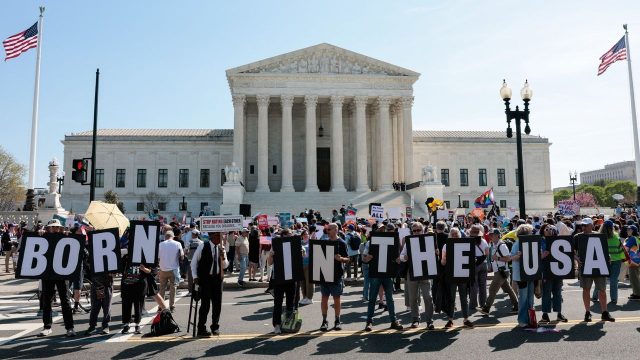
In a remarkable break with centuries of tradition, President Trump personally attended Supreme Court arguments this week, listening in as his administration asked the justices to overturn birthright citizenship. During the questioning in Trump v. Barbara, Chief Justice John Roberts and most other justices cast doubt on the constitutionality of an executive order Trump issued in his first week in office, which requires proof of parental citizenship or permanent residency for a newborn to become a U.S. citizen. If upheld, the order could deny citizenship to some 250,000 babies a year.
Solicitor General John Sauer said the new trend of “birth tourism” required new restrictions, but the justices pushed back. “It’s a new world. It’s the same Constitution,” Roberts said, adding, “The examples you give to support strike me as very quirky.” Most justices were skeptical of Sauer’s arguments. But Justice Samuel Alito said an 1898 precedent—the Wong Kim Ark case, which concerned the U.S.-born son of Chinese immigrants—was not the last word on interpretations of the 14th Amendment, which grants birthright citizenship. We’re dealing with “something that was basically unknown at the time,” said Alito: “illegal immigration.”
The landmark hearing occurred days after the court considered arguments for a separate Trump priority: limiting mail-in balloting. In Watson v. RNC, the Republican National Committee argued that a 2020 Mississippi law allowing the counting of votes postmarked by Election Day but received up to five days later violates the federal law designating a single day for voting. The court’s conservative majority appeared skeptical of the Mississippi law and poised to strike it down, although the three liberal justices expressed fears that such a move could invalidate all early voting and override states’ constitutional powers to organize elections. Decisions on both cases are expected by July.
What the columnists said
For well over a century, said Maureen Groppe in USA Today, presidents, justices, and lawmakers agreed that the 14th Amendment guarantees birthright citizenship “to nearly everyone.” The text is clear: “All persons born or naturalized in the United States, and subject to the jurisdiction thereof, are citizens of the United States.” The exceptions arise from the “jurisdiction” clause, which has always been read to exclude only those children born to diplomats or to invading soldiers. But on the very first day of his second term, Trump effectively gave himself the power to “redefine who is an American” by issuing an executive order aimed at the children of undocumented immigrants. Every lower court that has reviewed that order has ruled against it. Still, some of the conservative Supreme Court justices seemed to take the administration’s arguments seriously.
The outcome could hinge on what “domiciled” means, said Adam Liptak and Ann E. Marimow in The New York Times. In the Wong Kim Ark case, Wong’s parents were legal U.S. residents domiciled in California. Sauer argued that illegal immigrants and temporary visitors are not “domiciled” here, and therefore their babies are not citizens—“meaning the court could side with him and not overturn the precedent.” Trump’s presence “added to the drama” of an “emotionally charged” session, said Abbie VanSickle, also in the Times. Conservative justices asked tough questions of Cecillia Wang, a lawyer for the American Civil Liberties Union who is herself the recipient of birthright citizenship: Her Taiwanese parents were in the U.S. on student visas when she was born.
If the court were to find for the administration, the damage would “ripple far beyond undocumented immigrants,” said Scott Titshaw and Stephen Yale-Loehr in The Hill. Junking birthright citizenship would leave millions of children without legal status, many of them of Latino or Asian heritage. And because the executive order defines parents as “immediate biological progenitors,” it could deny citizenship to “children of same-sex couples” and those relying on surrogates. “The stakes could not be higher.”
Yet “Trump’s relationship with the Supreme Court has never been more toxic,” said James Romoser in The Wall Street Journal. Since the court ruled against his tariffs in February, “he has repeatedly disparaged the patriotism and loyalty of the justices who ruled against him.” Though birthright citizenship may be “a closer case than expected,” the administration “appears on shaky ground.” Trump seemed to realize that in the courtroom. After he left, he posted—inaccurately—on Truth Social: “We are the only Country in the World STUPID enough to allow ‘Birthright’ Citizenship!”
Justices seem doubtful of constitutionality of Trump executive order