As politicians scrambled to do damage control over the Joburg water shortages and resultant protests recently, someone remarked that in rural Limpopo we don’t protest against being without water for a few days because we just don’t know what it’s like to have a regular supply of clean drinking water. We laughed about it. But it is no laughing matter.
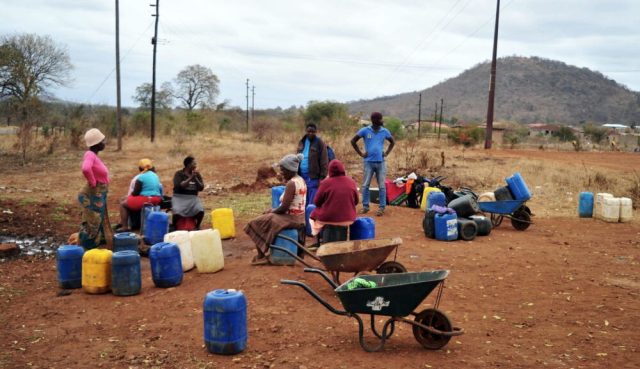
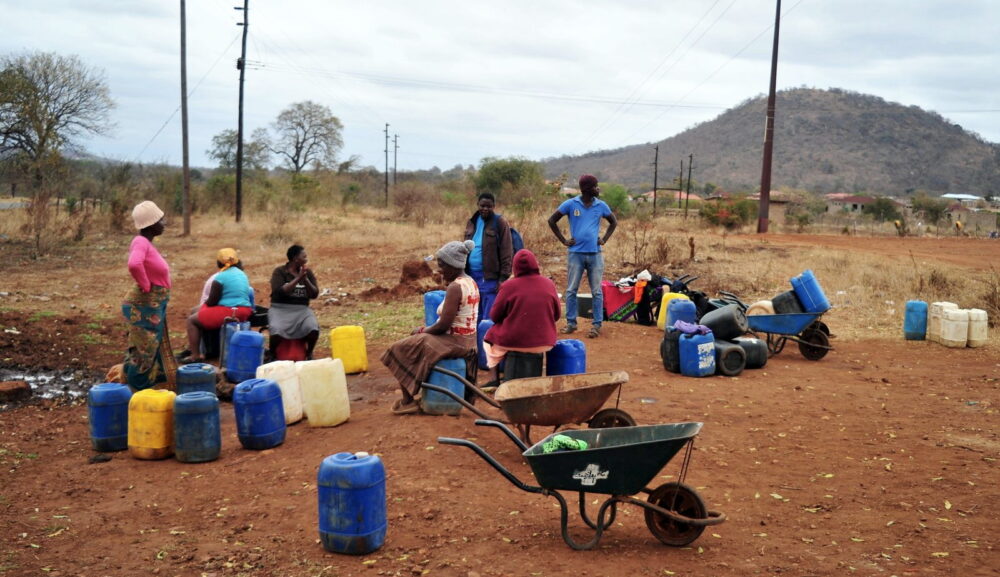
In Limpopo’s rural villages, being waterless has become so normalised that people seem to have accepted that this is just how life should be — spending hours a day queuing to fill just one 200 litre drum with water.
Most rural residents spend the better part of their days either searching for or standing in long queues to draw water from communal taps that dispense the sacred liquid only occasionally or at worst, drawing water from wells and streams where animals also quench their thirst or cool down.
In my village, a tanker from the Polokwane municipality delivers water to households, limited to four 200 litre drums a household, once a week and sometimes once every two weeks, depending on the water delivery driver’s mood or that of his employers. On such a day, residents line up containers at their gates and wait — and wait — for the tanker to roll in and deposit a few hundred litres for each household.
Elderly residents and children then spend hours transferring the water from the drums into other containers in the home after such a delivery. It is a “normal” way of life.
Most are indigent households that can hardly feed themselves and cannot afford the steep prices charged by private water sellers.
Those who have the means buy from water sellers — private citizens who have found a way of making money from the misery.
They make a roaring trade from water drawn either from boreholes on their properties or from free municipal water drawn from a water treatment plant 11km away.
They fill the tanks on the back of their trucks and lorries and resell it to water-starved households at R430 a 1 500-litre tank, for example.
The communal water taps at some street corners sometimes, out of the blue, cough up water. For a few hours, there is a scramble as people rush to fill up.
They line near the taps with sgubhus, buckets and all sorts of other containers. Some arrive on donkey-drawn carts laden with containers big and small; others in bakkies.
Nobody knows when or for how long the taps will run, hence there is tension and sometimes quarrels that break out. After the long wait, often under the broiling Limpopo sun, follows the indignity of struggling up dusty, rocky roads pushing wheelbarrows carrying sgubhus.
Water, being a basic human right, should be a priority of the government led by the oldest liberation movement. One would have expected that liberating citizens from the indignity of getting water from sources where animals also drink and bathe would be a priority.
It has been more than 30 years since the end of legislated apartheid and the ushering in of democracy. It is an undeniable fact that some of the structural and developmental issues caused by more than a century of racially segregated rule and underdevelopment exist.
But that cannot continue to be an excuse. It is reported that corruption in the country resulted in the loss of more than R437 billion. With the looting of so much money that would have made a world of difference to the lives of millions of water-starved citizens, one would have expected to see sustained operations to arrest and prosecute those responsible and recover the looted funds.
The looting, too, has become a “normal” way of life.
Billions have been spent on water projects but because of corruption and mismanagement, many of these were never completed. Broken water pipes at what used to be construction sites for the projects stand as poignant monuments to the rot.
In Giyani, the municipality spent R3.3bn on a water project over seven years. Still, residents remain without water. In 2021, during a government imbizo, municipal officials shamelessly told then-minister-of-water-affairs Senzo Mchunu they needed a further R1.1bn to finish the project.
The taps remain dry in Giyani and its 91 villages. In some villages, trenches left gaping years ago to install water pipes remain a stark reminder of a dream deferred. In the town, almost every household has invested in JoJo tanks and some have boreholes.
The project has been the subject of a Special Investigating Unit investigation for some time and some officials have appeared in court. Hopefully, this will yield results that might, in the end, see water flowing from the taps in Giyani.
As a result of a government failing to provide its citizens with this basic human right, residents weary of protesting and complaining have decided to do it themselves.
But for those who have no means to pay for a borehole, a water tank or water from water sellers, the only choice remains to endure the daily indignity of queuing and waiting.
Government executives, who live in gated staff villages that have an endless supply of water and other comforts paid for by the taxpayer, seem in no rush to save millions of residents from the daily suffering.
It appears that they believe the indignity should be accepted as a normal way of life and tolerated by the electorate.
Interestingly, most, if not all, of the politicians in the senior positions originate from some of these villages. One would expect that, since they have lived through the pain and suffering of not having a regular supply of clean drinking water and spent hours searching for water, as millions do today, they would prioritise and escalate efforts to reverse the situation.
Perhaps therein lies the problem: having grown up in such deprived areas, they too may have accepted this humiliation as a normal way of life for black people.
If that were not so, the water challenges would have been addressed with the same urgency and drive they display when organising lavish events paid for by the taxpayer.
It is a pity that this suffering is not limited to Limpopo; it is a daily struggle faced by rural residents across the country, from Njhakanjhaka to Umbumbulu, from Lusikisiki to Kgomo-Kgomo. Even more worrying is that there is no sign the suffering will end any time soon.
Even elderly residents who had high hopes that things would change when they voted for democratic change in April 1994 seem to have lost hope. In May 2024, on the 30th anniversary of the installation of Nelson Mandela as the country’s first democratic president, 83-year-old Ramadimetja Selema of Marulaneng, a village in the Nkumpi-Lepelle municipality, expressed frustration over the water issues.
She pointed at the 200 litre containers lined up against the fence waiting to be filled.
She spent R240 of her R2 280 monthly old-age pension to buy water at least twice a month. “I am old now and I still don’t know what it is like to have clean running water in my home. I have spent my whole life struggling to get water,” she told me in a resigned voice.
Perhaps politicians will raise their game, abandon the talk and act decisively now that the water shortages have reached Johannesburg, the richest city in Africa and the middle class and residents of other races, who have never grown used to going a few hours without water, are beginning to feel the daily suffering endured by millions in rural areas.
Lucas Ledwaba is the editor and publisher of Mukurukuru Media. He writes on issues of social justice, rural development, land reform, human rights and cultural heritage.
In Limpopo’s villages, being waterless has become so normalised that people seem to have accepted that this is just how life should be — spending hours a day queuing to fill a 200 litre drum