Soft life, in the South African context, has never been a singular thing. It slips between meanings, refusing to settle. For some, it is an aesthetic of ease, plush interiors, diffused lighting and linen curtains breathing with the wind.
For others, it is something far more political: a quiet rebellion against exhaustion, against the inherited urgency of survival. A good life, yes. But also a better one.
A softer landing in a country that has historically offered very few.
I often return to the work of Blessing Ngobeni, particularly his Mirror Soft Life series consisting of paintings and collectible furniture that collapse the boundary between object and memory.
In these works, textiles carry weight. They remember. They stretch across time, holding the residue of historical violence in their fibres, asking what it means to live comfortably in a place where comfort was once systematically denied.
In Ngobeni’s world, soft life is not indulgence. It is inheritance, negotiation and sometimes contradiction.
When Decorex Africa announced “Soft Life” as its 2026 theme, it felt less like a trend forecast and more like a cultural checkpoint, a moment to ask, with intention: What does softness look like here, now?
In conversation with Garreth van Niekerk and Alan Hayward, co-founders of Always Welcome and executive creative directors of the fair, it becomes clear that their approach resists definition. Instead, they are interested in multiplicity.
“What we were really trying to do when we landed on ‘Soft Life’ as a theme was find something that could resonate across different African contexts, something that didn’t feel imported or imposed,” they explain.
“We were drawn to the fact that the idea itself originated on the continent, from Nigeria, from a digital culture already questioning hustle culture and intensity.
“But more than that, we were interested in how that idea has evolved, how it has fractured into different meanings depending on who is using it and where they are using it. For us, it became a way of asking how those same principles of rest, ease and intentionality could be translated into design, into the spaces we inhabit every day,” Hayward says.
The translation, they insist, is both practical and emotional.
“When you start thinking about soft life in spatial terms, it’s not just about aesthetics in the superficial sense,” Hayward continues. “It’s about lighting that doesn’t overwhelm you, that actually soothes you when you enter a room. It’s about creating spaces that feel culturally grounded, familial, inviting rather than performative. It’s about asking how design can support a way of living that prioritises people over spectacle. That’s really where we started, with the idea that the intensity we’ve come to accept as normal doesn’t have to define how we design or live.”
Van Niekerk pushes the idea further, away from objects and into identity.
“What’s interesting about soft life is that it’s not a fixed concept, it’s almost quantum in the way that it shifts depending on who is engaging with it,” he says.
“There are people who reject it because they see it as indulgent or unrealistic and there are people who move toward it as a necessary correction to burnout culture.
“For us, especially in the context of Decorex, it becomes a lens to ask more personal questions: How do I actually want to live? Not how should my home look according to trends or magazines but how do I want to feel in my own space? And more importantly, how does that answer change when you’re living in South Africa, when you’re living as an African?”
It is here that soft life shifts from trend to tool.
“When you apply that thinking to furniture and interiors, the results can be quite radical,” he continues. “You start moving away from sharp, rigid forms toward something softer, literally rounding edges, choosing materials that are more tactile, more forgiving. You start thinking about textures that invite you to sit, to stay, to rest.
“But beyond that, there’s also a cultural translation happening. It’s about rejecting the idea that our homes should look like everywhere else in the world, that there’s a single global standard for what ‘good living’ looks like. Instead, it’s about allowing those spaces to reflect who we are, where we come from and what we need even if that looks completely different from what’s trending.”
That openness extends to the architecture of the fair.
“Because Decorex operates at such a large scale, across two cities, with over 600 exhibitors there’s only so much control we can or should have as creative directors,” Van Niekerk explains. “We put the theme out there, we share it with our networks and then there’s an application
process that brings in a much wider community.
“What’s exciting is that the show becomes a kind of collective interpretation of that theme. It’s shaped not just by us but by designers, curators and collaborators from across Africa and beyond. People are constantly introducing us to new voices, new materials, new ways of thinking. In many ways, the project grows beyond us, it becomes something that belongs to the community.”
Within that community, success is measured differently.
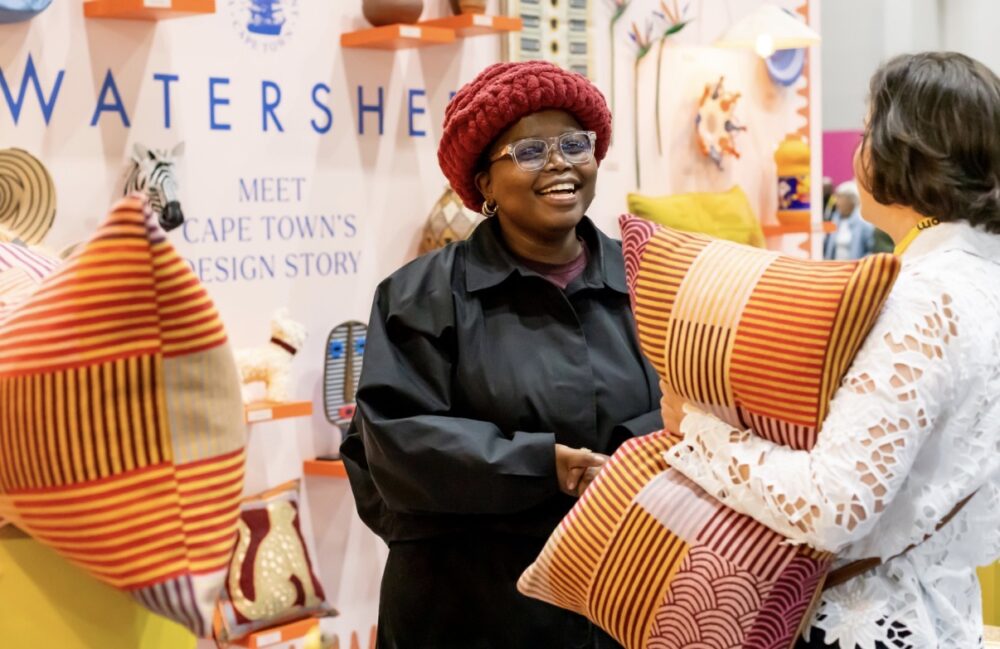
“For us, the core purpose of Decorex has always been about access,” they say. “A lot of designers and small businesses operate in isolation. They don’t always have the platforms or the networks to connect with clients, collaborators or even other creatives. Design fairs like this create a space where those connections can happen organically.
“It’s where you can exchange ideas, meet potential clients and get your work seen by a broader audience. When we think about success, it’s less about numbers and more about whether those opportunities are being created, whether people are leaving the show with something tangible, whether that’s a sale, a collaboration or even just a new way of thinking about their work.”
This year, the sense of expansion is deliberate. “We’ve been focused on creating meaningful opportunities that extend beyond the fair itself,” Hayward adds. “There are partnerships with international platforms like Maison in France, as well as connections with other African design weeks in Lagos and Mozambique. The idea is to create pathways, to give designers a way to move beyond their immediate context and engage with a global audience, while staying rooted in their own identity and practice.”
It is a reminder that soft life, in this context, is not about retreating from complexity but about engaging it differently.
“I think there’s sometimes a misconception that a theme like ‘Soft Life’ is a move away from more difficult conversations, around sustainability, technology, the future,” Van Niekerk reflects. “But actually, it’s the opposite. It’s about approaching those conversations in a more human-centred way.
“Instead of always projecting forward, always asking what comes next, we’re trying to look at what exists. What are the solutions that are present in our communities? What are we doing that works and how can we build on that?”
They point to emerging ideas like rural futurisms, approaches grounded in local knowledge, shaped by lived conditions as evidence.
“These ideas challenge the notion that innovation must come from elsewhere, that the future is something we have to import. In many cases, the answers are already here, they just need to be recognised, supported, expanded. In that sense, soft life becomes a way of being more attentive, more responsive, more grounded in reality.”
For visitors, the experience promises to be as layered as the theme itself. Across Cape Town and Johannesburg, the fair unfolds through a series of encounters: talks featuring local and international voices, workshops that invite participation, exhibitions that blur the line between art and function. There are rising talent showcases, designer-of-the-year features and lighting installations that shift the atmosphere of entire rooms.
But there is also something less tangible. An invitation to pause. To move through space not only as a consumer but as someone in search of resonance. To sit, to touch, to imagine what it might mean to build a life that feels in every sense of the word softer.
Perhaps that is the quiet promise of this year’s Decorex. Not that it will define soft life for you but that it will offer enough fragments, textures, ideas, conversations for you to begin defining it for yourself.
At Decorex Africa 2026, soft life shifts from aesthetic trend to cultural enquiry, asking how design can hold space for rest, identity and a more intentional way of living