
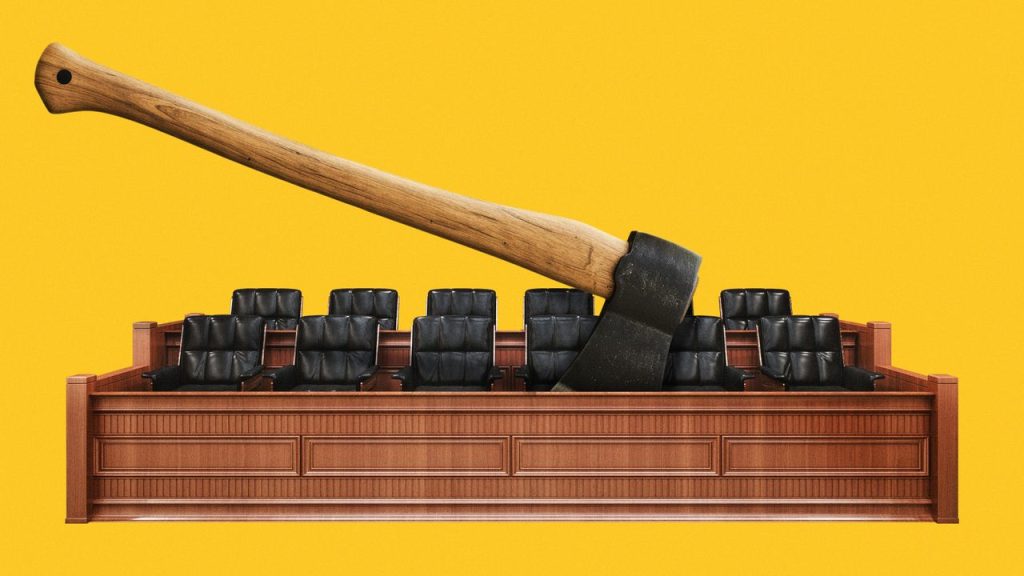
Justice Secretary David Lammy has unveiled a watered-down version of his plans to dispense with jury trials for all but the most serious offences.
Under his original plan, offences carrying a sentence of less than five years would have been heard in new judge-only courts. But following “cabinet feedback”, this has been scaled back to offences with a penalty of less than three years.
The current crown court backlog stands at around 80,000 cases, said the Ministry of Justice, and without urgent action could exceed 100,000 by 2028. “We must be bold,” Lammy said today in setting out the government’s plans, to rectify a court system on the “brink of collapse”.
What did the commentators say?
Trial by jury is one of the “central reasons” Britain’s legal system has “garnered such high levels of trust and respect around the world”, said The Times in an editorial. Lammy is correct that the “status quo cannot go on”, but “fundamental changes” towards a system of “secrecy” would face “grave public apprehension”.
Even if Lammy drives through his proposals, “scrapping jury trials alone might not be enough to clear the backlog”. If less serious offences could be overseen by a judge and two magistrates, as recommended in Brian Leveson’s judicial review, trial times could be reduced from “two days to a few hours”.
“Destroying jury trials because everything else is broken is a terrible idea,” said Tristan Kirk in London’s The Standard. Lammy’s proposal is an “act of pure desperation” from the Labour government. There is a “serious risk” that overhauling the system will cost “huge amounts of money and time” for “limited benefit”. Jury trials are “worth nourishing and investing in, instead of being constantly eroded”.
Had this come from a Boris Johnson or Nigel Farage government, Labour would “say we were on a rocky road, with something like fascism at the end of it”, said a Sunday Times editorial. Once gone, it is likely juries will “never come back”. Departing from centuries of tradition exposes the deputy prime minister’s “short-term” thinking, abandoning what many Britons see as a right “in the interests of expediency”. “Trial by jury is sacrosanct. Scrapping it is an affront to justice.”
This is out of character for Labour, said an editorial in The Telegraph. It “beggars belief” that a party “so obsessed with the artificial construct of the ECHR” would abandon such a “long-standing right”. The answer should be to “address the problems of capital and funding” in the criminal justice system, instead of “dispensing with the core principles of English justice”.
But “David Lammy is right to slash the use of juries”, said Simon Jenkins in The Guardian. “Archaic” and “inefficient”, they are “quaint relics of medieval jurisprudence”. We are falling behind many of our European neighbours, where judge-only courts have long been standard. Per 100,000 citizens, England and Wales imprison 145, compared to 71 and 54 in “jury-free” Germany and the Netherlands. “I do not believe that Britons are twice as criminal as Germans, or three times as Dutch.”
Labour’s reforms could be revolutionary for rape cases in particular, said The New Statesman. Currently, “women are being retraumatised for far too long” with delays of up to “half-a-decade” to have their cases heard in a system that “lets them down so badly”. Trying lower-level offences more efficiently will free up crown court time to make sure “the most serious crimes are heard quickly and fairly”. If reform isn’t enacted we risk perpetuating a system that “denies timely justice” and “fails to deter crime”.
What next?
Under the current proposals, magistrates will be allowed to hear cases with potential sentences of up to 18 months – as opposed to the current 12 – and this could still rise to two years, said The Telegraph.
The next stages of proposals aim to “create a new part of the crown court where there are no juries”, for sentences up to three years, said Sky News. This departs from the Leveson review, which proposed a panel of a judge supported by magistrates. Cases involving crimes that carry sentences of five years or more will still be heard in front of a jury.
With a crown court backlog of around 80,000 cases, David Lammy says ‘status quo cannot go on’