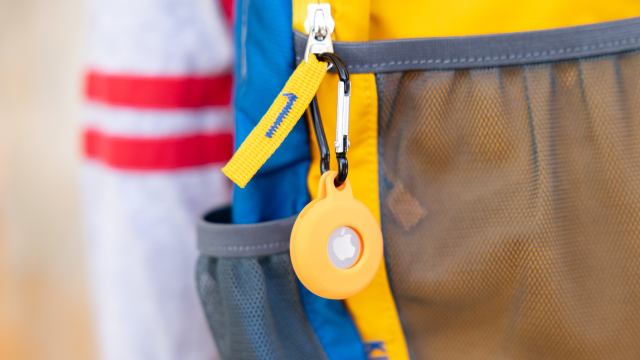
Parents keeping tabs on their children with an AirTag or through an app like Find My Friends has become widespread – even when they fly the nest.
A Unite Students survey of 1,027 parents of first-year university students carried out last September found that 67% tracked their child’s location using an app, while just 17% made contact on a daily basis. The survey found 71% of dads kept a close eye on their child, compared with 59% of mums.
But does the practice offer safety and comfort – or has the rise in parental surveillance shifted into murkier ethical territory?
‘Immense comfort’
When my son began getting the train to secondary school in London on his own, putting a “little disc in his blazer pocket” made the “nerve-racking journey slightly less intimidating – for me and for him”, said Naomi Greenaway in The Telegraph. And I’m not alone. Lots of parents in my class WhatsApp group said they used tracking devices.
It’s around the “tween years” that many parents opt to buy their child a smartphone, but knowing the “myriad issues” they bring, “I was loath to do so”.
Still, from experience, I know that “having a digital connection to my offspring can be of immense comfort at specific moments”. Being able to log in and watch my daughter at nursery on the “nanny cam” made “an emotionally draining experience a little more bearable”. Now, when I watch her “wind her way into the centre of town on my phone screen” it provides a similar “peace of mind”.
“There are two kinds of child in this world,” said Esther Walker in The Times – the “ones who wander off and the ones who don’t”. If you have the latter, “your child probably rattles with AirTags”. We once briefly lost our four-year-old daughter at an adventure playground and it was “the longest 10 minutes of my life”.
Now my children are at secondary school and as neither have smartphones, “both schoolbags are tagged”. This isn’t a “perfect solution”: AirTags often give “wildly inaccurate readings”, which can “freak you out for no good reason”, but for now it’s the “closest thing I’ve got to Mrs Weasley’s magic clock”.
Helicopter parenting
“I’d chuck an Apple AirTag tracking device into my children’s backpacks”, believing it was “the right thing to do”, said Charlotte Cripps in The Independent. “They were just six and four. If I kept a constant eye on them 24/7, I felt in control. Nothing could happen to them – could it?”
I thought tracking my kids would give me comfort but instead it turned me into a “neurotic and paranoid mother”, regularly checking my phone for updates on their whereabouts. If I couldn’t see them for a moment in the park, “I’d catastrophise it as a kidnapping, and ping the AirTag”. I began questioning my approach: “what the hell was I doing?” I had become “addicted to stalking my kids”.
A “coalition” of doctors, psychologists and other health professionals is “urging a rethink”, said The Times. Organised by Generation Focus – a campaigning organisation that is trying to make schools smartphone-free – the group believe the practice “breeds anxiety” in young people while harming their self-reliance and resilience. “We urge all parents to pause on tracking, and to reconsider whether the surveillance childhood we are sleepwalking into is really benefiting our children,” the group said in a letter.
“Helicopter parenting”, where middle-class mums and dads micromanage their offsprings’ lives, is widely thought to be “excessive and exhausting for both parent and child”, said Zing Tsjeng in The i Paper. “Of course, I understand the safety reason” for wanting to keep tabs on your child, “but at some point you have to ask yourself: when is enough enough? Do you trust your child to get themselves back home safe when they’re 19? What about when they’re 20? Or 21? Where does it end – and when can you let go?”
Experts warn the line between care and control is getting murkier – and could have consequences