
Shantay Robinson (ARTnews) offers a fascinating review of the work of Jamaican-born Samantha Box and her photographic work in three (two, ongoing) exhibitions. Her work is on view at the Des Moines Art Center in Iowa (through January 19, 2026) and the National Museum of Women in the Arts in Washington D.C. (through March 23, 2026), presenting her series “Caribbean Dreams” and “Invisible.” Her recent exhibition, “Home/Land,” which closed on December 21, 2025, was on view at Baxter St. at the Camera Club of New York. See more on her work at ARTnews.
After 12 years of photographing queer youth in New York’s Hell’s Kitchen neighborhood, photographer Samantha Box came to the realization around 2018 that this sort of documentation was not work that appealed to her any longer.
“I don’t believe in documentary photography anymore,” she told ARTnews during a visit to her Bronx studio in October. “I don’t believe in the capacity to hold multiple questions or to even create a space for questions. I don’t think I necessarily should be doing this work.”
To create her “Invisible” series, Box would spend up to eight hours a night after her job at a photo agency documenting the lives of the queer young people who relied on Sylvia’s Place, the city’s only emergency shelter for LGBTQ+ homeless youth, when they had nowhere else to go. In these images, she captures the intimacy of community and chosen families, seen in the spaces where her subjects are able to be authentically themselves without fear.
She discovered that the dominant narrative of coming out and then being kicked out of their homes by their families was not typically the circumstance that placed many of the young people at the shelter. Many were, instead, victims of institutional policies like Clinton-era adoption laws that continue to devastate Black families. One image in the “Invisible” series, from 2007, shows Cocco, who left the foster care they were placed in and then found a place at the shelter, visiting their mother’s grave site.
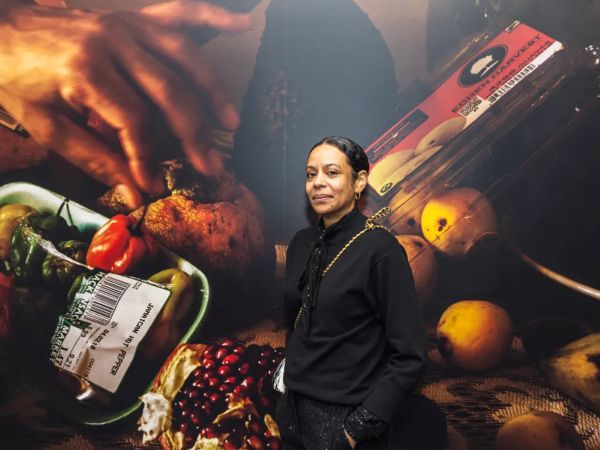
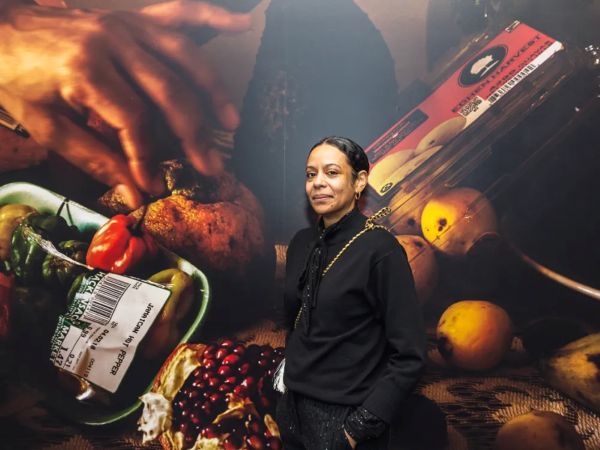
Abandoning her documentarian approach, Box began photographing the Caribbean foods she grew up with as a way to turn the lens inward, creating new documents of her own story. The resulting series, “Caribbean Dreams,” does not feature succulent tropical fruits and vegetables strategically placed on a table like a Dutch still life. Instead, Box leaves the mass-produced products she photographs in their containers. At times, she inserts herself into the frame. She often collages receipts from the grocery stores where she purchased these items in her finished pieces. In One Kind of Story, for example, Box pairs a large, pixilated self-portrait with photographs of her female family members in the periphery.
With these photographs, Box wants to address the commodification of food items exported to diasporic Caribbean communities around the world. (She named the series after a company that does this exporting.) Whereas Dutch still lifes depicted wealth and decadence, Box’s versions show how her experience as a diasporic Jamaican, who immigrated to New Jersey as a child, has itself been commodified and fabricated.
“She uses that very complex relationship to this idea of a nostalgic home, to really talk through this experience of diaspora in this beautiful, complicated way,” said Mia Laufer, who is the curator of one three current shows focused on Box.
Laufer’s show at the Des Moines Art Center in Iowa (on view through January 19) focuses specifically on the “Caribbean Dreams” series, while “Confluences” at the National Museum of Women in the Arts in Washington D.C. (through March 23) presents “Caribbean Dreams” alongside “Invisible” for the first time. Orin Zahra, the curator of “Confluences,” said in highlighting the older series she wanted to show “the very nuanced and complex lives these young people lead, of lives that are filled with joy, grief, love and reflection. I think those are common emotions that we can all connect to.”
For the Des Moines and Washington D.C. exhibitions, Box has added an aural element to “Caribbean Dreams.” Flashcards is a suite of images showing the artist holding different food items in her hands; below each image is a small sampling of the food item with a label. In the gallery, visitors hear Box and her mother saying the names of the food items, which Box buys at the Green Market in the Bronx, in their distinct American and Trinidadian accents, respectively. [. . .]
For full article, audio, and photographs, see https://www.artnews.com/art-news/artists/samantha-box-photographer-profile-caribbean-dreams-1234727742/
See more on S. Box at https://samanthabox.com/
Shantay Robinson (ARTnews) offers a fascinating review of the work of Jamaican-born Samantha Box and her photographic work in three (two, ongoing) exhibitions. Her work is on view at the Des Moines Art Center in Iowa (through January 19, 2026) and the National Museum of Women in the Arts in Washington D.C. (through March 23, 2026), presenting her series