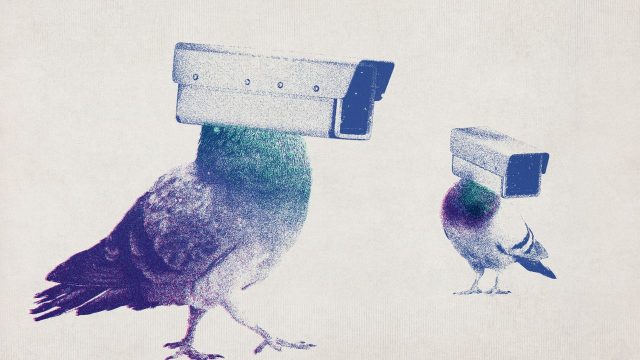
For thousands of years, humans have trained pigeons to race, deliver messages and “spy behind enemy lines”, said Bloomberg. “What would happen if people could bypass the training and steer their bird brains instead?”
A Russian neurotechnology company linked to Vladimir Putin’s daughter is claiming to do just that, said The Times. Scientists at Neiry have reportedly been implanting computer chips into the birds’ brains and strapping video cameras to their chests, trying to transform them into “living drones”.
There has been “no independent scientific verification” of the company’s claims – but in theory, the birds could be “adapted for military surveillance”.
Bio-drones
Under the project, codenamed PJN-1, neural chips are reportedly implanted into the birds’ brains, with flight paths controlled by remote operators. The Moscow-based company claims the birds can be steered by “stimulating their brains with electrodes to make them turn left or right”, said the paper.
Pigeons outperform traditional drones because animals “do not require battery swaps or frequent landings”, according to Neiry. They can fly up to 400km a day without a break, and can reach areas where drones would be restricted, the company says.
“Our current focus is pigeons, but different species may be used depending on the environment or payload,” said Alexander Panov, founder and chief executive. “For transporting heavier payloads we plan to use ravens.”
And there are other advantages to these bird-brained “bio-drones”, said Bloomberg. Drones may be “easier to control, can carry bigger loads and don’t need to eat or poop”. But birds are better suited to covert surveillance. A person is far more likely to notice a drone overhead than “one more pigeon flapping around”.
Remote-controlled assassins?
There’s plenty of precedent in attempts to control the minds of animals for military purposes. During the Cold War, the CIA tried to turn dogs into “remote-controlled canine assassins”, said The Times. It also inserted a microphone into a cat’s ear and a radio transmitter into its skull, “hoping to use it as a device to spy” on the Soviets.
Several countries, including China and the US, have also explored controlling birds through neural implants. Last year Chinese scientists “created cyborg bees” with brain controllers to direct their flight, said The Telegraph. And in January, Neiry unveiled “what it claimed was the world’s first rat connected to AI, allowing it to access online information and answer questions via a keyboard”.
Neiry says the birds are intended for peaceful purposes, to help with search and rescue operations and to monitor infrastructure. “We make every effort to ensure that our bio-drones are used exclusively for civilian purposes, with no concealed or secondary use,” the company said in a statement.
But experts warn the technology could “easily be adapted for military use”, said the paper. Russia already sends trained dolphins to guard its Black Sea naval base, and has reportedly “mounted Starlink terminals on horses to extend internet coverage along the front line”.
An investigation by T-Invariant, an independent anti-war outlet, found that Neiry had received about one billion roubles (almost £10 million) in funding, “much of it from Kremlin-linked sources”. The company has received funding “on a scale Russian neuroscience has never seen”, one neurologist told the outlet.
Brain implant technology has also advanced rapidly in recent years. Several companies are developing neural chips for humans to treat diseases and improve cognitive capabilities. Plus Russia has been expanding its drone capabilities in the war against Ukraine – a war keenly supported by Panov. He has “lamented what he called the ‘gentle style’ of Russia’s so-called ‘special military operation’ in Ukraine”, said The Telegraph. He has also described his “ultimate ambition” of creating the next human species after Homo sapiens: so-called Homo superior.
Moscow neurotech company with Kremlin-linked funding claims to implant neural chips in birds’ brains to control their flight, and create ‘bio-drones’