
The painter Rose Wylie “is one of the great personalities” of the British art world, said Lucy Davies in the Financial Times – but until she was in her late-70s, “she was barely known”. Although she trained at art school in the 1950s, Wylie (b.1934) gave up painting while she raised her children; it was only once they were grown up that she took to the easel again.
In recent years, her giant canvases with bold colours, naive cartoon-like images, painted texts and wild juxtapositions – she paints football players, film stars, Old Testament prophets, totalitarian symbols, chocolate biscuits – have captivated audiences young and old.
This show is her biggest yet, a thorough retrospective of her painting since 1989, since when she has been producing canvases at a prodigious rate from “her ramshackle cottage in Kent”. The colours alone make it a worthwhile experience: “ballerina pink”, “marzipan yellow”, “zingy, toothpastey green”. Viewers fall for her paintings “because they are so full of self and energy”, but it’s the “collisions” she creates between “wildly different things” that make them so memorable. This show is a fascinating insight into her “magnificent, unruly inner world”.
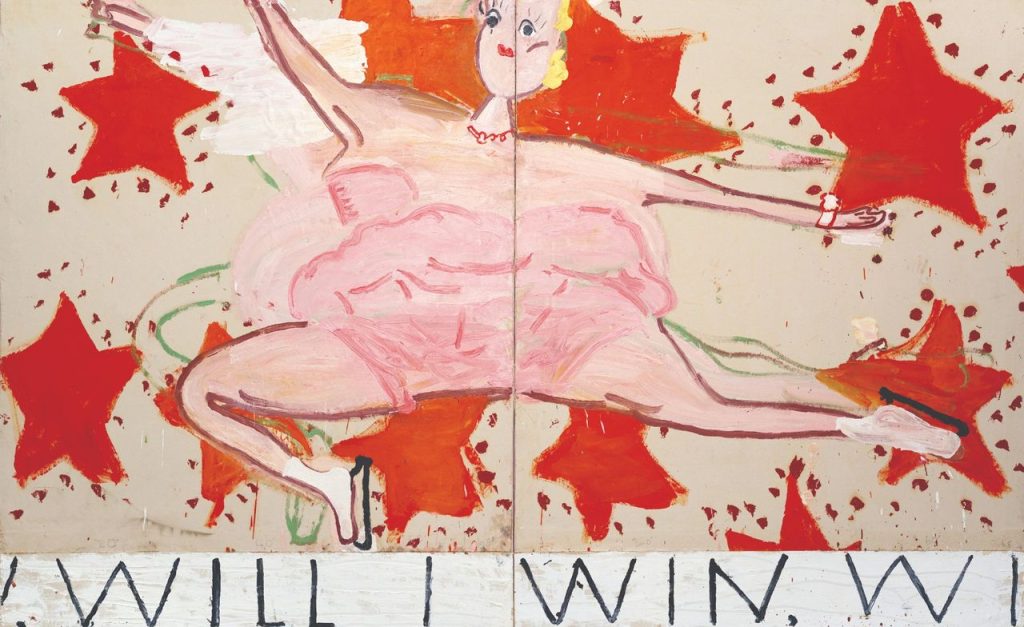
Wylie is “unstuffy, funny and forthright”, said Laura Freeman in The Times. She paints exactly what she likes. At best, her works exist in a “larky” universe of their own, borrowing from film stills or press cuttings and accessorising them with “arrows, annotations and titles”, often painted in bold capital letters. 2015’s “Pink Skater (Will I Win, Will I Win)”, for instance, radiates a sense of “gliding elation”; the four canvases of “Park Dogs & Air Raid”, meanwhile, capture a unique child’s-eye view of a wartime dogfight over Kensington Gardens. The subject matter – dogs, ducks, propeller planes – seems exactly the sort of thing that might attract the eye of a little girl.
Yet the “duds” here are numerous. “Often, there’s a sense that a Christmas cracker has been pulled. The painting goes off with a bang… then nothing falls out. There’s an immediate visual impact but little lasting reward.”
The “wilful roughness” of Wylie’s approach gets up some people’s noses, said Alastair Sooke in The Telegraph: her paintings can resemble “graffiti in a public toilet”. Yet when Wylie is good, she’s really good. She can summon art “from almost anything”: from a photo of Nicole Kidman on the red carpet to “berries on a bowl of porridge”; and her seemingly childlike style belies a wealth of complexity, erudition and art-historical reference. Her paintings frequently call out misogyny with “subtle, cunning wit”: one here sees the disembodied bust of an actress splayed out next to an axe; “she could be a victim on the chopping block”.
At her best, Wylie is “irreverent, irrepressible, anarchic” and “intensely charismatic”. “It’s rare to find yourself inside a gallery having this much fun while being made to think.”
Royal Academy, London W1, until 19 April.
Covering subjects from Old Testament prophets to chocolate biscuits, the artist delves into her ‘magnificent, unruly inner world’