
Nobody knows how the phrase “Vedi Napoli e mori” (See Naples and die) came into being. The sentiment that once you have seen the beauties of Naples there is no need to go on is most commonly ascribed to Johann Wolfgang von Goethe on his grand tour of Italy in the 1780s. Goethe and I have little in common – just ask my GCSE German teacher – but it is a feeling that is easy to share. Indeed my first time in the shadow of Mount Vesuvius was much like the volcano itself: beguiling and beautiful but filled with noise, theatre and barely contained energy.
It is all the more surprising, then, that the most impressive hotel on the Naples waterfront achieves its effect not through a crescendo of Neapolitan drama and excess but through piano, or restraint. ROMEO Napoli is a hotel that exudes class, almost effortlessly, and in a city that is so turned up to 11, that quality alone is something of a luxury.
Why stay here?

The building has a history worthy of its surroundings. Once the headquarters of Achille Lauro’s legendary shipping fleet, the palazzo was entrusted to the late Pritzker prize-winning Japanese architect Kenzō Tange for a transformation that is stark and yet incorporates so much of what has gone before.
The result is a double skin of glass and steel rendered in an aquamarine shimmer, its gently undulating curves calling to mind the prow of a great vessel preparing to cast off. It is striking in the way that all great Italian suits are striking, in that you can’t quite take your eyes off it, but you’d struggle to explain why. Against the backdrop of Naples’ Unesco-listed historic centre, it somehow manages to stand entirely apart while remaining very much of its place.
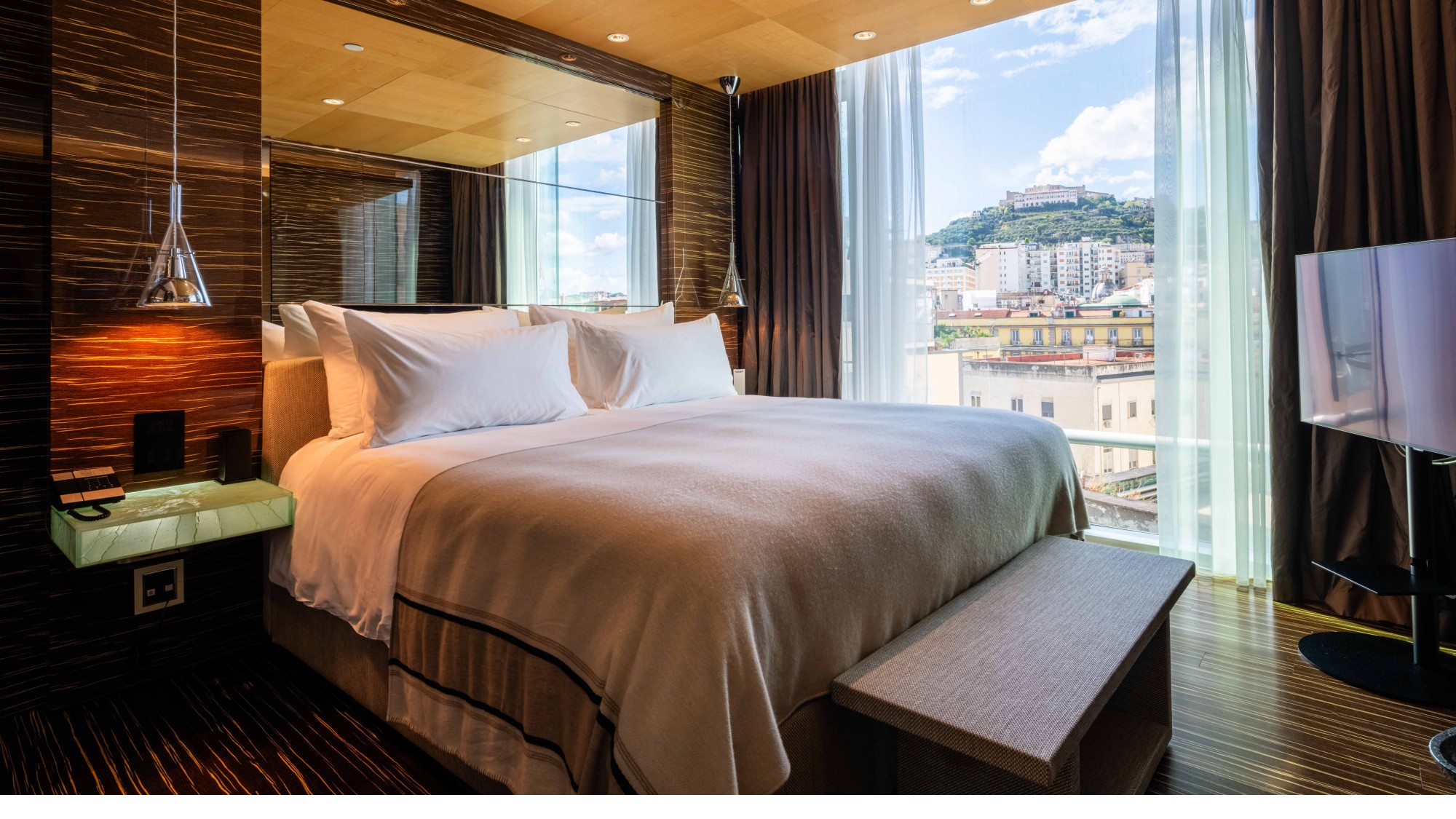
Inside, the philosophy is one of “essentiality”, something I took to mean that while some of the art and decor could feel over the top, it instead feels perfectly appointed. Black marble floors and Macassar ebony flow through communal spaces and into the 77 rooms and suites, each a tightly composed study in materiality. All the mod-cons of the highest end hotels are here, while the bed has a comfort level that is usually reserved only for your own one at home.
The mostly monochromatic palette, punctuated with flashes of blood red and cobalt, lends the whole place a cinematic quality, like something from a Paolo Sorrentino film, rather than your standard five-star interior. The Gulf of Naples, visible from most rooms, remains the star attraction and the “essentiality” of the interior decor means that there is nothing too in-your-face to compete for your attention.
The art collection deserves a mention, too, as it is not art for the sake of art. The founder, Alfredo Romeo, is himself a serious collector, and the works here – ranging from 17th-century paintings to Samurai armour, from Mario Schifano’s pop-inflected take on Vesuvius to Andy Warhol’s typically flat, iconic treatment of the same volcano – feel genuinely chosen rather than acquired.
Mark Kostabi, the American artist whose stylised, mannequin-like figures explore themes of isolation and alienation in the age of technology, is another recurring presence. His pieces appearing in the rooms as well as the public spaces give an unsettling elegance. Marc Chagall’s dreamlike figurative work brings a note of European modernism to the mix, while a lenticular piece by Neapolitan artist Francesco Clemente shifts and transforms as you move past it. Lemons, sheep, Vesuvius – the iconography of the area flickers in and out of focus like a half-remembered memory. It is a fitting tribute to a city that always shows you something different.
Eating and drinking

That Alain Ducasse chose Naples for his first Italian restaurant is testament to the history, quality and excitement that eating in the city can bring. The food offering at the ROMEO is the perfect example of all three. Il Ristorante Alain Ducasse Napoli, on the ninth floor with panoramic views across the Gulf, has already been awarded its first Michelin star. It would be no surprise if more were on the way.
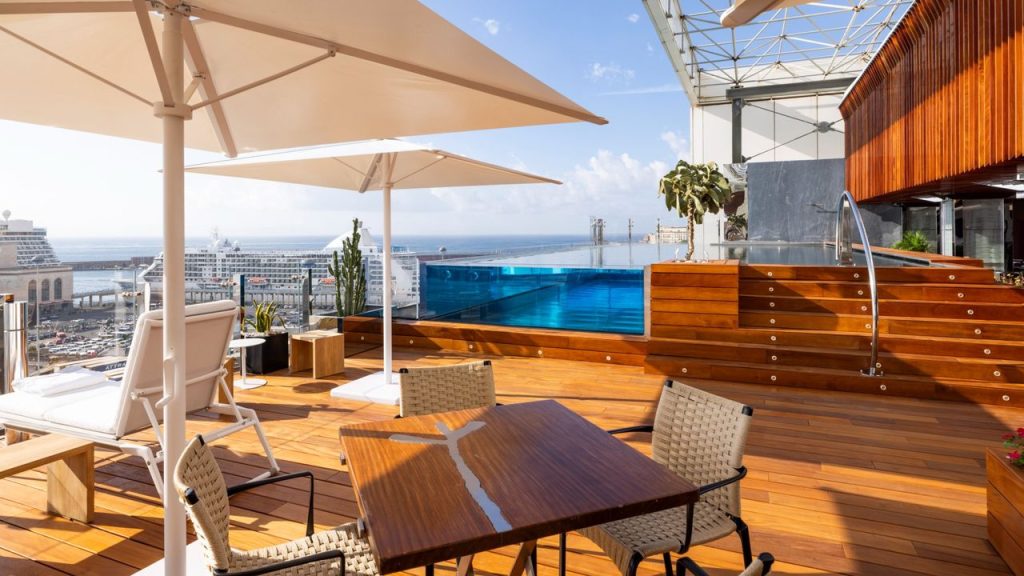
On Sundays and Mondays, when the main restaurant rests, the kitchen migrates up to La Terrazza, where lunch and dinner are served against a view that, well, it is a cliché, but it took my breath away. As we were there on a Monday we were treated to a smorgasbord of delights from the menu, once we’d caught our breath of course. It’s rare that a salad steals the show, but the caprese was quite simply perfect – the tomatoes in this part of the world are worth travelling for.
While the two pastas were divine, a pomodoro sauce and a white wine and clam number, it was in fact the ceviche and octopus courses that have lived long in the memory.
Despite to this day being a thriving port city and with so many people so close to the sea, Naples has plenty of substandard fish restaurants. But at ROMEO the simplicity of cooking is a key reason behind its excellence. Executive chef Alessandro Lucassino’s kitchen operates on the principle of letting the exceptional Mediterranean produce speak for itself. This is shown in the delectable nature of their fish and seafood dishes.
Lemons are the other food staple that are just better in Naples than pretty much anywhere else on the planet and we ended our meal with a lemon tart that was truly out of this world. There’s an ease and warmth in which the food is served that also speaks to the quality of the dining experience. Too often high-end places with this sort of menu can feel stuffy, but the ROMEO has a quality offering that comes with an air of relaxed confidence, with is both instantly appealing and relaxing in equal measure.
Breakfast, served in the same space, is another Ducasse production and considerably above what most hotels consider sufficient. For something more casual, Il Bar, a sleek all-day space with an interesting past life as Naples’ first fusion restaurant, offers seasonal plates at any hour.
Things to do
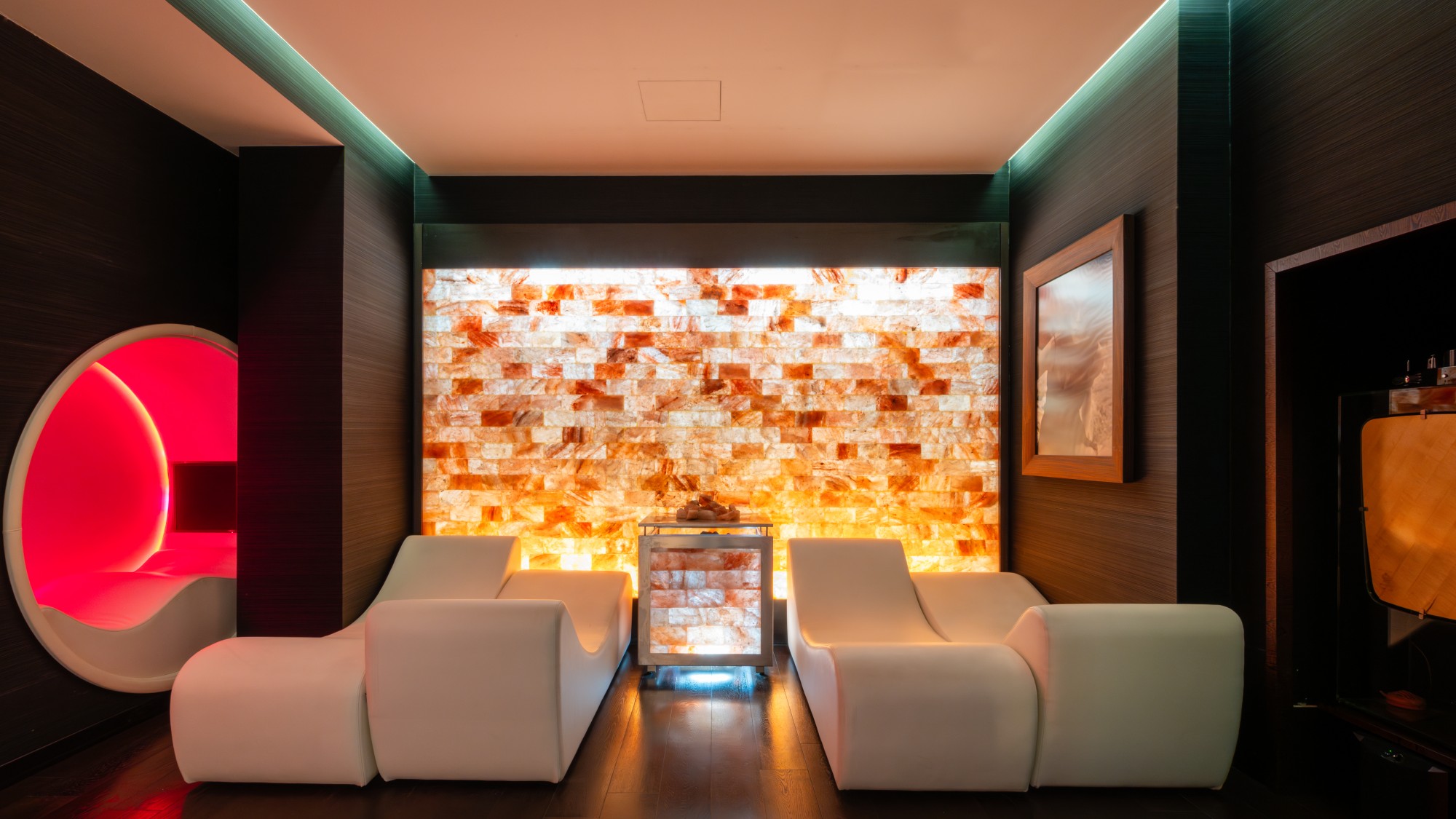
Few hotel spas manage to be impressive in scale and genuinely immersive in atmosphere at the same time. LA SPA by Sisley Paris, occupying more than 1,000 square metres within what was historically the city’s salt customs office, manages both with considerable style.
Descending into it feels like entering an entirely different world. In fact, if you’ve ever wondered what it might feel like to be a very well-pampered astronaut, the spa has the answer. There is a salt cave, an infrared sauna and a snow room that delivers exactly the kind of bracing shock to the system that you didn’t know you needed. Three plunge pools are backed by futuristic projections of water scenes, while most remarkable of all are the circular “phyto-aromatic” cabins. They are neon-lit pods in which you lie back, breathe in essential oils and watch scenes from the natural world play out above you.
The treatments themselves are everything you would expect from a brand such as Sisley. I felt rejuvenated, revitalised and really could have spent my whole week down there. But there were more delights above ground with the two pools, and the Krug Champagne terrace on the rooftop, offering a different but no less necessary kind of therapy. On a clear day, the 120-square-metre infinity pool appears to dissolve into the Gulf itself, with the islands of Ischia and Capri floating on the horizon.
The verdict
Naples, as Goethe well knew, is one of those cities that stays with you long after you leave. ROMEO Napoli, rather than fighting that feeling, channels it into something altogether more considered.
A special mention too must go to the staff who all went above and beyond to ensure our stay was such a delight. It’s rare to see staff members engaged in such convivial conversations with so many of the guests but that seems to be the ROMEO way.
From the architecture and the art to the dining and the view, no trip to the ROMEO is wasted, while the spa, the pools and that terrace ensure that “see Naples and die” feels, for the duration of your stay at least, like a very long way off indeed.
Rooms from approximately €514 per night. Il Ristorante Alain Ducasse Napoli is open Tuesday to Saturday for dinner; reservations are essential. Daily spa access is included for hotel guests. theromeocollection.com
The aquamarine masterpiece on the Naples waterfront is a quiet triumph in the loudest of cities