

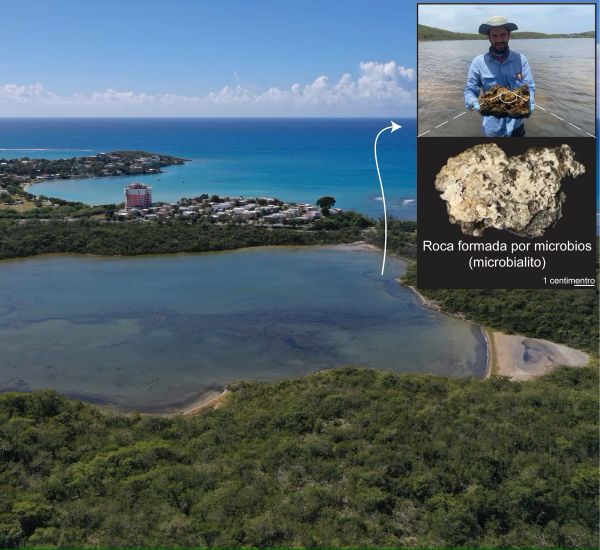
Melanie Ortiz Álvarez (El Nuevo Día) reports that Puerto Rican geobiologist Bryan Rodríguez Colón— who is leading a study on rock structures formed by microbialites in Laguna Providencia in Guánica— is calling for the conservation of the area, which represents a new and unique natural system in the archipelago. Read more excerpts below and access the full article at El Nuevo Día.
For the first time in Puerto Rico, scientists have found rare rock structures formed by microorganisms that could help identify possible signs of extraterrestrial life on Mars. However, they are at risk of being lost.
A new study reveals that these structures, known as microbialites, were found in Laguna Providencia in Guánica, making Puerto Rico one of the few places in the Caribbean where they have been documented. They also represent a new and unique natural system for the archipelago. “I always wanted to study microbialites in Puerto Rico, but since they had never been identified on the island, I never thought I would be able to document them here. I thought I would have to go to Australia, where there are many of them,” geobiologist Bryan Rodríguez Colón, who conducted the study, told El Nuevo Día.
A native of Manatí and a doctoral candidate at the University of Kansas, Rodríguez Colón made the surprising discovery as part of his research on hypersaline lagoons (bodies of water with a salt concentration higher than that of the ocean) in the southwestern region of the country. His research also revealed that recent changes in the salinity of Laguna Providencia have damaged the microbialite ecosystem, putting its conservation at risk.
Windows into the past… and Mars
Microbialites have tremendous scientific value because they serve as windows into Earth’s past and help scientists interpret possible evidence of extraterrestrial life. “When we search for evidence of life on Mars, we need to know how to distinguish a rock formed by biological processes from one formed solely through chemical processes. Modern microbialites help us interpret those signals,” explained Rodríguez Colón. For millions of years, before plants and animals appeared, Earth was dominated by microorganisms. Microbialites were abundant, and the cyanobacteria that lived within them contributed to the Great Oxidation Event, a process that enriched the atmosphere with oxygen and allowed the evolution of complex life forms.
Today, these systems survive mainly in extreme environments where few organisms can feed on them, making them analogs of early Earth.
Why in Guánica?
Microbialites originate from microbial mats, communities of microorganisms that grow on sediment and form layers of different colors. Rodríguez Colón compares them to a lasagna. “Each layer contains different communities. Some carry out photosynthesis and produce oxygen; others live without oxygen and recycle sulfur compounds. It is a complete ecosystem that exists within just a few millimeters of soil,” he explained. During their metabolism, these microorganisms alter the chemical environment around them. Under the right conditions, minerals such as calcium carbonate attach to their cells until they eventually form rock.
Although microbial mats had previously been studied in Puerto Rico’s Las Salinas de Cabo Rojo — by researchers such as Dr. Lilliam Casillas Martínez — microbialites had never been documented.
Rodríguez Colón suspects that the geology of Laguna Providencia plays an important role: “The limestone surrounding the lagoon could provide, through groundwater, the minerals needed to form them. In addition, the high salinity, pH, and chemical composition of the water create ideal conditions for them.”
A call for conservation
Using aerial photographs taken between 2006 and 2022, the research team documented a dramatic loss of microbialites in Laguna Providencia.
In 2020, an old channel connecting the lagoon to the Caribbean Sea was kept open to benefit aquatic birds. That connection altered the system’s salinity and allowed fish to enter. As a result, much [sic] of the microbialites lost their layer of living microorganisms, leaving the fossilized rock exposed. “If you change the salinity, you change the entire ecosystem. When we carry out conservation projects, we have to think about all species, not just animals,” Rodríguez Colón warned.
During a recent drought, some areas showed signs of recovery, suggesting that the system could still be restored if proper environmental conditions are reestablished.
Currently, Rodríguez Colón is in discussions with the Department of Natural and Environmental Resources to evaluate closing the channel.
He also hopes the discovery will spark public interest and encourage new students to explore fields such as geology and biology. [. . .]
For full article, see https://www.elnuevodia.com/english/news/story/rock-structures-discovered-in-guanica-could-help-identify-life-on-mars/
Melanie Ortiz Álvarez (El Nuevo Día) reports that Puerto Rican geobiologist Bryan Rodríguez Colón— who is leading a study on rock structures formed by microbialites in Laguna Providencia in Guánica— is calling for the conservation of the area, which represents a new and unique natural system in the archipelago. Read more excerpts below and access the full