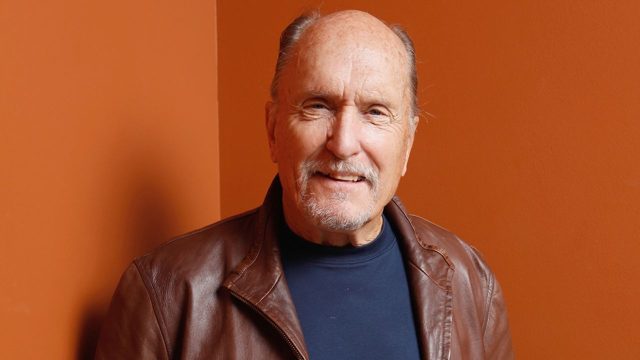
Robert Duvall disappeared into his characters. Over a six-decade career he approached highly diverse roles like “an ethnologist on a field trip into the soul,” as one critic put it. Among his memorable leading performances were roles as an explosive Marine pilot who tyrannizes his family in The Great Santini (1979) and as a fading, alcoholic country singer in Tender Mercies (1983), which won him a Best Actor Oscar. He also starred as an illiterate, deeply kind farmer in the Faulkner adaptation Tomorrow (1972), and as a fallen Pentecostal preacher in The Apostle (1997), which he wrote and directed. But many of Duvall’s best performances came in supporting roles: as a ruthless TV executive in Network (1976), the stoic mob lawyer in The Godfather (1972), and the maniacal lieutenant colonel in Apocalypse Now (1979) who loves “the smell of napalm in the morning.” Secondary roles suited Duvall just fine, he said, and were often more interesting. “Being a leading man is an agent’s dream,” he said, “not an actor’s.”
Born in San Diego, Duvall grew up in a series of Navy towns where his rear admiral father was stationed, said the Associated Press. An aimless youth, he attended Principia College in Illinois but “nearly flunked out.” His concerned parents steered him toward theater and he “flourished in drama classes.” After his Army service, he moved to New York City to study acting, falling in with fellow students Gene Hackman and Dustin Hoffman. Working odd jobs to support himself, he soon began landing stage and TV roles. He “got his film break” when cast as the misunderstood recluse Boo Radley in To Kill a Mockingbird (1962), said Rolling Stone, making an indelible impression without speaking a word of dialogue. Having built his reputation as a character actor over the next decade, he became “a central figure in the New Hollywood of the 1970s,” adding “grit and soul to legendary works” from directors such as George Lucas, Robert Altman, and Francis Ford Coppola.
An exacting performer who researched roles with “intense studiousness,” Duvall was also a private man who kept “Hollywood at arm’s length,” said The New York Times. He spent years living with his fourth wife on a horse farm in rural Virginia, though he acted into his 90s. Despite that intensity, he was unpretentious about his craft, which, he said, just boiled down to “talking and listening.” In acting, “there’s no right or wrong,” he said, “just truthful or untruthful.”
The actor’s storied career spanned decades