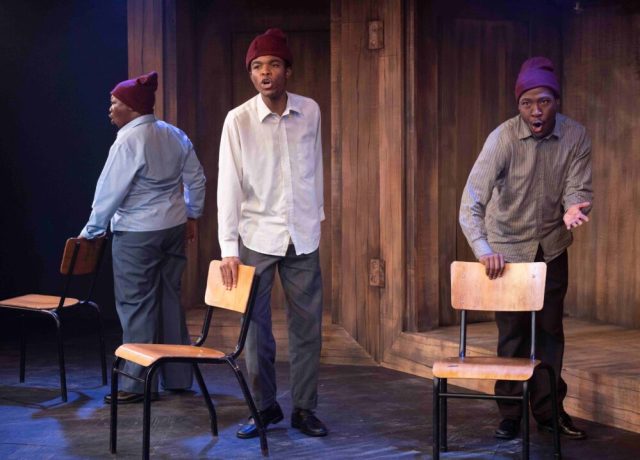
There are theatre productions that grab you by the throat in the first five minutes and refuse to let go. Then there are those that ask you to sit still, lean in and do the labour of remembering alongside them. Rise ’76, the ambitious new commemorative work by Tiisetso Mashifane wa Noni, belongs firmly in the latter category.
Clocking in at roughly 140 minutes, Rise ’76 drifts dangerously close to becoming a staged oral archive rather than living theatre. Conversations linger. Testimonies expand. Historical detail piles onto historical detail. The script is sharp, witty and often profoundly moving but it is also indulgent in places.
One understands why Mashifane wa Noni’s first draft ran close to four hours.
“To hit as many historically accurate, emotional and storytelling beats as possible, I was always aware that the play would sit at about two hours, the challenge then became a matter of how to pace the play for maximum impact,” explained Mashifane wa Noni.
Be that as it may, this is a must-see, must-experience and must-awaken-consciousness kind of production.
Rise ’76 does not offer easy catharsis. It asks for patience. It asks for concentration. Occasionally, it asks for too much of both.
But it also offers something increasingly rare in contemporary theatre: seriousness of purpose.
Commissioned by the Market Theatre and the Baxter Theatre in recognition of the 50th anniversary of the 1976 Soweto Youth Uprising, Rise ’76 is not interested in offering audiences a sanitised liberation narrative. Mashifane wa Noni instead approaches June 16 through the slippery, unreliable architecture of memory itself.
“What more can one say about a historical event that everyone knows about?”
Mashifane wa Noni, who grew up in Pretoria and attended Glenstantia Primary before matriculating from St Mary’s Diocesan School for Girls Pretoria in 2013, writes like someone deeply conscious of history as both political machinery and emotional inheritance.
Her academic background in politics, philosophy and dramatic arts bleeds through every scene. You can hear the influence of a young woman who witnessed first hand both #FeesMustFall and #RUReferenceList while studying at Rhodes University. Someone who understood early that protest movements are never experienced uniformly by those inside them.
Rise ’76 refuses uniformity.
The production synthesises insights gathered from more than 40 interviewees, assembled during research between September and November 2025. The density of testimony becomes both the script’s greatest weapon and occasional Achilles heel (for me). There is richness in how the play stitches together fragments of real lives into composite characters and emotionally layered scenes.

Rise ‘76 which offers a seriousness of purpose.
A particularly haunting sequence, drawn from the testimonies of three former schoolchildren; Sam, Priscilla and Dikeledi, reconstructs the terror of encountering an armed white policeman amid the chaos of June 16. Elsewhere, the chilling testimony of the lieutenant-colonel allegedly responsible for firing the first fatal shot becomes a confrontation scene that lingers long after the show.
“Memory, as the pillar of my creative interpretation of the play, allowed for conflicting accounts to play an interesting narrative role because my cast and I quickly realised that someone would say one thing in their testimony that completely contradicts what someone else said in theirs.
“Or someone would remember something that did not make any factual sense but keeping in mind that is how the person remembers it. And then having to decide on whether we portray it as it is, even if it’s somewhat incorrect.”
Key resources also used in drafting the play include Truth and Reconciliation Commission testimonies; The Soweto Uprisings: Counter Memories of June 1976 by Professor Sifiso Mxolisi Ndlovu; I Saw a Nightmare — Doing Violence to Memory: The Soweto Uprising, June 16, 1976 by Professor Helena Pohlandt-McCormack; and Sam Nzima: A Journey Through His Lens by Nhlanhla Mthethwa.
The writing of the production avoids simplistic hero worship. The young people of 1976 are portrayed not as mythologised martyrs carved from granite but as frightened, ordinary children thrust into extraordinary violence.
The production’s most affecting insight is perhaps its insistence that history happened to people who could easily have been us. Back then. There is also something quietly profound about the way so many high school learners have reportedly responded to Rise ’76 at The Baxter.
Despite the common assumption that younger South Africans engage with June 16 only in abstract, textbook terms, they appeared deeply affected by the production’s emotional and historical texture. Perhaps beneath the perceived distance we so often attribute to today’s youth lies unresolved transgenerational grief/trauma/guilt searching for a language, direction and release.
The emotional reckoning became evident in conversations with learners who attended a school’s performance at the Baxter last week.
“Personally, it was very emotional and I thought that the characters were well-developed and that it really humanised a story that people do not really speak about a lot. We saw the perspective of the schoolkids and we saw how heart-wrenching it was for everyone that was involved,” Halo said [full name withheld].
Another learner, Zintle, perhaps articulated the production’s deepest provocation most clearly: “Walking away from the play, I have more emotions than I do have thoughts.
“The fire has been ignited in me. I am really confronted by the question of what is it that I am going to do or that our generation is going to do about the injustices in our society today? And I do feel a bit of guilt because it’s been 50 years since 1976 and I do not think we have maintained the struggle or the reasons that the students fought and died for back then.”
Rise ’76 is showing at the Baxter Studio, in Cape Town, until 30 May 2026 before it heads to the Market Theatre’s Mannie Manim Theatre, in Johannesburg, from 5 to 28 June 2026.
A powerful and emotionally layered theatrical work revisits the 1976 Soweto Uprising through testimony, memory, contradiction and unresolved generational grief