
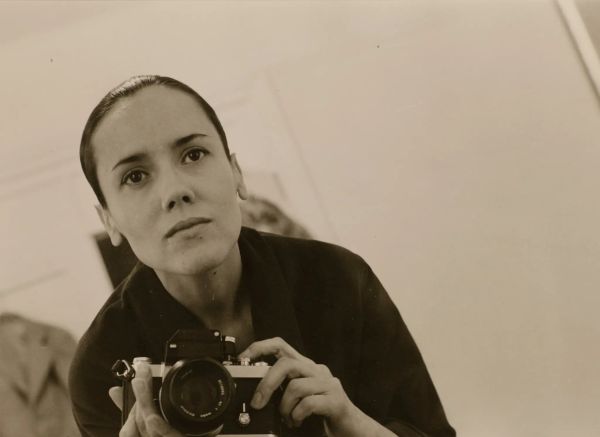
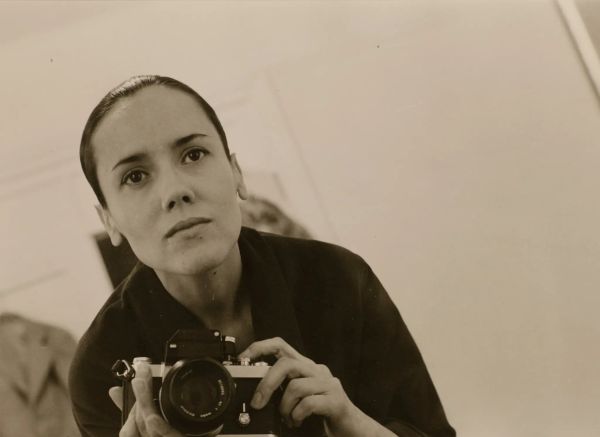
The New York Times Critic’s Pick column features Sophie Rivera’s “Double Exposures,” a retrospective of the photographer’s work, which is on view at El Museo del Barrio (1230 Fifth Avenue, New York, New York) through August 2, 2026. Hollan Cotter writes “’Double Exposures,’ the first museum survey for the artist, highlights a career spent documenting New Yorkers, in ways both traditional and strange.” He concludes, “How great that El Museo has now brought her fully into the light.” See excerpts below; for Cotter’s full review and photos, go to The New York Times. [Also see our previous post https://repeatingislands.com/2026/02/11/forthcoming-exhibition-sophie-rivera-double-exposures/.]
From the mid-1960s until her death in 2021 at 82, the wise and passionate New York photographer Sophie Rivera lived and worked in an apartment in the Morningside Heights section of Manhattan with an eye-level view of the local elevated subway.
From the apartment, which was also her studio, she photographed trains covered with a brilliant new form of art known as graffiti. She photographed (and befriended) transit workers maintaining the tracks. She photographed homeless people sheltering inside stations. A commuter herself, she photographed other commuters daily riding the rails.

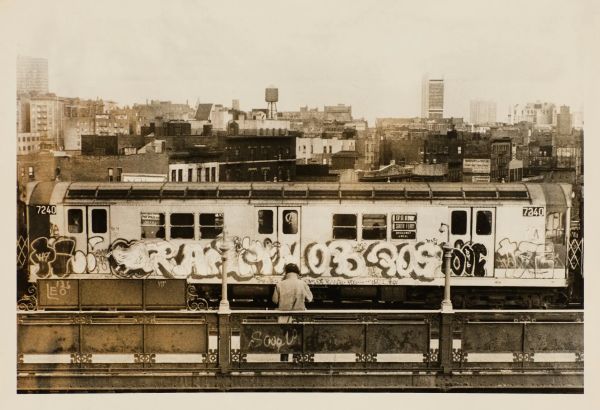
And such fellow passengers — urban-life companions, young and old, of a kind she also encountered in parks and playgrounds, and on the street in parades and protest marches — are recurrent presences in “Sophie Rivera: Double Exposures,” the artist’s first and long overdue retrospective, at El Museo del Barrio.
Rivera was born in Brooklyn to parents who moved from Puerto Rico. When their marriage broke up, she and her four older sisters were packed off to a Roman Catholic orphanage on Staten Island, where she lived through the end of her high school years. A few years after graduation, she met her life partner, Martin Hurwitz, a young psychiatrist, and moved with him to the Morningside Heights apartment where they would spend their lives. (Hurwitz died in 2023.)
Always interested in art, in 1972, she bought her first camera and signed up for a beginners workshop at the New School for Social Research. She lucked out with her teachers there: the European-born street photographer Lisette Model (1901-1983) and the Nuyorican documentarian Benedict J. Fernandez (1936-2021).
The influence of Model, who took New York City and its people as her subject, is clear in Rivera’s work from the start. But it seems to have been the example set by Fernandez, who had focused his work on recording the civil rights conflicts of the time, that turned Rivera’s attention in a distinctly political — leftist, feminist — direction.
Many of the Rivera images that open El Museo’s show are straightforwardly documentary in intent, made for publication in alternative news sources: shots of street demonstrations demanding fair labor practices, education reform, affirmative action, women’s rights. [. . .]
The organizers of the Rivera retrospective — El Museo’s interim chief curator Susanna V. Temkin, along with Serda Yalkin and Carlos Ortiz Burgos of the curatorial department — have placed the “Latino Portraits” at a roughly halfway point in the show, which makes sense, as the series represents, or at least has up until now, a peak moment in Rivera’s art world reputation, if not in her art. But there are surprises to be found in the galleries ahead. [. . .]
For full article, seehttps://www.nytimes.com/2026/05/07/arts/design/review-sophie-riveras-museo-del-barrio.html
[Photo above: 1) Sophie Rivera; 2) An untitled work by Rivera from the 1970s. Rivera’s apartment in the Morningside Heights neighborhood of Manhattan had a view of the elevated subway. Sophie Rivera; via Estate of Martin Hurwitz.]
The New York Times Critic’s Pick column features Sophie Rivera’s “Double Exposures,” a retrospective of the photographer’s work, which is on view at El Museo del Barrio (1230 Fifth Avenue, New York, New York) through August 2, 2026. Hollan Cotter writes “’Double Exposures,’ the first museum survey for the artist, highlights a career spent documenting