
The full title of this article is “ReefGrazers to restore Caribbean corals and support local fisheries.” According to DCNA, in Bonaire, Saba, St. Eustatius, a new initiative called the ReefGrazers project is set to begin in September, aiming to restore coral reefs in the Caribbean and support sustainable fishing practices.
[. . .] Unified efforts for nature restoration
ReefGrazers is a collaborative effort involving Van Hall Larenstein University of Applied Sciences, Wageningen University, Wageningen Marine Research, the Public Entity Saba, DCNA’s Network Partners STINAPA Bonaire, STENAPA and Saba Conservation Foundation, and WWF-Netherlands. This partnership was developed to address the urgent need to conserve Caribbean corals, which have been severely damaged since the 1970s by climate change, hurricanes, diseases, and pollution. These factors have led to widespread algae overgrowth on many reefs, making it difficult for corals to recover. This problem is largely due to the decline of algae-eating animals, whose populations have been greatly reduced by overfishing and disease.
Increase in algae-eating animals
Healthy coral reefs are crucial for protecting coastlines, supporting fisheries, and attracting tourists, all of which are essential to the Caribbean’s economy and culture. The ReefGrazers project aims to restore these reefs by reintroducing native algae-eating species, such as the Caribbean king crab, West Indian sea egg, and West Indian top shell (whelk), to help control algae. The project will study the current populations of these species, their impact on the reefs, and the effectiveness of efforts to boost their numbers.
Sustainable fisheries
It will also explore sustainable fishing practices that could emerge from the successful restocking of these animals, offering new opportunities for small-scale fisheries. This initiative is important not only for Bonaire, St. Eustatius, and Saba but it could also serve as a model for protecting coral reefs throughout the Caribbean.
For full article, see https://dcnanature.org/reefgrazers/
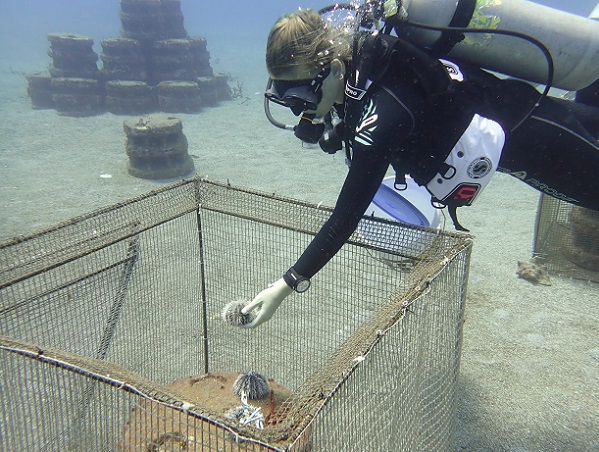
[Photo above by Alwin Hylkema: Researcher introducing West Indian sea egg on an artificial reef. The reef is caged to measure the effect of the grazer on the algae.]
The full title of this article is “ReefGrazers to restore Caribbean corals and support local fisheries.” According to DCNA, in Bonaire, Saba, St. Eustatius, a new initiative called the ReefGrazers project is set to begin in September, aiming to restore coral reefs in the Caribbean and support sustainable fishing practices. [. . .] Unified efforts