
Eleanor Shearer, Senior Research Fellow at Common Wealth, is the author of River Sing Me Home (Headline, 2023), a historical novel. In “’Rebranded Plantation,’…” she writes about how the British colonial wealth extraction system still influences the region’s tourist industry. Herer are excerpts; for the full article, see The Guardian. [Many thanks to Peter Jordens for bringing this item to our attention.]
Luxury tourism in the Caribbean sells a kind of timelessness. A paradise of sun, sea and sand. But to step off the cruise ship or away from the all-inclusive resort is to see a more complex picture: a history of colonialism and a future of climate devastation. New research from the Common Wealth thinktank maps how, over the 400 years since the first English ships arrived in Barbados, empire engineered a system of wealth extraction that shapes the tourism economies of today.
Sir Hilary Beckles, Barbadian historian and chair of the Caricom Reparations Commission, describes Barbados as the birthplace of British slave society. Between 1640 and 1807, Britain transported about 387,000 enslaved west Africans to the island. Extraordinary violence, from whippings to amputations and executions, were a regular feature of their lives. On the Codrington Plantation in the mid-18th century, 43% of the enslaved died within three years of their arrival. Life expectancy at birth for an enslaved person on the island was 29 years old. This was the incalculable human cost of the transatlantic slave economy.
On the back of this suffering was built extraordinary wealth for European colonial powers. Historian Joseph E Inikori has estimated that in the 18th century, 80% of the value of export commodities in the Americas was generated by enslaved Africans’ labour. Although plantation owners in the Caribbean did grow rich – the Drax family, ancestors of former Tory MP Richard Drax, made about £600,000 a year in today’s money from their Barbados plantation in the mid-19th Century – British imperial policy was designed to ensure most of the wealth flew away from the colonies. Two-thirds of the economic value of the sugar industry went to Britain, via the merchants who shipped unrefined sugar across the Atlantic, the businesses such as Lloyd’s of London that insured them, and the sugar refineries that created the final product.
These geographies of production left a lasting mark on the Caribbean, long after the collapse of the sugar industry. Islands such as Barbados now have a “rebranded plantation economy built for leisure instead of sugar”, says Fiona Compton, a St Lucian artist, historian and founder of the Know Your Caribbean platform. She highlights how most of the region’s hotel chains, cruise lines, airlines and booking platforms aren’t owned locally. For every dollar spent in the Caribbean, 80 cents will end up overseas, thanks to large foreign firms repatriating their profits.
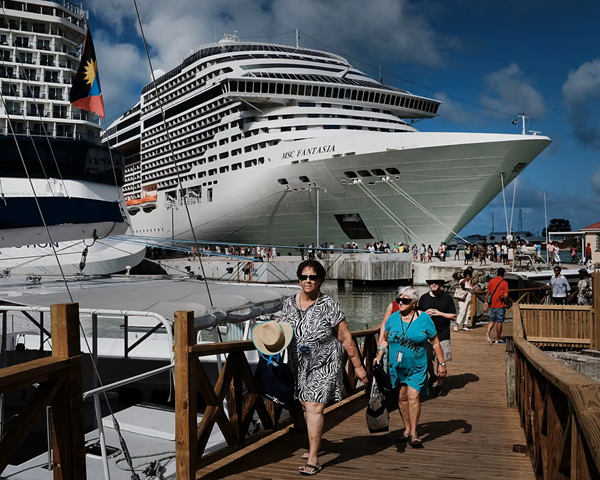
Hoteliers were wooed with the prospect of generous tax breaks, while large cruise lines have been able to negotiate extremely low port charges because if a government tries to charge them more, they can just weigh anchor and dock elsewhere. Segregated inside all-inclusive resorts, tourists often have little interaction with the local economy. [. . .]
Like the plantations before it, tourism also wreaks havoc on local ecosystems. In one day, a typical cruise ship produces 21,000 gallons of sewage, a tonne of rubbish, 170,000 gallons of wastewater, more than 25 pounds of batteries, fluorescent lights and other chemical and medical waste, and up to 6,400 gallons of oily bilge-water from its engines. Meanwhile, on land, hotels guzzle water and pollute additional supplies, something the water-distressed countries of the region can ill afford, and also consume huge amounts of energy. “Their lights are on all night, they’re burning energy 24/7,” says Rodney Grant, a Barbados government adviser. “Governments alone can’t carry the burden of the social and environmental fallout.”
So why, despite these costs, is tourism so prevalent in the region? “This is the only industry, at least in the current configuration of the global economy, that can generate significant foreign exchange earnings for small Caribbean countries,” notes Matthew Bishop from the University of Sheffield, whose research looks at the political economy of development in the region. In the 1970s and 1980s, some newly independent Caribbean countries experimented with more socialist development models and government ownership of key industries. These were abandoned or violently overthrown under pressure from the US, which even briefly invaded socialist Grenada in 1983. With the only available pathway one of attracting foreign investment to transition away from sugar agriculture, tourism emerged for the Caribbean as the “last resort”. [. . .]
[Fiona Compton] has created the Caribbean Green Book as a resource for travellers looking for locally owned businesses. [. . .]
For full article, see https://www.theguardian.com/news/2025/dec/12/rebranded-plantations-how-empire-shaped-luxury-caribbean-tourism
Also see more on the author at https://www.common-wealth.org/author/eleanor-shearer
[Photo above by Spencer Platt/Getty Images: Tourists disembark from a cruise ship in St John’s, Antigua.]
Eleanor Shearer, Senior Research Fellow at Common Wealth, is the author of River Sing Me Home (Headline, 2023), a historical novel. In “’Rebranded Plantation,’…” she writes about how the British colonial wealth extraction system still influences the region’s tourist industry. Herer are excerpts; for the full article, see The Guardian. [Many thanks to Peter Jordens for bringing this