
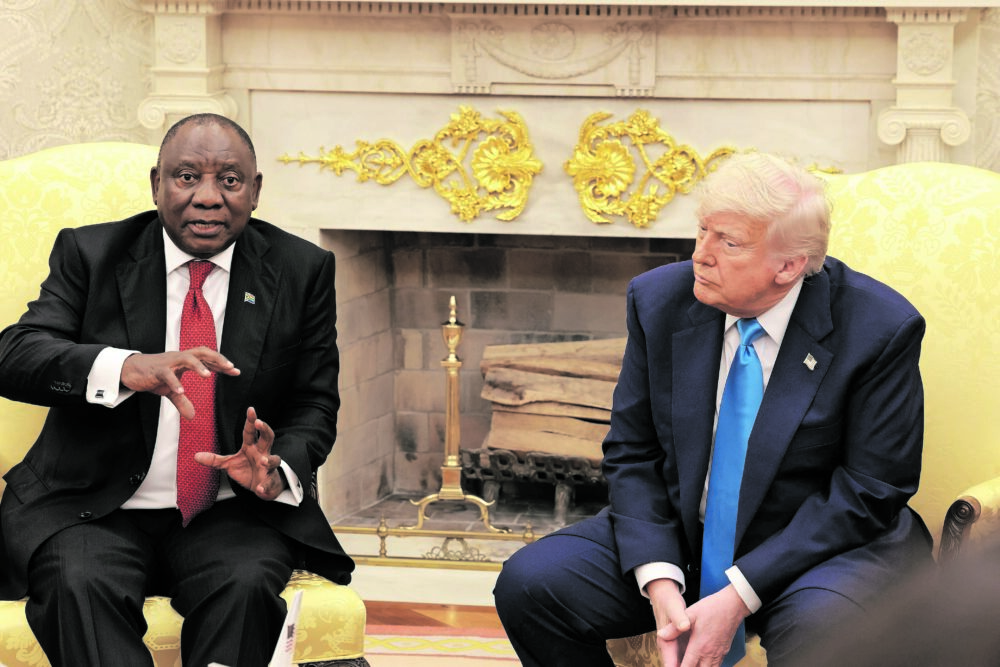
President Cyril Ramaphosa left Washington this week with a commitment to further trade talks with the US — the reward for enduring an Oval Office ambush in which President Donald Trump accused him of enabling ethnic mass murder.
“There will continue to be engagement between South Africa and United States officials, particularly at the trade and industry level, to deal with the package of issues that we had tabled that had to do with trade and investment,” a visibly tired Ramaphosa said after two hours of talks with Trump.
“So, I was rather pleased that there is a firm agreement and undertaking that we are going to continue engaging. So there is no disengagement. For us, that was one of the key outcomes that we had wanted.”
A member of the delegation to Washington told the Mail & Guardian that South African officials would meet representatives of the office of trade representative Jamie Greer in Washington on Friday to discuss the trade proposals prepared by a ministerial team over the past two months.
“It is significant because it is an immediate continuation of the engagement at the White House.
“There will be a further exchange of information and we hope that it will mark the formalisation of a process that will, over a number of months, lead to an agreement that resets trade relations.”
He added that the Trump administration had expressed a keen interest in access to rare minerals — it already imports significant quantities of platinum group minerals — and had asked for further details as to what “South Africa wants out of the deal from our side”.
“Obviously we will engage on the goods that we currently export to the United States, including agricultural produce, and seek to expand trade but we want to do so in a manner that entrenches mutual interest.”
Tariffs were on the table from the outset during this week’s visit to Washington, although Trump showed little interest in the fine print of trade relations during his joint briefing with Ramaphosa, preferring to assail him with mock evidence of genocide of Afrikaner farmers.
Trade and Industry Minister Parks Tau confirmed that South Africa was angling for future preferential access to the US market and added that officials were advised to take this up in the context of the current deliberations in the US Congress on the future of the African Growth and Opportunity Act (Agoa).
The decades-old trade agreement, which benefits 32 sub-Saharan African countries, is due to expire in September.
It has long been uncertain that South Africa would retain membership, if the pact were extended.
But the country lost trade-free access months before that question could be settled when, in April, Trump announced punitive 30 percent tariffs on imports from South Africa and a host of nations he said “treat us badly”.
In a swift about-turn, he then suspended the reciprocal tariffs and instead applied a 10% base tariff across the board for 90 days to allow for negotiations.
Since roughly a quarter of South Africa’s almost $14 billion worth of exports to the US went through Agoa in 2023, initiating negotiations on a reprieve was near the top of Ramaphosa’s agenda.
“The feedback we received in our negotiations on Monday with regard to Agoa was that this is a matter that is currently in Congress, so it would be important for us to follow up in Congress with regards to the reauthorisation of Agoa,” Tau told reporters.

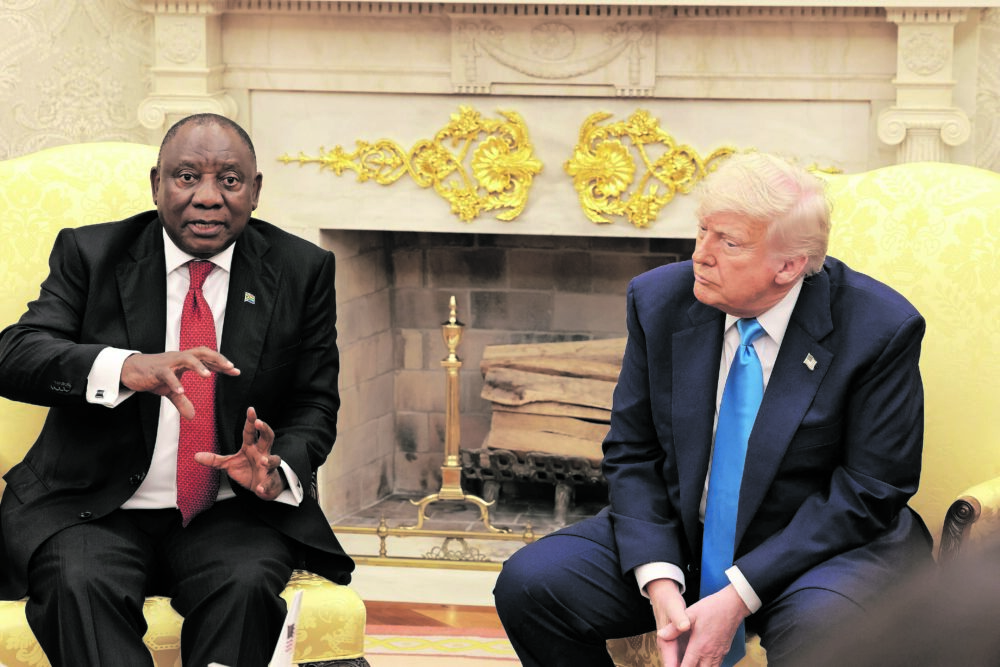
Although Trump is famously sceptical of trading blocs, the minister said US officials have encouraged a collective approach to negotiations with Southern Africa on the way forward with Agoa and sought elaboration on tariff accords in the regional customs union.
“The US has also indicated that they will be convening a US-Africa forum at which we intend to present in detail our proposition on Agoa … we have it in our docket that the reauthorisation of Agoa is important.”
Ramaphosa responded to Trump’s genocide accusations with pleas for investment, suggesting that, along with technological co-operation on crime-fighting, it would go some way towards lowering levels of violence in South Africa.
He stressed, with the help of Richemont chairperson Johann Rupert, who was part of the delegation, that while crime was a scourge, it affected all race groups.
Crucially, he remained calm and measured while trying to refute Trump’s claim: “You’re taking people’s land away and, in many cases, those people are being executed.”
Ramaphosa had been braced for spectacle — possibly humiliation — and what transpired was plainly choreographed.
Trump ordered the lights in the Oval Office dimmed before an aide play footage of Economic Freedom Fighters leader Julius Malema chanting the anti-apartheid slogan “kill the boer, kill the farmer” at several rallies, speaking about “cutting the throat of whiteness”, saying “revolutionaries should never be afraid to kill” and stating that his party would occupy land and didn’t need the consent of the president to do so.
Ever obsessed with crowd sizes, Trump remarked that up to a 100 000 people came to listen to Malema, before pointing to imagery of white crosses he described as a burial field where Afrikaners gathered weekly to mourn murdered family members.
Ramaphosa asked where the area was. “I have never seen it,” he said. “It’s in South Africa,” said Trump.
US Vice-President JD Vance then handed Trump a bundle of pages said to be articles on farm murders.
Trump leafed through it, saying “Death, death, death,” and complained that the “fake news” in the US didn’t want to talk about such.
Responded Ramaphosa: “I would like us to talk about it very calmly, to sit down around a table and talk about it, including trade matters.”
The US was a trade partner, continued Ramaphosa, “and these are things we are willing to talk about”.
Trump invited Rupert to comment. The tycoon has been on standby for months to help normalise relations after the US president declared diplomatic war on South Africa in February and he landed points without wasting words.
He began by saying he was “the biggest target of that rabble-rouser [Malema] for over 10 years”.
“We have too many deaths,” Rupert continued, “and it’s not only white farmers, it’s across the board.”
He added that violent crime was most rampant in the Cape Flats area of the Western Cape, which is under the political control of the Democratic Alliance (DA), headed by the agriculture minister John Steenhuisen, who was part of the delegation.
“We need technological help. We need Starlink at every little police station. We need drones,” Rupert said, adding that if the South African economy did not grow, the country’s “culture of lawlessness and dependency” would increase.
“We need your help, sir, and we need Elon’s technology,” Rupert added, referring to Starlink, X and SpaceX owner Elon Musk, who has spearheaded Trump’s propaganda on South Africa and was in the room.
Steenhuisen told Trump most farmers wanted to remain in South Africa and expanded on Ramaphosa’s assurances that Malema’s views were a world away from government policy.
“The reason my party, the DA, chose to join hands with Mr Ramaphosa’s party was precisely to keep those people out of power,” he said.
“We cannot have those people sitting in the union buildings making decisions. That is why, after 30 years of us exchanging barbs [with the ANC] across the floor, we have decided to join hands — precisely to keep that lot out.
“Because, the day they get control of the Union Buildings or parliament, that is what you are going to see.”
Also in the room were South African golfers Ernie Els and Retief Goosen, in an awkward diplomatic nod to Trump’s passion for golf.
Both let the side down with complaints about conditions in their country of birth.
Els bizarrely thanked the US for the apartheid regime’s war in Angola.
Speaking to the media afterwards, Ramaphosa conceded they could have been better briefed. He downplayed the drama in the Oval Office and said he believed there is “doubt and disbelief” in Trump’s mind about the narrative of racial persecution.
“In the discussions over lunch, we did not dwell on that issue, it having been dealt with more thoroughly during the engagement in the Oval Office,” he said.
Members of the delegation said there was a marked shift in tone when the two leaders sat down to a meal of chicken breast with asparagus, before returning to the Oval Office to continue talks.
“The political theatre fell away and there was a much more cordial atmosphere. You do not spend two hours talking to someone, and even appear to enjoy their company, if you truly regard them as a genocidal leader,” one told the M&G.
“So, we think we have managed to break the ice and the visit was a success in that regard.”
Ramaphosa’s spokesperson Vincent Magwenya said the conversation again turned to South Africa’s presidency of the G20, which the Trump administration has disparaged.
It has snubbed key meetings of the forum, which it will lead next year, and Ramaphosa stressed on Wednesday he wanted to pass the baton to Trump in person.
“We are optimistic that President Trump will accept the invitation to attend the G20 leaders’ summit,” he told the M&G.
But he secured tentative trade talks as negotiations with officials on a pact between South Africa and the US were set to continue