Natricia Duncan andAnthony Lugg (The Guardian)report on a recent court victory in Jamaica: “A temporary injunction in the coastline battle for beaches to be publicly accessible, not sealed off for private developments, is just a step in fighting what islanders call a tourism model that disadvantages Jamaicans.” [Note: Eva Buzo, the Australian human rights lawyer who completed a 34-kilometer protest swim in Montego Bay, recently performed the same feat in Puerto Rico for the same cause!] Read full article, with photographs by Ina Sotirova, in The Guardian.
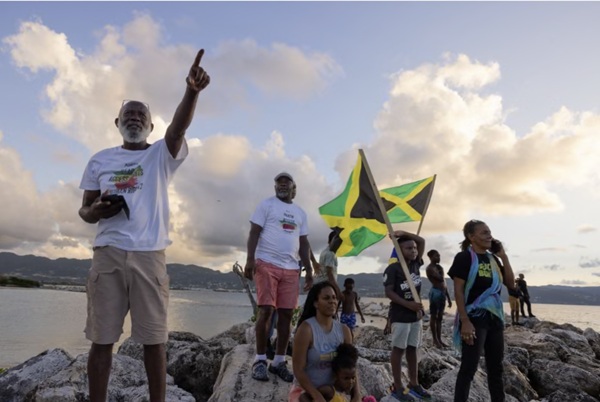
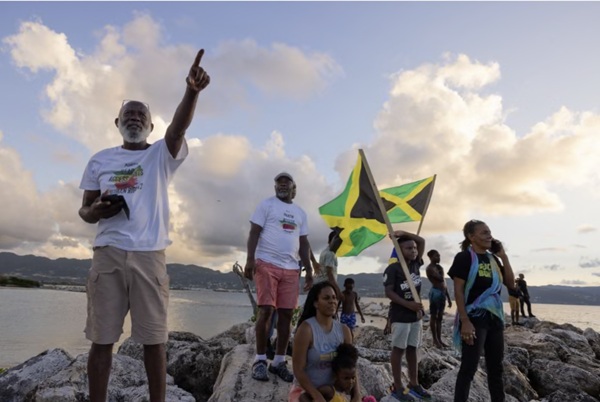
When the Australian human rights lawyer Eva Buzo emerged from the sea on to the shores of One Man Beach in Montego Bay on Sunday after her gruelling, nearly 11-hour-long swim, the thunderous pulse of welcome drums was drowned out by the chants of “free beach” from jubilant supporters.
Here in Jamaica’s tourism capital, against a backdrop of jagged mountains and sunset-tinted clouds, Buzo – a celebrated marathon swimmer – said she was pleased to help support the important work of the Jamaica Beach Birthright Environmental Movement (Jabbem) and others fighting for free public access to Jamaica’s beaches.
“People’s rights are more important these days than ever, and people keep on trying to encroach on our fundamental freedoms,” she said, calling the privatisation of beaches a colonial legacy. But for Jabbem, her swim was not the most significant milestone this month in its fight for public access.
That came earlier in October, when Jabbem celebrated a rare victory in one of several court cases to end the 1956 Beach Control Act that had given the state ownership of the island’s foreshore and seabed. The act has allowed successive administrations to restrict access to beaches and sell off coastlines to wealthy luxury hoteliers.
In October, however, the court issued an injunction preventing the government from continuing to restrict access to Little Dunn’s River in St Ann while the case continues.
“This victory means a lot for the Jamaican people. It means that our case is strong,” said Dr Devon Taylor, an immunologist with a PhD in biochemistry, who founded Jabbem in 2020. [. . .]
Paul Roberts, a British architect living in Jamaica and Jabbem’s St Ann community coordinator, argued that the government is creating a false impression that Jamaicans cannot be trusted. “It’s a load of rubbish,” he said. “I’ve been coming here for 15 years now and I’ve never had any trouble. I’ve never been robbed, I’ve never been mugged and I’ve never faced any issues.”
Campaigners did not oppose hotels, Taylor said, but rather a “plantation tourism” model that disadvantaged Jamaicans.
“Cheap labour of the Jamaican people, degradation of the environment, exclusion of the Jamaican people from the foreshore, plantation tourism, untenable working conditions. Lock us out using colonial-era law. The industry is guilty of that,” he said.
“We the people do not want to be treated as second-class citizens in our country … we want fairness, equality and equity.” [. . .]
For full article, see https://www.theguardian.com/world/2026/oct/31/jamaicans-beach-access-fight-court-victory-hope
[Photo above by Ina Sotirova.]
Natricia Duncan andAnthony Lugg (The Guardian)report on a recent court victory in Jamaica: “A temporary injunction in the coastline battle for beaches to be publicly accessible, not sealed off for private developments, is just a step in fighting what islanders call a tourism model that disadvantages Jamaicans.” [Note: Eva Buzo, the Australian human rights lawyer