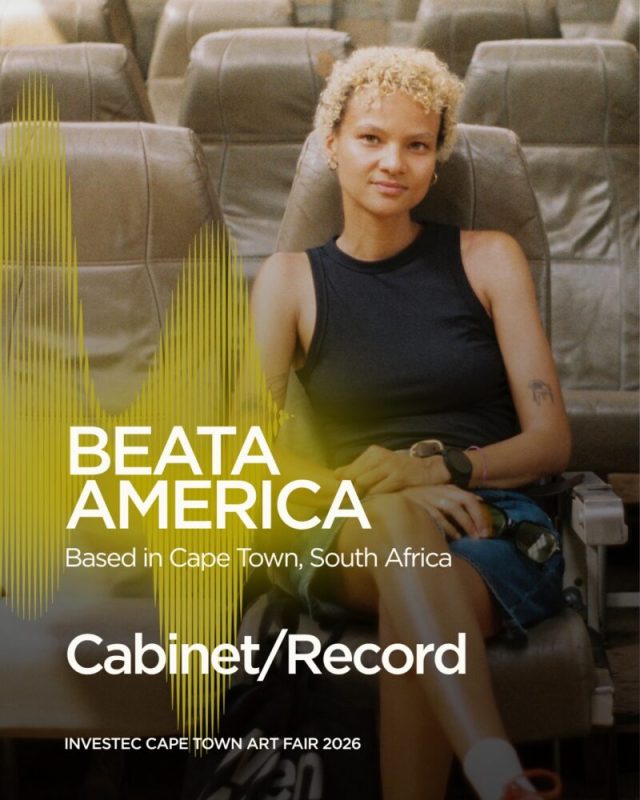
Photography is doing more than documenting at this year’s Investec Cape Town Art Fair. It’s listening. Through her curated Cabinet section, Record, curator Beata America approaches the camera not as a silent observer but as a sensory instrument capable of holding memory, vibration and emotional residue.
For America, who is based in Cape Town and works as an assistant curator at Zeitz MOCAA, the project is personal. Long before she entered the visual arts, she was classically trained in music, studying piano and guitar after years of early musical immersion. That background quietly underpins her response to the fair’s broader theme, Listen.
Rather than taking the brief literally, America leans into metaphor. Photography, in her framing, becomes a record in both senses of the word, a sonic reference and an archival device. The Cabinet format becomes part of the conceptual architecture. Cabinets, she notes, are inherently nostalgic objects, domestic spaces designed to hold what matters. Photographs perform a similar function, preserving fragments of time while inviting viewers to actively interpret what they see and, crucially, what they might hear beneath the surface.

This conceptual elasticity shapes Record. The exhibition does not attempt to produce sound in a literal way; instead, it explores listening as an idiomatic and sensory experience. Phrases like “the sound of resistance” or “the sound of silence” hover in the background of the show’s logic, guiding viewers toward a more associative mode of looking.
America’s selection process reflects both rigorous research and an organic responsiveness to artistic practice across the continent. South Africa’s rich photographic tradition forms one anchor but the section deliberately widens its geographic reach. Among the participating spaces is Everyday Lusaka, the Zambian gallery founded by Sana Jinwala, marking its first appearance at the fair and extending the exhibition’s continental dialogue.
Within the works themselves, subtle generational conversations emerge. Veteran photographer Daniel Morolong, born in 1928 and also once a jazz double bassist with the African Quavers, later the Havana Swingsters, appears alongside younger contemporary voices. The resonance is neither forced nor nostalgic for its own sake; instead, it reveals how artistic preoccupations echo across time.
Material experimentation further expands the field. The gallery, Art Harare, injects performative energy into the section through an interactive passport project. Fairgoers will be photographed on site, their identity images inserted into specially designed “art world passports” and displayed within the space, a gesture that transforms spectators into participants and temporarily folds the public into the archive.
In the frenetic environment of an art fair, where attention is constantly pulled in multiple directions, America is intentionally creating moments of pause. The goal is not spectacle but attunement, encouraging viewers to linger, to notice and perhaps to reconsider what it means to truly listen to an image.
If Record succeeds, it will do so quietly. Not by amplifying noise but by sharpening perception, reminding audiences that photography has always been, in its own way, a deeply acoustic medium.
Beata America transforms photography into a medium of listening and memory in her Cabinet section, Record, at the Investec Cape Town Art Fair