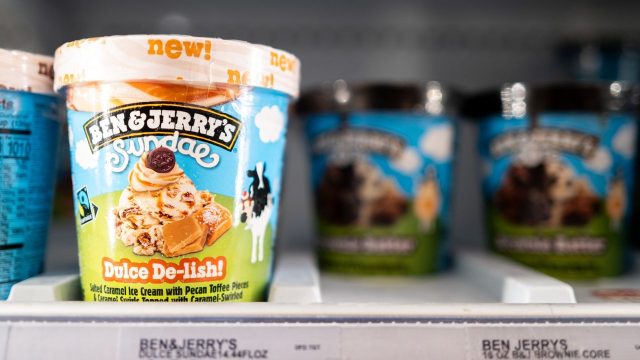
Investors are cooling on Ben & Jerry’s as the founders continue to be caught up in a spat with the ice cream brand’s owners.
The Magnum Ice Cream Company, which owns Ben & Jerry’s as well as Cornetto and Wall’s, completed a spin-off from parent firm Unilever this week and began trading on the European stock market as a standalone business, but its initial valuation was “significantly lower” than expected, said The Times.
Unilever, and now Magnum, have been embroiled in a “war of words” with Ben Cohen and Jerry Greenfield, the founders of Ben & Jerry’s. The pair have accused both companies of silencing the brand’s “social mission”, after they were told by Magnum boss Peter ter Kulve that they should “hand over to a new generation”.
‘Tug of war’ over activism
Magnum has inherited a “long-running legal spat” about the “powers to define the company’s direction”, which has threatened to “overshadow the demerger” this week, said consumer industries reporter Madeleine Speed in the Financial Times. Since the company was acquired by Unilever in 2000 for $326 million, Cohen and Greenfield have become “increasingly vocal about their dissatisfaction with the direction of the brand”.
The long “series of rows” has been an ever-present “tug of war” between the two companies, said business reporter James Sillars in Sky News. Unilever has responded by trying to remove the chair of Ben & Jerry’s independent board, stating that she “no longer meets the criteria”.
Unilever has suggested that Ben & Jerry’s history of pro-Gaza activism “risks derailing” the success of the demerger, said senior business reporter Tom Haynes in The Telegraph. Back in 2021, “tensions flared” between the two companies as the ice cream brand announced it would halt sales in “occupied Palestinian territory”, followed by a lawsuit when Unilever sold the distribution rights in Israel and the West Bank to a “local licensee”. This was resolved out of court.
In November 2024, Ben & Jerry’s claimed that Unilever had “tried to silence” elements of its social mission in the Middle East, said Haynes. The “damage” continues to this day. In a prospectus for investors seen by The Telegraph, Unilever said the political views of Ben & Jerry’s founders could “adversely impact the Group’s reputation, business, financial condition, and results of operations”.
‘Corporate activism is melting’
When Greenfield quit Ben & Jerry’s in September, after more than 50 years with the company, it was the latest “casualty” of a “broader reckoning” going on in Donald Trump’s second term, said David Kaufman in Monocle. Corporate activism, particularly on the left, is “melting”.
The administration’s promotion of “anti-diversity, America-first mindset” is at odds with the “feel-good, save-the-world, ‘kumbaya’ philosophy” that has fuelled Ben & Jerry’s marketing. When Unilever bought the brand, the co-founders said the company “not only understood their social-mindedness but guaranteed that it could continue without interference”. In a public letter explaining his resignation from Ben & Jerry’s in September, Greenfield said he could not “in good conscience” work for a company that had been “silenced” by Unilever.
Cohen, who is still involved with the company, is “in the middle of a bitter feud” with Unilever, said The Times’ chief business correspondent William Turvill. Cohen claims the founders have been “muzzled” by attempts to “disempower” the board by discussing removing Anuradha Mittal as chair of the independent board.
However, “Unilever believes it has acted reasonably”. The company said they would allow calls for a ceasefire in Gaza in late 2023, only if Ben & Jerry’s “also condemned Hamas terrorism and called for the release of hostages taken in October of that year”. And Unilever is hardly “the only big company that shies away from antagonising the White House”.
But Cohen “shows no sign of shrinking away” either, said Turvill. He will “continue to speak out” and at upcoming conferences, will “take Unilever and Magnum to task on European soil”.
After a landmark demerger by Unilever, spinning off their ice cream brands, a war of words over activism threatens to ‘overshadow’ the deal