
My university introduction to the art world positioned the city as the heart of art, although now, the landscape faces strange and disheartening shifts.
In less than a year, the industry has witnessed the closure of a few prominent Johannesburg galleries including Guns & Rain, STEVENSON and Kalashnikovv and the censorship of Gabrielle Goliath’s representation for the South African pavilion at the 61st Venice Biennale by Minister of Sport, Arts and Culture Gayton McKenzie.
The case of the minister pulling funds is synonymous with other long-standing events of significance such as the National Arts Festival, Klein Karoo National Arts Festival, Joy of Jazz and Open Book Festival.
What happens when we decentralise city art institutions and our dependency on them?
In April I saw an invitation to the group exhibition Experiment. Introduce. Enjoy by artist manager and consultant Togo Langa. The concept aimed to explore an art exhibition space and the idea of process and experimentation.
A line that caught my attention: “How does one continue doing what works without being held captive to the point of stagnation?”
Since there are minimal spaces that give ground for experimentation, most of what we engage with is the final product, leaving us caught in a conundrum of perfection. The invitation had the courage to denounce perfection and welcome play and the unknown into the process of making and engaging with art.
A bit hesitant about an almost three-hour drive from the city to the location given in the form of GPS coordinates, I pondered on the trip for a week until a friend mentioned she got her ticket.
We finalised our arrangements and on a Saturday morning, we were on the N4 highway to North West. The break from the city’s compact landscape was occupied with roadworks and vast mountain outlines of blue hues on the horizon. The sight of bright sunflower fields gave assurance that I made the right decision.
After getting a little lost, we reached our destination at the home of “Kwa Langa” and were welcomed by Langa and his niece. As we entered, a huge candelabra tree, indigenous to most parts of southern Africa stood, as a monument.
The tree was accompanied by Mankebe Seakgoe’s work, When the Sky Opened up and Swallowed us Whole (2023), erupting with strokes of blue and black tones, mimicking the dance of white clouds in the background.
This was one of four, where two-dimensional works were hung on purpose-built white walls at different points on the property, along with three-dimensional works.
The group exhibition consisted of indoor and outdoor installations but I wish to draw focus to the outside space. I’ve experienced a sculpture park before but this was different, an eccentric experience — an experiment. My museum background leapt to the fore at the absence of a temperature-controlled climate and a fluctuating harmony of the hot sun and gentle breeze.
Footsteps or a cough echoing in silence were replaced by the sound of a cow bell in the distance, laughter and a literal breath of fresh air.
I observed how the environment threw the concept of the white cube out the window, dissolving walls, leaving the eye to wonder, to consider spatial awareness and the influence it has on the reading of the works.
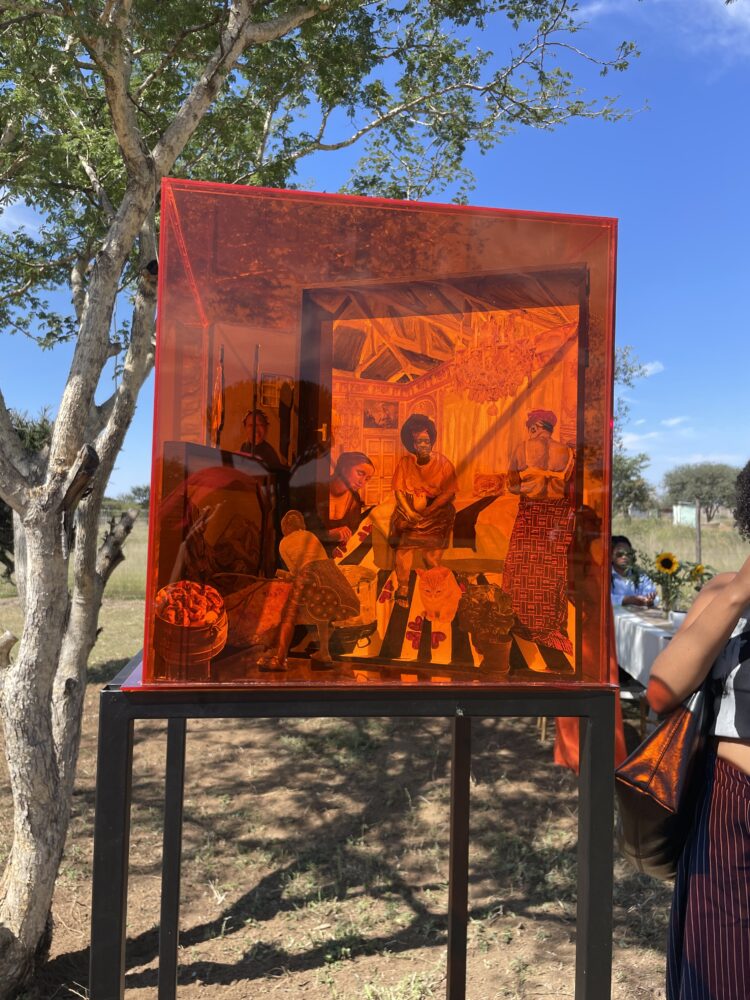
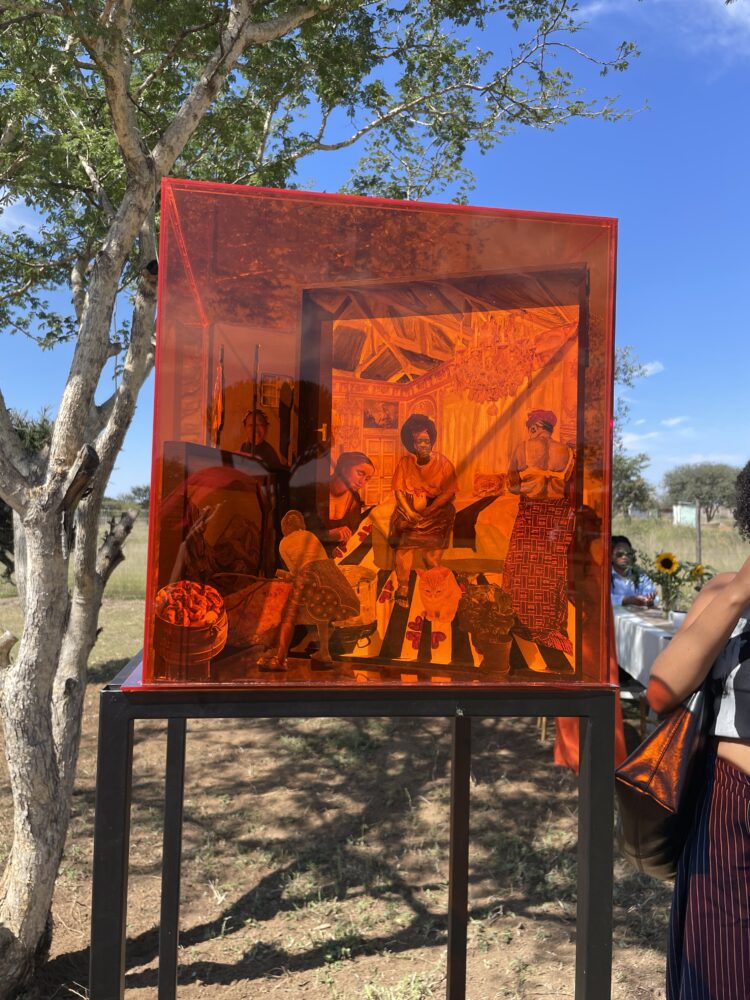
The outdoor exhibition drew us to a beaming orange cube on a metal stand, filled with an arrangement of collage compositions. Ke teng (2026), which loosely translates to “I’m here”, by Keabetswe Seema, is an artwork I would describe as sculptural. Shadows enhanced its geometric characteristics.


Seema’s practice has evolved in an exploratory manner since my first encounter with her work in 2023, at the School of Arts graduation exhibition at the University of Pretoria.
Seema’s compositions include the use of paper cut-outs and paint as a means to achieve a built environment seen through the three-dimensional object.
The orange Perspex puts a tint to the viewer’s perspective of the figures, while a small circular cut-out gives a glimpse of the work without the orange tint. The composition encourages an intimate observation of female figures in domestic spaces of work and leisure. Juxtapositions of different environments open conversation to intricacies in relation to the presence of black women in history and culture.
Seema’s placement of her likeness alongside other subjects in her work is a visual and conceptual demonstration of how she remains in conversation with her own work.
Caught in the novelty of the exhibition environment, we shared a table with others where we chatted about the ways in which the environment affected our reading of the works. Apart from a delay in the programme’s schedule, I appreciated the setting’s influence on our interactions, creating a sense of community with strangers.
We shared a wholesome meal cooked on an open fire in the distance. I could taste a trace of earth and smoky flavours — a nostalgic taste, reminiscent of the food my grandma used to cook over the fire when I was young.
The session concluded with a live ceramic firing by Rebaone Finger, an artist who’s interested in the discourse of food as a naming culture in the black South African context.
Her ceramic works are notable for the ubiquity of chicken feet, a delicacy in some cultures.
The work also addresses socio-economic matters associated with certain kinds of food that are economically feasible though not always viewed as desirable. This time she didn’t have one of her elaborate ceramic works, instead she placed small clay chicken feet moulds on coals accumulated from the day’s kitchen and added more sticks to ignite the fire from the coals.
This form of firing was the first experience for the artist, an experiment. We shared our table with Finger earlier, where she disclosed some of the challenges she encounters in the process of making: from the amount of time it takes to mould clay into a final piece to how her work has a tendency of fighting the kiln because of its form — thicker clay usually explodes at high temperatures.
Wondering if we would encounter an explosion here, I joined the rest of the guests as they stood around the fire, as though gathering for a folktale. The artist spoke of her work and as the fire settled, fired-clay chicken feet emerged from the ashes.
The orientation of the experiment could not have happened in an institution’s setting — an open flame is against health and safety policy.
Art institutions have rules that uphold the institution along with its building. At times one would think the rules are “intentionally” set to make a producer and curator’s life difficult as the policies mostly protect the building rather than create ground for an artwork to be seen at its fruition.
This is probably because museums and art institutions in the Southern Hemisphere borrow from Western traditions of care and display that uphold a certain standard of presentation and preservation.
The “standards” ultimately become points of contention that disadvantage the South when it comes to repatriation conversations. Yes, cold temperatures and adequate facilities help preserve art and history, however, a question that arises is: Were the objects made to last?
What if the long-standing aspect should be the way of life instead of the object/artwork? If the tradition of making is consciously carried through generations, then art is not really lost, is it? Of course, I’m aware that time, politics and the environment influence our interests, however, there is room for old traditions to carry on, such as firing ceramic works without a kiln.
Great artists such as Noria Mabasa, Helen Sibidi and Rebecca Mathibe fire their ceramic pieces without a kiln — a technique passed down from those before them.
I suppose it boils down to our environment and what we are exposed to — if we are exposed to institutions that only cater for Western forms of art, we will live within those confines. Though if we step outside, what we create would be governed by new limitations.
At times like this, when the state pulls funding, does the private sector intervene or does it remain in the shadows leaving practitioners to fend for themselves with resources and skills they have acquired?
Or has the fatigue of sending through the umpteenth funding application got a hold of us? Can we be hopeful enough to play, experiment and dream up new ways of making and displaying art? While creating spaces for ourselves, it is important to not repeat traits of the structures we aim to break from.
Other artists in the exhibition included Tatenda Chidora, Njabulo Hlope, Oratile Papi Konopi, Wisani Manyisi, Mlungisi Mlungwana, Nkensani Rihlampfu and Tshepo Phokojoe.
A group exhibition in North West challenged institutional norms, inviting artists and audiences to rethink experimentation, community and artistic freedom