
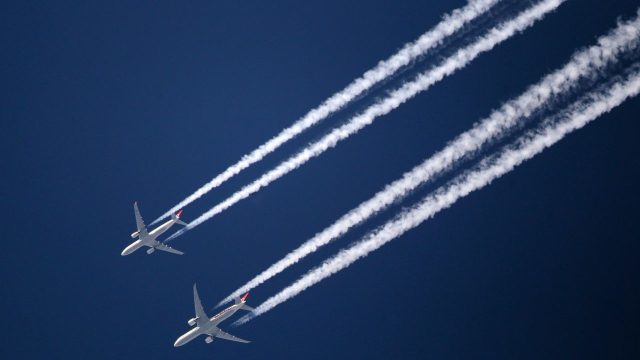
The sight of a white cloud-like trail streaming behind a plane “set against a bright blue sky creates a romantic image of aviation”, said Aerospace Global News. But their existence “also represents the darker side of flying”.
These innocuous-looking trails “are one of the most urgent yet solvable climate challenges facing aviation today”, said Google, which is taking part in a £5 million trial known as Operation Blue Skies headed by the UK government. Together, they are looking to explore whether tweaking flight paths could address this problem.
Heat trappers
The streams are known as “condensation trails”, or “contrails”, said Google, which is partnering with the government, the Met Office, air traffic control provider NATS and researchers from the University of Cambridge and Imperial College London.
These trails form when aircraft engine emissions encounter extremely cold air found at high altitudes, causing tiny ice particles to develop. They often fade soon after they appear, but very cold and moist atmospheric conditions can allow them to linger and spread. Over time, they may contribute to cloud formation that traps heat that would otherwise radiate away from the Earth.
Contrails are sometimes known as “vapour trails” but they’re different to so-called “chemtrails”, which conspiracy theorists claim are secret chemical or biological agents being sprayed on purpose for weather and population control, or geoengineering projects.
Trails ‘persisted and widened’
In 2019, around 40 million scheduled passenger flights took place, adding up to around 38 billion miles of travel, said The Economist. And more than 40% of these flights left contrails behind them for at least part of the journey. Many were “ephemeral”, but in more than 5% of the total distance flown – “comfortably enough for 10 round-trips a day to the Moon” – they “persisted and widened”, becoming cirrus clouds. “In doing so they warm the planet.”
Operation Blue Skies is based on a theory that if scientists, using artificial intelligence, can predict the areas of the atmosphere where contrails are likely to form, jets would be able to avoid them.
The trial will focus on the Shanwick airspace in the eastern half of the North Atlantic corridor, which accounts for around 5% of global contrail warming. Using satellite images and flight data to identify where planes have previously produced contrails, and combining these with weather patterns, Google will forecast where the conditions for new contrails are most likely to occur. Air traffic controllers will then direct pilots to avoid those areas.
But far from “dramatically changing” the route of a flight, the aircrafts’ altitude will only change by around 2,000ft. This is the same sort of re-route that occurs already to “avoid turbulence and bad weather” so passengers are “unlikely to notice”, said the BBC.
The data centre question
Testing will take place during evenings and nights in the winters of 2026-27 and 2027-28, when the volume of air traffic is lower. Approximately 10,000 flights are expected to pass through the airspace during the trial periods.
Changing the altitude of an aircraft “can mean it burns more fuel”, which raises the “obvious question” of whether avoiding contrails “simply” creates additional carbon emissions elsewhere. Paul Hodgson, Google’s technical lead for the operation, said the “CO2 penalty is in the order of less than 1%” and that is outweighed by the climate benefit of preventing a warming contrail.
Questions have been raised over Google’s involvement in the project. It is “one of many big tech companies spending billions on new data centres – the giant, power-hungry banks which power AI” and have serious implications for climate change.
Landmark government-led trial hopes to slash the aviation sector’s impact on global warming