
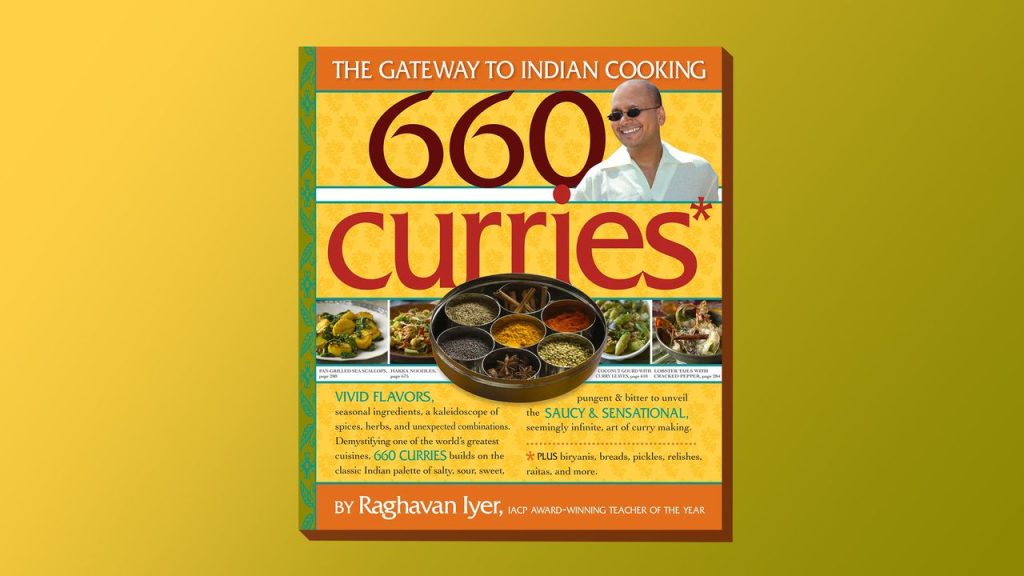
Most standard-size cookbooks showcase between 100 and 150 recipes. In 2008, the author and cooking teacher Raghavan Iyer said “pshaw” and published his magnum opus, “660 Curries.”
“To us Indians, a curry is a sauce-based dish,” wrote Iyer, meaning “curry” as employed in Western instances like all-purpose “curry powder” is a term so general as to lose all significance. Curry instead is both the alpha and the omega: It is both a saucy dish across the subcontinent and a hyper-regional way of preparing said saucy dishes.
Name your cooking weapon
Pick a base, and you are nearly guaranteed at least one recipe for it in “660 Curries.” More often, you will be bombarded with an array of options.
Consider the legume. Yellow split peas, horse gram, chickpeas, brown lentils, moth beans — Iyer assembles an armada of more than 15 different types of legumes for the Legume Curries chapter. The hits are present, including a faultless recipe for that restaurant icon, dal makhani, its whole black lentils opulent with Punjabi garam masala and both yogurt and heavy cream.
A behemoth is forever going to do the absolute most, so, less-known regional specialties are everywhere across the book. Toovar dal (split yellow split peas) are softened into a bath of unripe green mango, green bell pepper and coconut milk, a dish from the southwestern state of Kerala. Stressing the omnipresent influence of the Portuguese colonizers, chorizo cooks with red kidney beans and black-eyed peas in a spunky chile-vinegar tomato sauce, a Goan adaptation of Brazilian feijoada. Here and in the book’s other chapters on vegetables, seafood, poultry and eggs, meat and paneer, curry is no catch-all. It slips, it shifts, it adapts.
To the curry-sphere and beyond!
Iyer cheated a touch with the book’s name because a number of chapters exist afield from sauce-world. The opening chapter, Spice Blends and Paste, provides a constellation of building blocks, endless masalas with seven types of garam masala alone.
The final chapter, Curry Cohorts, dabbles in a touch of everything: rice preparations, including a Maharashtrian-style fried rice with peanuts and curry leaves; all manner of breads, such as poori, roti and naan; even a mango cheesecake and saffron-licked green tea. “660 Curries” is an imposing endeavor. And, oh, how the book’s recipes work.
Iyer died, too young, at 61 in 2023. He was an admired teacher and an indefatigable researcher. “660 Curries,” almost 20 years later, remains as essential as it was when it first appeared. Scratch that. “660 Curries” is all the more pertinent now. The world needed time to embrace its sweeping, detailed grandeur.
A mammoth book tries to capture the breadth of Indian cooking