
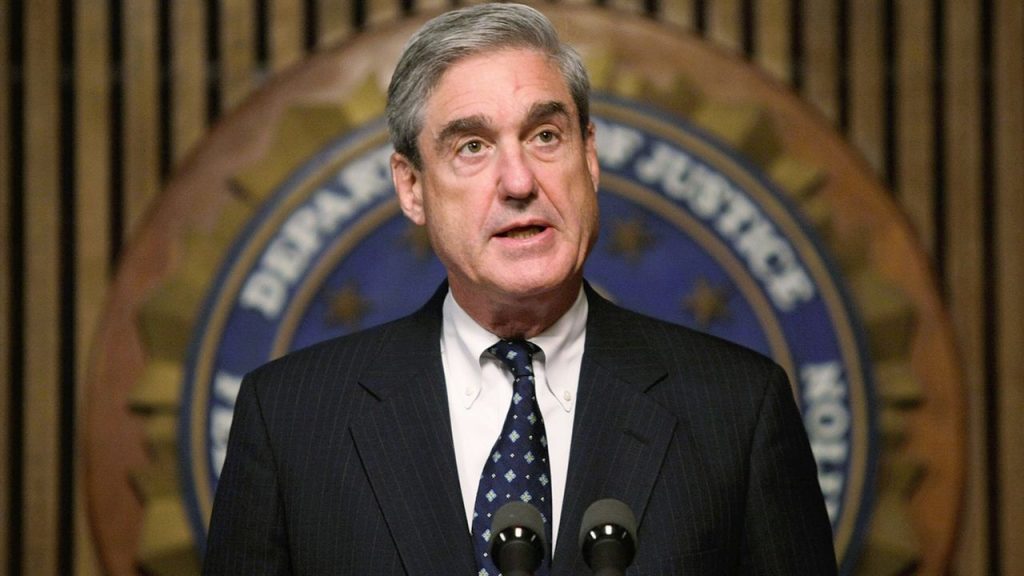
Robert Mueller began his term as FBI director on Sept. 4, 2001, just a week before the 9/11 terrorist attacks that refocused the agency’s mission. A decorated Vietnam veteran who’d spent years prosecuting major cases as a U.S. attorney—and earned a reputation as a by-the-book lawman of the highest integrity— Mueller knew right away that the bureau faced a new era. Over a 12-year term under Republican and Democratic presidents, he expanded its focus from domestic crime to thwarting terrorism. Four years after that term ended, Mueller became a household name as the special counsel investigating ties between President Trump’s 2016 campaign and Russia.
Issued in 2019, the resulting Mueller Report found numerous links between Trump’s team and Russia but stopped short of declaring a criminal conspiracy. Trump said the report was the work of “Trump haters.” But pursuing justice was Mueller’s “only lifetime motivation,” said biographer Garrett M. Graff in 2017. He “might just be America’s straightest arrow.”
Raised in a “stately manor” outside Philadelphia, Mueller was “born into privilege,” said The New York Times. He attended the “elite boarding school” St. Paul’s, where he captained the hockey and lacrosse teams, and then went to Princeton.
Upon graduating, he volunteered to join the Marines and led a rifle platoon in Vietnam, earning a Bronze Star and a Purple Heart. He then studied law at the University of Virginia and became a federal prosecutor. Stationed in San Francisco and then Boston, he “rose swiftly through the ranks,” and in 1990 headed the Justice Department’s criminal division, where he oversaw winning prosecutions of Panamanian dictator Manuel Noriega and mob boss John Gotti. Tapped by George W. Bush as FBI chief, he “built a reputation for nonpartisan rectitude and stonefaced reserve,” said The Washington Post. When the Bush administration proposed to extend a secret wiretapping program on U.S. citizens, he threatened to resign—and Bush backed down.
As special counsel in the Trump investigation, the tight-lipped Mueller maintained his “oldschool, buttoned-down style” as he led a probe that riveted the nation, said the Associated Press. In the end, he brought charges against six Trump associates, but his “nebulous” report—which left to Congress the question of whether Trump obstructed justice—“did not deliver the knockout punch” Democrats hoped for. Still, Mueller did explicitly refute the president’s claim that there was no substance to the Russia investigation. “Absolutely,” he said, “it was not a hoax.”
The respected FBI chief who investigated Trump