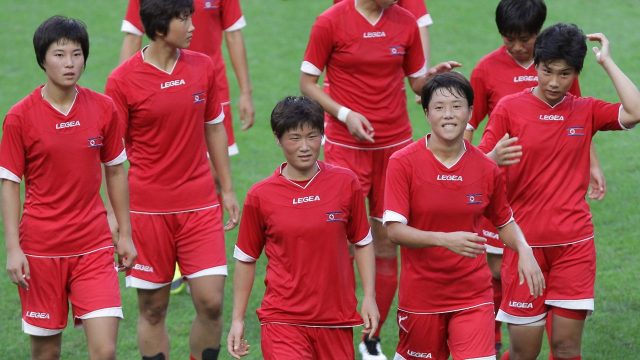
North Korea, one of the world’s most secretive and patriarchal countries, dominates in a surprising arena: women’s football.
The hermit kingdom became a powerhouse after the regime invested heavily in the women’s game as a tool of soft power and propaganda. The youth team still excels internationally, but after losing the Asian Cup final to Australia in 2010 the senior team “all but disappeared from global competition”, said The Guardian.
Now, the Eastern Azaleas are back in the tournament, playing their opening match against Uzbekistan in Sydney tomorrow. Invigorated by a “new generation of youth World Cup winners”, they are “hoping to return to the summit of Asian football”.
Rise and fall
At Fifa’s annual congress in 1986, the Norwegian delegate “demanded the creation of a World Cup for women”, said The Guardian. North Korean officials, so the story goes, were “inspired”. They returned to Pyongyang with a plan to use women’s football as a “tool to reassert their collapsing power on the world stage”.
Like China, the government saw sport as an opportunity to “strengthen their international profile”. Under Kim Jong Il, the women’s game “became a proxy platform” for North Korea’s political agenda. The government introduced development programmes in schools, built new facilities and even had teams in the military where players trained full-time at the state’s expense. That investment “paid off almost immediately”.
Between the 1990s and the 2010s, North Korea had one of the world’s best women’s football teams, winning three Asian Cup titles and more trophies across the continent. Then Kim Jong Un came to power in 2011 and, like his father, made competitive sport a “key policy priority”, said Jung Woo Lee, senior sport lecturer at the University of Edinburgh, on The Conversation. Any victory on the global stage “helps boost nationalism among the country’s people”. As North Korea grew more internationally isolated, sport became one of the only avenues through which it could assert itself.
But in 2011, a major doping scandal “put the brakes on this success”. Five players tested positive for a banned steroid at the Women’s World Cup in Germany. North Korea had a “bizarre excuse”, said The Times, claiming they had been “struck by lightning” and given a traditional Chinese medicine of deer musk gland, which caused the positive tests. Fifa was “not persuaded”.
North Korea was banned from the 2015 World Cup, then failed to qualify for the Asian Cup in 2018 and the World Cup in 2019. Tightening sanctions also made it impossible for players to sign overseas contracts. Then, when the pandemic hit, North Korea shut its borders and withdrew from both tournaments.
The missing decade
During the senior team’s missing decade, the youth teams flourished. The regime has “developed a sporting powerhouse of young girls”, said The Observer.
In 2013, it opened a state-run elite training facility to develop talent. At the Pyongyang International Football School, young girls are “selected, developed and educated following a highly disciplined and scientific approach”, said DW.
The first generation of graduates from that school are the reigning under-20 and under-17 World Cup and Asian Cup champions, and have won five of these titles since 2020. They have “cemented their status as the dominant force in women’s youth football”.
Their success is “the product of a broader strategy aimed at strengthening national pride and boosting the country’s international standing”, said Lee. Domestically, the regime uses the popular sport of football as a “propaganda tool to glorify their leaders and also how great their country is”, Lee told DW.
Many North Korean media reports say that players under a communist regime “do whatever they can, even if they’re physically exhausted”, said Lee. “Then they directly compare those mentalities with capitalist countries.” When those athletes are exhausted, they are substituted.
“That psychological element has seemingly given the team an edge, but beyond a strong sense of patriotism and years of disciplined work lies the motivation of a life-changing reward.” The regime can give players living in poorer rural areas, where food and healthcare shortages are common, a chance of a far better life in Pyongyang. It’s like “winning a lottery”, said Lee.
It remains to be seen whether North Korea can qualify for the senior women’s World Cup in Brazil next year. But this year’s Asian Cup, said The Guardian, will be “the best glimpse yet of whether this old, unlikely superpower of women’s football is rumbling back to life”.
Once a powerhouse team and regime’s tool of soft power, the Eastern Azaleas then ‘all but disappeared’ from international competition