
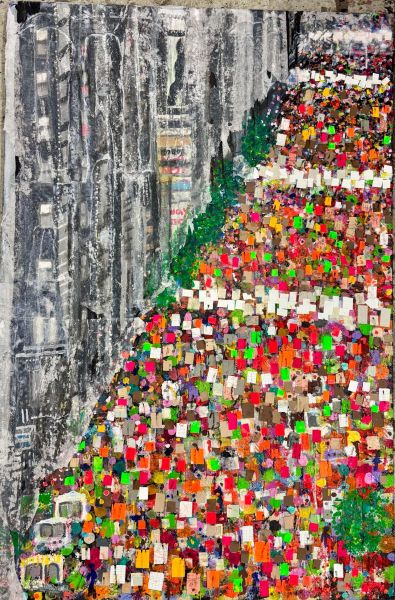
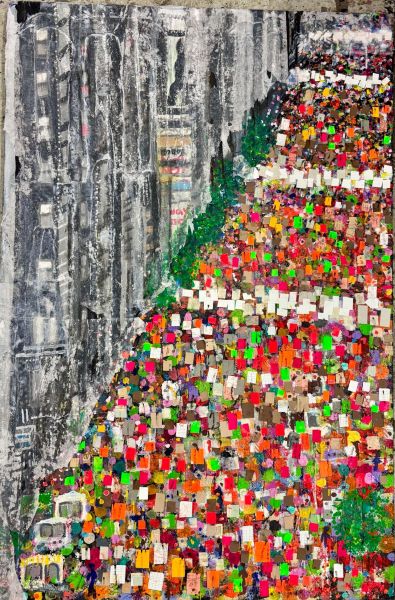
Bryan Martin (Hyperallergic) writes, “This year’s edition proves that the key to viewing work by so-called ‘autodidact’ artists is recognizing its capacity and merit as equal to all other art forms.” Among the artists featured is Alyson Vega, a New Yorker of Puerto Rican descent “who had to leave her job as a math teacher after sustaining a brain injury.” [Vega’s “ICE Kills” shown here.]
The Outsider Art Fair has enriched New York City’s art world since its inception in 1993, presenting eclectic and idiosyncratic artists who challenge traditional fine art hierarchies. The fair serves as an egalitarian anchor during unstable times in the art market and the United States, marking an optimistic moment to watch art quickly sell off the walls and a range of visitors express genuine delight. The event, this year featuring 68 exhibitors at Chelsea’s bustling Metropolitan Pavilion through Sunday, March 22, has long been an antidote to the sterile, pretentious nature of a blue-chip gallery fair.
What exactly qualifies as “outsider art,” though? “Self-Taught,” “Folk,” “Visionary,” “Naive,” and “Autodidactic” are other terms historically used to describe artists from so-called unconventional backgrounds; however, the artists on view here at the fair are most importantly unified by their existence on the periphery of academic and institutional contexts. While research in these genres celebrates the exceptional creativity of outsider artists, it paradoxically limits our aesthetic appreciation of their work by undervaluing them as separate from formally trained artists.
Several must-see booths at the Outsider Art Fair displayed brilliant, rigorous practices that signal that the key to viewing outsider art is recognizing its capacity and merit as equal to all other art forms, regardless of superficial distinctions. [. . .]
Massachusetts-based PULP featured a noteworthy selection of lesser-known figures, including Afsoongar, an alias for a young Iranian artist who anonymously creates subversive works that push against the Iranian regime’s restrictive patriarchy. The artist renders defiant women, nude amid compositions that recall action-movie fight scenes. Her work is a topical reminder of self-taught art’s political potency, actively engaging with the broader Iranian women’s movement in an immediate way. [. . .]
Andrea Gutiérrez, whose work is on view at the booth of Idaho’s Stewart Gallery, examines femininity through a domestic lens. The artist implements delicate thread-and-needle techniques she learned from her mother to create small-scale works that sumptuously depict the quotidian: picking potatoes, cutting onions, and women with their backs to us.
When I ran into Brooklyn- and Los Angeles-based artist Jaqueline Cedar, who was visiting the fair for the first time, her reflections highlighted the overlap between formally trained and self-taught artists — reinforcing the porosity of these categorizations.
“It was a nice range,” Cedar said. “I discovered so many artists. I feel like my work aligns with a lot of these aesthetics. They’re all connected.”
Many nonprofit art studios across the country facilitate art education for adults with disabilities and no prior art experience, thereby fostering a rich lineage within outsider art history.
Fountain House Studio and Gallery in Manhattan works with people with mental illnesses, supporting artists like Alyson Vega, who had to leave her job as a math teacher after sustaining a brain injury. Through Fountain House’s booth, the native New Yorker of Puerto Rican descent displayed her remarkably sophisticated compositions of the city’s streets during Trump protests, using fabric, acrylic, and paper. [. . .]
For full article, see https://hyperallergic.com/new-ways-of-seeing-at-the-outsider-art-fair/
For more on Alyson Vega’s work, see https://www.alysonvega.com/?ref=hyperallergic.com and https://www.alysonvega.com/about
Bryan Martin (Hyperallergic) writes, “This year’s edition proves that the key to viewing work by so-called ‘autodidact’ artists is recognizing its capacity and merit as equal to all other art forms.” Among the artists featured is Alyson Vega, a New Yorker of Puerto Rican descent “who had to leave her job as a math teacher