
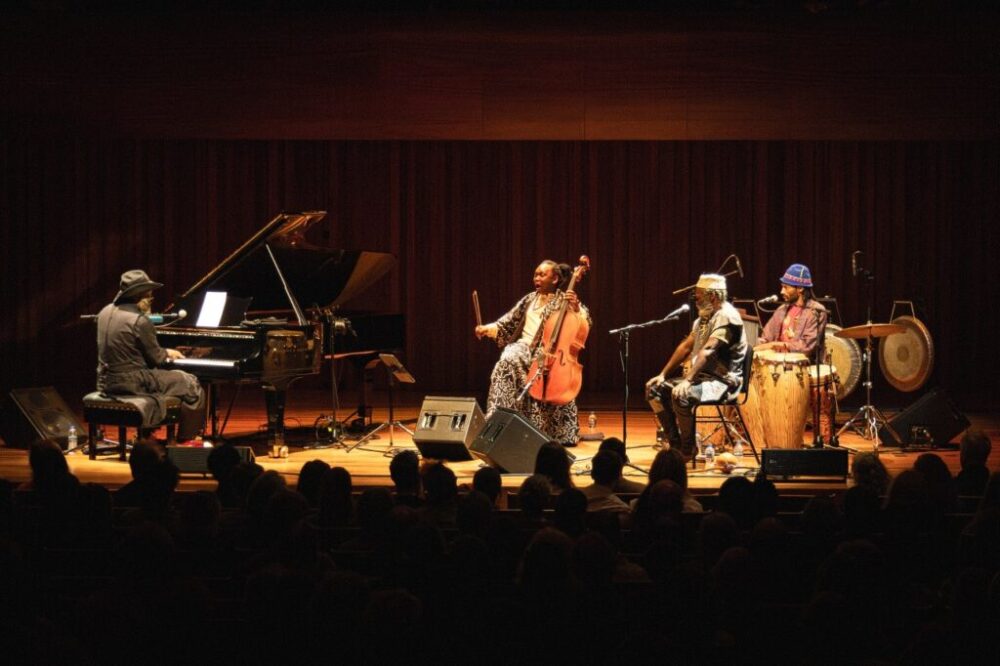
Nduduzo Makhathini has been back in Durban for only a day when we speak. Two months on the road — Princeton, Houston, Phoenix, Seattle, Berkeley, London, Antwerp and points between — and now home, which he says with the particular relief of someone who means it.
“Man,” he says, settling into the word. “It really does feel good. After two months. It really does.”
But even in the exhale of homecoming, his mind is moving. It moves the way it always does: restlessly, laterally, pulling threads between centuries and continents, between a greeting in KwaZulu-Natal and the technology of the stars.
He is, by the evidence of an hour’s conversation, less a musician who thinks deeply than a philosopher who happens to express himself through a piano.
At 26 years in the industry, he has earned the title of jazz elder, though what becomes clear quickly is that he wears his elderhood less as a crown than as a responsibility.


The tour, he says, was really five projects compressed into one stretch. His own trio on dates across the US. A collaboration in London with cellist Abel Selaocoe, vocalist Mbuso Khoza and choreographer Mthuthuzeli November.

A performance with the Espinho Jazz Orchestra in Portugal and another with the WDR Big Band in Germany. And then, at the end, something intimate and enormous: sharing the stage with Black Coffee at the O2 Arena, the largest venue in London, alongside artists like Msaki and Nakhane.
“It was huge,” he says. There’s genuine weight in the word. But his mind doesn’t rest on the spectacle. It moves, as it tends to, towards what the moment means — what it ought to be made to mean, before it slips away.
“I wonder if South Africa is going to write about this moment,” he says. “Just for Black Coffee and what it means for him. I know in the UK they’re going to do it. But I won’t be surprised if there’s not a single article about this in South Africa.” He pauses. “And that’s really my critique. Because it is a historic moment.
The biggest venue in London, headlined by South African artists, with South African artists in support. That’s remarkable. And we let remarkable things pass us by.”
This is the thing that seems to burn in him most: the question of who tells the story and whether anyone tells it at all. Social media, he argues, is not the answer.
“The problem of temporality,” he calls it. “It’s not permanent there.”
What he wants is writing. Archives. The kind of record that will mean something to a grandchild who isn’t born yet.
It’s a preoccupation that connects everything about this particular tour. One of its most significant moments was a concert series honouring the centenary of John Coltrane — performed alongside legends including Joe Lovano and Jeff “Tain” Watts. Coltrane’s music, recorded in the 1960s, was itself an act of memory: black Atlantic music reaching back toward Africa, trying to hold on across the rupture of slavery.

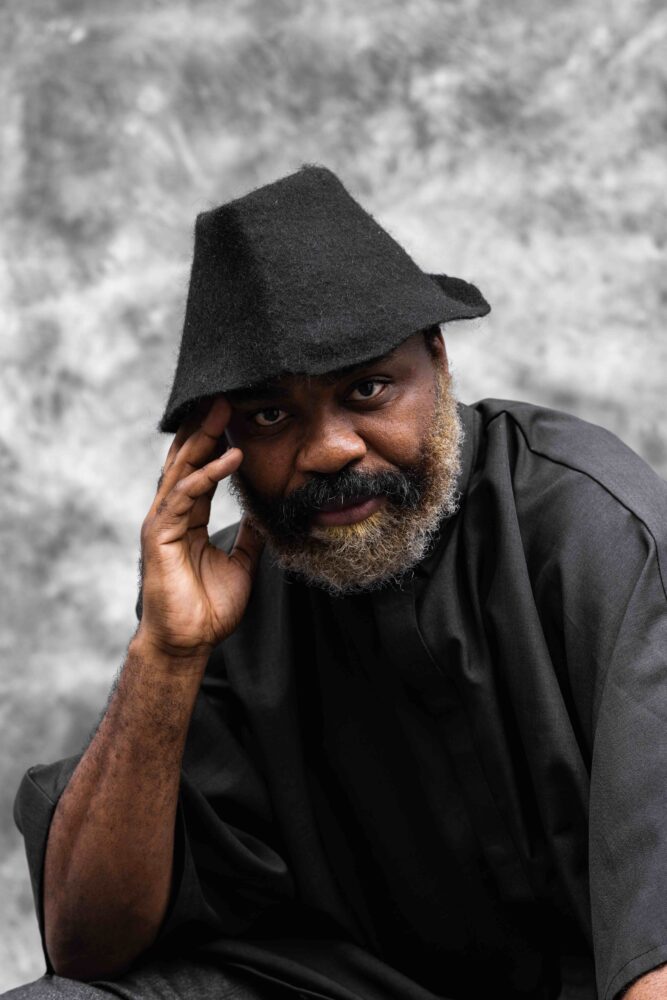
For Makhathini, who first encountered jazz through Coltrane’s records and who was introduced to their depth by the great South African pianist Bheki Mseleku, playing the music felt like standing inside a circle that had closed.
“I was introduced to jazz through John Coltrane,” he says. “When I started, I met Baba Mseleku, who emphasised the importance of Coltrane’s music in terms of black aesthetics. And here I was, celebrating his centenary. Many things came full circle.”
Then he describes being backstage at the O2, hours before going on with Black Coffee and seeing Kabza de Small. One of the architects of Amapiano, at 33 years of age, generations removed from Coltrane’s centenary music and yet part of the same unbroken thread.
“For me,” Makhathini says, “there’s a story there.” From a man who would have been 100, to a young man in his early thirties making the music that will matter to the next generation. The line runs straight, even when it isn’t visible.
He spoke to Kabza that night. Told him he followed his work, that it moved him. Then he says something that reframes everything: what he hears in Amapiano, underneath the piano lines and the log drums, is something profound about black cosmology. About healing. About ancestral presence.
“The singers featured in Amapiano; what they are saying is so profound,” he says. “It’s like a reawakening of black cosmology. They speak about healing, about dealing with traumas, about ancestral technologies, ancestral presence. People are on the dance floor but they are channelling a very deep message.”
He sees it, he says, as a form of protest. A refusal to forget who we are.
“To find that the most religious music, in terms of its text, is now Amapiano,” he adds. “Which is extraordinary, if you think about it.”
This is, for him, not just an observation but a call to action. He has been thinking for years about how jazz, with all its philosophical weight, finds its way to the people who need it most. The answer, he believes, is collaboration — not as a marketing strategy but as a genuine merging of worlds.

“When Black Coffee invited me, around 2018, he was recording Music is King,” Makhathini says.
“His idea was that the highest thing we should be serving is the music, not the genre. On the album he featured myself, Mbuso Khoza, Samthing Soweto — all of us coming from different sonic worlds.”
The response to his appearance at the O2 told the same story in reverse: Black Coffee’s audience, not expecting intense jazz vocabulary, encountered it anyway.
His own audience went to see him and ended up dancing.
“The more we can blur these genre confines,” he says, “the quicker the message will reach the young people. Because young people want to move to something.”
He is clear that nostalgia has no place in this. The innovators of jazz — Coltrane and Miles Davis — were in their twenties when they changed everything. “So let’s not be nostalgic about jazz as old people’s music,” he says. “In fact, it never was.”
The album Makhathini is releasing next month, A Myth We Choose, carries all this in its DNA. It features Black Coffee.
It features Muneyi, a young singer-songwriter from Venda whose storytelling draws on traditions his own people have carried for centuries. It features Thando Zide, Robin Fassie and Keenan Meyer.
Three singles have been released: Kuzodlula, Liyoze Line Nangakithi and Imvunge KaNtu. It was produced by his 18-year-old son, Thingo.
He tells this story with the particular delight of a parent who was genuinely surprised.
Thingo grew up in a household where both parents — Makhathini and his wife, singer Omagugu — are musicians. Classical piano lessons, then clarinet, then saxophone, then guitar. A TikTok account his father didn’t know about, full of videos that a friend had to send him.
When Thingo asked to produce the album, Makhathini took it to his wife first. Then he asked Thingo to show him what he had.
“He brought these sketches of ideas,” Makhathini says. “Man, I was so blown away.”
At a listening session with Blue Note, the label’s first question about the opening tracks was: Who produced this? When Makhathini said his son, they didn’t believe him.
“The album produced by an 18-year-old,” he says, “really opens up this invitation.” The invitation being: the intergenerational conversation he keeps returning to isn’t just an idea for him. He’s living it. He was shaped by Coltrane, who was shaped by Africa and now his son, who grew up hearing both, is shaping what his father’s music sounds like in 2026.
There is a moment toward the end of our conversation when Makhathini describes his final concert of the tour: a solo piano performance in Antwerp. He’d been thinking about what it means to play alone and how the word “solo” doesn’t really map onto the African understanding of the self.
In KwaZulu-Natal, the standard greeting is sanibonani — plural, always plural, even when you’re addressing one person. Because you are never really addressing one person. You are addressing them and their history and the ones who came before them.
He also describes how among the Batswana, the greeting Le kae? — which might be translated as “How are you?” — is more accurately rendered as “Where are you?” Not where your body is but where are you located in the cosmos, in relation to the stars and the ancestors. The answer, Re teng — “we are here” — is the affirmation that you are aligned, present, in place. Only then does the conversation begin.
He says this and then explains that this is what he was trying to share with the audience in Antwerp. That what looks like a solo performance is something communal. That the bandstand is never empty when he plays, because he brings all this with him — the teachings of Credo Mutwa, the music of Bheki Mseleku, the questions he has been sitting with for 26 years.

“Performance for me is a space of study,” he says. “It’s not just random performance. We bring something and we take something back.”
It explains, too, why he went back for a PhD after his master’s, despite his wife’s gentle suggestion to take a break.
Why his research — into Ntu cosmology, into the spiritual foundations of South African jazz, into what he calls “delinking” from colonial frameworks in order to hear this music on its own terms — feeds directly into what he plays.
He wanted to collapse the distance between scholar and artist, to insist that to be an artist is to be a scholar. The younger musicians who have been inspired to pursue their own postgraduate studies, musicians like Benjamin Jephta, are perhaps the most tangible evidence that this insistence has taken root.
“It is pointless,” he says, “to read African music through a Western art lens. That is an argument Kofi Agawu makes — about the challenge of being read from a foreign hermeneutic. It is a type of violence.”
He brings up, near the end, a distinction he encountered in an interview — the idea that the word “story” contains two functions at once: storying, as in the telling and storing, as in the preservation. Both are present in every act of narration. To tell a story is also to keep it alive.
I mention to him that the words “invention” and “inventory” share the same Latin root — invenire — and that this wasn’t coincidental, that it was once understood that creating something new and keeping a careful account of what exists are not opposing activities but aspects of the same one.
He lights up. “You see? You see? Precisely.” It is, he says, why etymology matters to him: because the origins of words are where their deepest meanings live, before centuries of use have worn them smooth.
This is Nduduzo Makhathini, really: a man who plays the piano, teaches at a university, raises children who produce his albums and greets his audiences in a language that asks them where they are in the stars. He holds all these things not as separate pursuits but as one continuous act of remembering. Of storying and storing.
He has been home for a day. Tomorrow or the day after, he will probably sit down at the piano and the tour will become something more than a series of concerts. It will become part of the archive. Something he can hand to the generations coming up behind him, so that they know it happened, so that they know it mattered.
He is, in this way, not so different from John Coltrane looking back across the Atlantic toward a continent that shaped him. Except that Makhathini is on the continent and he is looking forward.
From John Coltrane’s centenary to the O2 Arena with Black Coffee, Nduduzo Makhathini’s recent world tour was a masterclass in the cyclical, intergenerational nature of black music