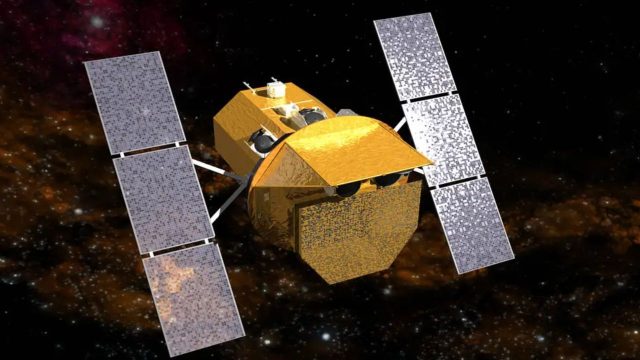
Nasa has launched a spacecraft to catch a falling telescope, an unprecedented mission that could pave the way for similar future rescues.
The Neil Gehrels Swift Observatory telescope, known simply as Swift and launched in 2004, detects some of the most powerful explosions in the Universe. Its name comes from its ability to point at a new target in the solar system in a matter of minutes, compared to other space telescopes such as Hubble, which can take up to two days to focus on a target.
Because of its success spotting distant gamma-ray bursts, Swift’s mission has been repeatedly extended. But now it is sinking faster than expected due to recent solar storms and is at risk of crashing back to Earth in a matter of months unless something is done to change its orbit.
‘Mind-bogglingly short’ turnaround
To carry out the mission Nasa has turned to Arizona-based Katalyst Space Technologies. Swift has no engines of its own and was not built with docking hardware, so Katalyst engineered a “custom capture mechanism” that will use three guided robotic arms “to latch onto a structural feature without disturbing Swift’s instruments”, said Astronomy.
Having successfully launched last week, Katalyst’s Link spacecraft is now carrying out a series of navigation and propulsion systems checks before approaching Swift. It will survey the telescope to determine the best point of contact, and eventually capture and lift the observatory, which is about the size of a small car, back into its correct altitude.
The capture itself will be “especially tricky because Swift was never meant to be touched again once it reached orbit”. Katalyst CEO Ghonhee Lee told Aerospace America that it has been made even more complicated because “nobody took a picture of the backside of Swift before it launched”.
Katalyst was awarded the contract only last September, a “mind-bogglingly short” turnaround time, said Space. If it succeeds in saving Swift, the company will have done something unprecedented: “reboosting an ailing space telescope using a spacecraft developed in less than a year to rescue a target that was meant to be left in space on its own forever”.
‘A spacecraft worth saving’
At a cost of $30 million, the mission to save “a nearly 22-year-old space telescope, well past its prime” seems, “on paper” at least, not great value for money, said Space. But “Swift, it turns out, is still worth it, according to Nasa”.
“We didn’t want to set the precedent that anything that comes out of orbit has to be boosted, because it is part of our space ecosystem to have things deorbit frequently,” said Shawn Domagal-Goldman, Nasa’s astrophysics division director, in June. But Swift is “not just any spacecraft” and has a unique ability to “quickly pivot across the night sky to find things that go boom in the night”.
“In short,” said BBC science correspondent Pallab Ghosh, “there is nothing like Swift, and Nasa deemed that it was a spacecraft worth saving.”
Such an “ambitious” mission “has never been carried out before” and “a lot will have to go right if it is to succeed”. If it does, however, “attention will turn to whether the next rescue mission could be to save the even more famous Hubble Space Telescope”.
‘A lot will have to go right’ if first-of-its-kind Swift observatory rescue mission is to succeed