
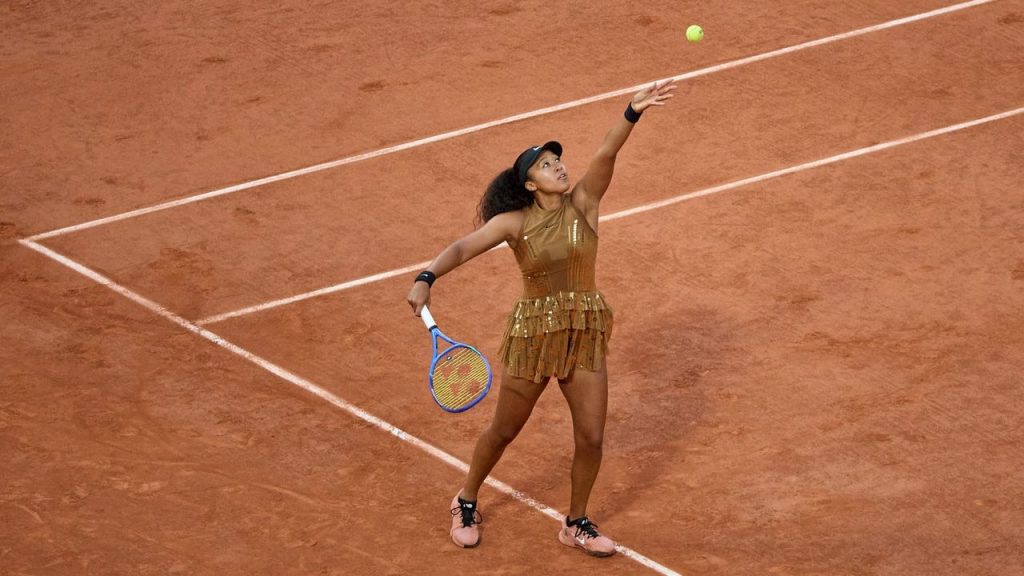
“I came here to play tennis, not to put on a fashion show,” said Laura Siegemund, following her loss to Naomi Osaka in the first round of the French Open. “If other people want to do a fashion show, they can do that.”
Osaka came on court in a black corset and matching pleated skirt to face Siegemund. Though she eventually lost to Aryna Sabalenka in the fourth round in a landmark night session, Osaka’s “shimmering gold dress” became even “more eye-catching under the lights”, said The Guardian.
Known for her “elaborate” playing outfits, including a jellyfish-inspired outfit at the Australian Open, Osaka sparked concern that she may “serve as a distraction”. With Wimbledon around the corner, the tennis-fashion debate is likely to intensify.
‘Another language’
Osaka “really knows how to turn a tennis court into a catwalk” and has done so for years, said the Daily Maverick. Though her “court-ure”, which also included an Eiffel Tower-inspired outfit, has been labelled “problematic” by critics, her choice of fashion is “part of how she chooses to be seen”. For someone who has spoken openly about her struggles with anxiety, depression and public communication, her outfits have become “another language”.
The four-time grand slam champion has “never had average tastes when it comes to fashion”, said The Athletic. Her look at the Australian Open – a “dreamy, dramatic ensemble” that was meant to “evoke jellyfish” – “took over cultural discourse far beyond her match”.
Female athletes “don’t want to be known or judged for their outfits alone”, said The Independent, but with less prime-time coverage of their games than male players, it “can’t hurt to turn a few heads and garner extra attention using a bit of tulle and some sequins, right?”
I understand “how annoying it must be for Osaka’s opponents”, said The Times’ fashion director Anna Murphy. Her “ballroom skirt” and “spangled waistcoat” are “more usually seen in ‘Bridgerton’” and “Dancing on Ice”. I appreciate her angle: professional tennis “isn’t for the shy and retiring”, and if you’re on a rumoured $10 million sponsorship deal, “why not milk it”?
Wimbledon has indicated it will go along with Osaka’s “fancy-dress-adjacent thing”, provided what she wears is white. The restrictions are only on colour, not style, “so what’s it going to be for SW19? A snowman? A snowball? A snowballgirl?” But this sets a precedent that could turn the circuit into a “fancy dress party”, inviting others to follow suit. I am “not sure how even I, a fashion journalist, feel about that”.
Fashion ‘embedded’ in tennis
Tennis has “always been a runway” and fashion has “long been entrenched” in the sport, said the Daily Maverick. Osaka’s idols, the Williams sisters, used fashion as a “platform of empowerment”. Serena Williams’ “iconic” 2018 catsuit “became one of the most discussed outfits in tennis history”, while Venus’ “‘scandalous’ cabaret-inspired 2010 look” also “challenged conventions”.
Such pageantry has become commonplace in other sports too, with “paddock fashion” in Formula 1 and “tunnel walks” in US basketball. People are only noticing, and commenting, because Osaka is “using fashion as a form of self-expression on her own terms”.
Outfits worn by Osaka and Sabalenka have “crystallised how deeply luxury fashion has embedded itself in tennis”, said the Financial Times. “Indeed, the relationship between luxury and tennis isn’t new.” Many of the major stars will have a partnership with a high-end brand: Jannik Sinner and Gucci, Carlos Alcaraz and Louis Vuitton, Zheng Qinwen and Dior, British star Jack Draper and Burberry; the list goes on.
Professional tennis is a “visual theatre”, with increasingly viable commercial opportunities. Lacoste, Ralph Lauren and Rolex have all been “intertwined” with the sport, but there has been a dramatic shift in tennis’ “scale and visibility, both as a participatory sport and a spectacle”. Broader participation in the US (up by 54% since 2019, according to the US Tennis Association), and rising broadcast audiences mean tennis has become a “compelling stage” for marketing. Tennis offers a “rare opportunity to speak simultaneously to affluent buyers and aspirational young fans”.
Japanese star’s ‘court-ure’ has sparked fierce debate within the tennis community