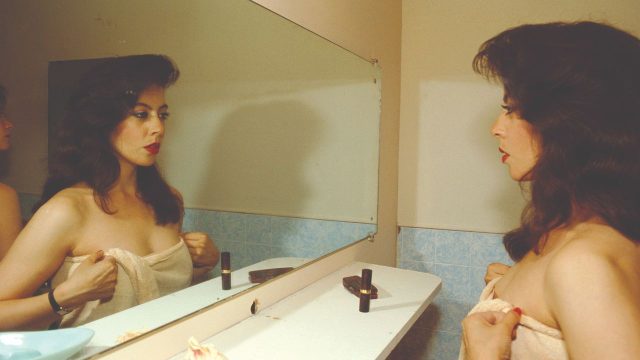
Forty years ago, the American photographer Nan Goldin published what became “one of the most influential photo books ever made”, said Jacqui Palumbo on CNN. Entitled “The Ballad of Sexual Dependency”, it documented life in New York City’s East Village in the 1970s and 1980s, with excursions to Chicago, London and Mexico City. The “searingly intimate” pictures showed Goldin and her “predominantly queer” friends in a variety of locations, from “darkened nightclubs” to “daylit bedrooms”. Their gazes are variously “bright, or disaffected, or longing”, and cigarette smoke hangs in the air.
Goldin conceived the series “as a slideshow timed to songs by ‘The Velvet Underground’ and Dionne Warwick”, which was played in nightclubs. The photos were rarely displayed together. Now, though, they have come to the UK for the first time, and are being shown as framed prints at the Gagosian gallery in Mayfair.
Goldin, who was born in 1953, “was a teenage runaway”, said India Block in The London Standard: after her beloved sister died by suicide, she fled the “stifling” Boston suburb she’d grown up in and moved to New York, where she threw herself into the city’s gritty underground scene. She originally started photographing her friends’ exploits when she discovered drinking (then heroin), “and wanted a record unaltered by mind-altering substances”.
Named after a song by Bertolt Brecht, the “Ballad” series is “glamorous, engrossing and gross (in a good way)”: hyper-saturated images show a heavily pregnant woman in “a sparkly bikini”, a friend masturbating, someone else urinating, “a vulva framed by a surgery scar from an ectopic pregnancy”. Given the rawness of the images, “there’s something rather punk” about seeing them “gussied up and gorgeous” in a gallery; though you do long to see them “in a darkened room with pulsing music”. Still, “with each photograph occupying the same size frame”, your eye is left free to alight on whichever moment it chooses; and all these years on, the pictures are “as fresh, exciting, comforting and confronting” as they were in 1986.
“I’ve been familiar with these images for much of my adult life,” said Adrian Searle in The Guardian, and what struck me on this viewing was how “normal” the lives of Goldin and her friends look today. “We are now used” to people posting photos online as an often “self-conscious and calculated mirage of their lives”. Still, the great power of these photographs – each of which “leaves you on a kind of brink” – is undiminished, and the display here, which covers three black walls, is satisfyingly immersive, sending the eye “pinballing between captured moments and emotions”. The “apparent casualness” of Goldin’s approach is deceptive: there is an “emotional texture and atmosphere” to her work that proves that “not everyone who can hold a phone can take photographs worth looking at”.
Gagosian, 17-19 Davies Street, London W1. Until 21 March.
All 126 images from the American photographer’s ‘influential’ photobook have come to the UK for the first time