In an absolute monarchy, the syllables uttered by the sovereign can quickly translate into the stroke of a baton against a citizen.
When King Mswati III speaks, his words do not merely drift into the atmosphere as political ‘opinion’; they often become violent state policy. This is the reality of Eswatini, where the right to freedom of expression — including the right to hold dissenting political views — is increasingly being systematically dismantled by the very tongue that claims to protect ‘traditional values’.
To understand the current crisis facing the LGBTIQ+ community in Eswatini, one must view it through the lens of a broader strategy: the weaponisation of culture to justify the elimination of dissent.
As observed across the Southern African Development Community (SADC), from the streets of Harare to the parliamentary assembly of Dakar, African leaders are increasingly using marginalised groups as an entry point to dismantle civil society.
In Eswatini, this strategy has found its most brutal expression in the king’s recent rhetoric about sexual orientation and gender identity.
The risk of the king’s words lies in their interpretation by the state apparatus as a divine mandate for persecution.
We have observed this ‘rhetoric-to-policy pipeline’ operate with chilling efficiency. Shortly after the minister of education expressed public hostility towards LGBTIQ+ students, reports surfaced of children being expelled from schools.
In a country where the king is culturally referred to as the ‘ingwenyama’ (the lion), the bureaucracy acts as his pride.
When the leadership indicates that a particular group is ‘un-African’ or ‘deviant’, the machinery of the state — along with emboldened segments of the public — moves to purge that group from the social fabric.
For an openly gay man who has dedicated most of his adulthood to advancing equality and dignity for all, especially marginalised communities, these are not just policy shifts; they are existential threats.
When a powerful leader speaks, they provide a moral shield for the dogmatist and a legal roadmap for the police.
In Eswatini, where political parties are banned and the tinkhundla system is touted as the only ‘authentic’ form of governance, any identity that falls outside the narrow, state-defined ‘tradition’ is treated as treason.

By labelling LGBTIQ+ rights as ‘ungodly’ and unwelcome in Eswatini, the monarchy effectively classifies the mere existence of queer Swazis as a subversive act against the crown.
The most harrowing example of this pattern is the assassination of human rights lawyer Thulani Maseko in January 2023. Maseko’s murder did not occur in isolation. It followed a period of heated rhetoric aimed at those calling for democratic reforms.
The king had publicly warned that those demanding change would face consequences.
On the evening after the king said, “[t]hese people started the violence first, but when the state institutes a crackdown on them for their actions, they make a lot of noise blaming King Mswati for bringing in mercenaries,” Maseko was shot dead at his home in front of his family.
The parallel here is unavoidable. When the king targets the LGBTIQ+ community with his words, he is placing a target on the most vulnerable.
If a world-renowned human rights lawyer can be silenced after royal condemnation, what chance does a queer youth in a rural area have when the king’s words reach the local chief or school head?
This is what I call ‘chaos as governance’: a state where the law is replaced by the monarch’s whims, leaving the population in a constant state of managed chaos that makes collective defence nearly impossible.
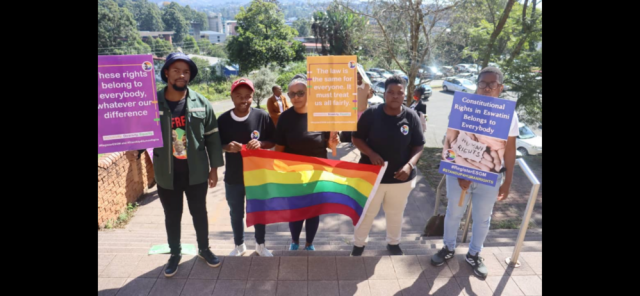
Despite strong condemnation from Eswatini Sexual and Gender Minorities (ESGM), recent reports suggest growing support for the king’s rhetoric, indicating difficult weeks and months ahead for queer people in Eswatini.
The monarchy’s defence of these actions is almost always based on ‘African tradition’.
As Mswati has shown, the ban on political parties and the suppression of minority rights are framed as a return to indigenous governance — the tinkhundla system.
But we must ask: whose culture is being defended?
Is it a culture that historically valued communal care and diverse social roles or is it a modern, imported authoritarianism cloaked in the robes of the ancestors?
When he uses his platform at the sibaya (traditional gathering) to alienate a segment of his own people, he is not engaging in dialogue; he is delivering a monologue of exclusion.
This weaponised version of culture serves a dual purpose.
First, it provides a ‘neo-colonial’ defence against international criticism, framing human rights as a foreign threat. Second, it creates an internal enemy — the ‘terrorist’ political dissident or the ‘immoral’ LGBTIQ+ person — to distract from the fact that nearly two-thirds of the population lives below the poverty line.
In contrast, the royal family lives in extreme luxury, acquiring fleets of expensive vehicles.
The silence of its neighbours worsens the situation in Eswatini. SADC, a regional organisation ostensibly committed to democracy and human rights, has repeatedly allowed Mswati to evade accountability.
By agreeing to remove Eswatini from the Organ Troika agenda at the king’s request in 2024, SADC sent a message to every authoritarian in the region: if you conceal repression behind the guise of tradition, there will be no intervention.
The call for freedom of expression, including LGBTIQ+ rights, is a fundamental human right vital for safety and dignity. It demands that a child should not be expelled from school because of who they are. It insists that a lawyer should not be murdered for believing in the vote. It states that a king’s word should not be a death sentence.
We must resist the ‘politics of distraction’ that portrays the fight for minority rights as separate from the fight for democratic reform.
The dissolution of political parties in Burkina Faso, attacks on lawyers in Zimbabwe and the criminalisation of advocacy in Senegal, Tanzania and Uganda are all part of the same pattern. They reflect a leadership class that fears its own people. It is time for the African Union and SADC to decide whether to uphold the ideals of their charters or prioritise political convenience.
For the people of Eswatini, improving livelihoods and human development can only happen when the king’s words are limited by a constitution that safeguards every citizen, no matter who they love or how they pray. Until then, the chaos is not a failure; it is the purpose.
The monarch’s word may be law today but the universal right to dignity is the only law that will endure.
We must demand an Eswatini — and, by extension, an Africa — that seeks to improve the lives of its people and where the ‘lion’ protects all his people rather than hunting those he deems ‘unworthy’.
Melusi Simelane is the founder and board chairperson of Eswatini Sexual and Gender Minorities (ESGM), a civic rights programme manager at Southern Africa Litigation Centre and an MA International Relations Student at the University of Sussex.
The call for freedom of expression, including LGBTIQ+ rights, is a fundamental human right vital for safety and dignity