
Contrary to earlier indications that the Passenger Rail Agency of South Africa’s (Prasa) general overhaul (GO) programme was lagging behind, parliament’s portfolio committee on transport has expressed satisfaction with the turnaround the agency has made.
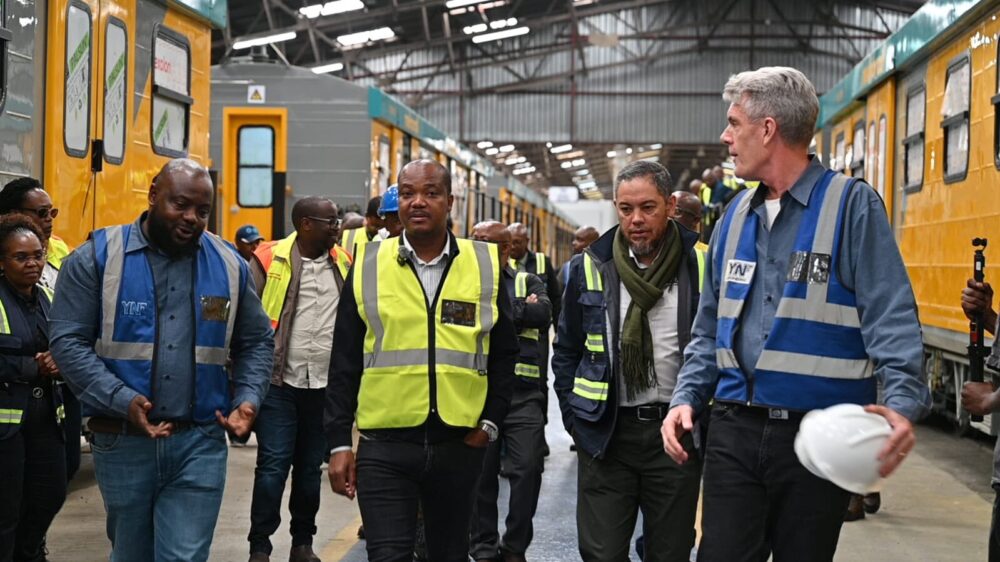
This week, the committee conducted an oversight inspection at YNF’s Isando rail refurbishment facility as part of parliament’s review of transport delivery.
YNF is a 100% black female-owned, broad-based BEE-compliant South African engineering company that has 30 years’ operational experience in the rail and heavy engineering sector, specialising in refurbishment, manufacturing, maintenance and life-extension programmes for passenger rail assets.
MPs said YNF’s presentation highlighted the significant economic value of returning refurbished trains to service.
The visit followed recent engagements in parliament where the committee called Prasa to account on progress in the GO programme.
Committee chairperson Donald Selamolela said the purpose of the inspection was to compare what had been presented to parliament with implementation on the ground.
“We came here as part of our ongoing oversight to see how the transport system is functioning in the Republic.
“We wanted to test what had been presented to Parliament against what is happening on the ground,” said Selamolela.
After summoning Prasa to parliament, MPs requested to inspect a supplier facility.
“There has been an outcry about the GO programme. Prasa gave us answers in parliament but we wanted to see for ourselves. We requested that we visit one contractor to understand what is actually happening,” he said.
After the inspection, Selamolela said the committee had seen evidence contradicting claims that the programme had failed. He said the narrative had been that the GO programme was not working, “with trains lying idle and no refurbishment taking place”.
“What we have seen here tells a different story”.
MPs praised the quality of the YNF facility, its technical capability and its contribution to skills development. “We are highly impressed, highly motivated and inspired. We leave here knowing we have done an important service by seeing for ourselves what is actually happening,” said Selamolela.
He added: “This is a world-class facility. But beyond the infrastructure, what stands out is the human capital, skilled and experienced people who are being developed into artisans and technical specialists.”
YNF chief executive Jade Orren said the company used the opportunity to demonstrate its delivery record, future capability and the wider economic ecosystem supported through manufacturing.


“We showcased our capacity, what we have delivered, the work currently under way and what we can do in the future. We also demonstrated the jobs we create, the procurement ecosystem we help sustain and challenged the narrative that these yellow trains cannot be used,” said Orren.
YNF’s focus was on building industrial capability and delivering reliable rolling stock for commuters at an affordable cost.
“In addition, we explained to the committee how pricing for the GO contract worked and that the cost to Prasa was in line with the contract terms,” he said.
On money spent on the contract by Prasa, Orren said costs would have been recovered within the first three years of use.
He said the assets had a 10-year lifespan and if the trains were returned to service, “it would prove to be valuable for Prasa and the public”.
Prasa group chief executive Hishaam Emeran said the visit followed a detailed presentation to parliament, after which committee members requested first-hand verification of progress.
“The members appreciated the presentation but immediately asked to see the work first-hand.”
He said the programme focused on extending the lifespan of the fleet and broadening rail access across the country.
“We are overhauling the existing fleet to extend its lifespan by another 10 to 12 years.”
Emeran said Prasa had a fleet of more than 4 000 coaches. “While not all require general overhaul, it is critical that we preserve and modernise viable assets.”
The committee emphasised that affordable commuter rail was critical to easing household pressure, reducing road congestion and reconnecting workers, learners and communities to economic opportunity.
MPs also expressed concern about worsening congestion on major routes. Earlier this year, the Mail & Guardian reported on Prasa’s internal forensic probe into the agency’s multibillion-rand GO programme, which identified management weaknesses.
The report found that while the GO project was conceived as a strategic intervention to stabilise Prasa’s legacy fleet during the transition to new rolling stock under the rolling recapitalisation programme, weaknesses emerged in its execution.
According to the report, management implemented structural reforms to ensure that any further capital deployment under the GO contract was legal, defensible, commercially rational and aligned with operational needs.
The Prasa board was also required to consider whether further capital should continue to be deployed towards metro coach refurbishment “in light of network readiness constraints”.
The probe into allegations of corruption in the GO programme pointed to governance weaknesses in the execution of the project, including allocation controls, pricing discipline, performance management and oversight mechanisms.
Through the rolling stock recapitalisation programme, Prasa procured new rolling stock for its Metrorail operations as part of its long-term modernisation strategy.
The new fleet was designed to be phased in progressively and the legacy yellow fleet phased out over an extended transition period expected to conclude around 2033.
At the time the GO programme was initiated, the legacy fleet was experiencing declining reliability, increasing technical failures, safety compliance pressures and reduced availability, materially affecting service reliability and commuter confidence.
After inspecting YNF’s Isando rail refurbishment facility, Parliament’s transport committee says Prasa’s general overhaul programme is showing progress