
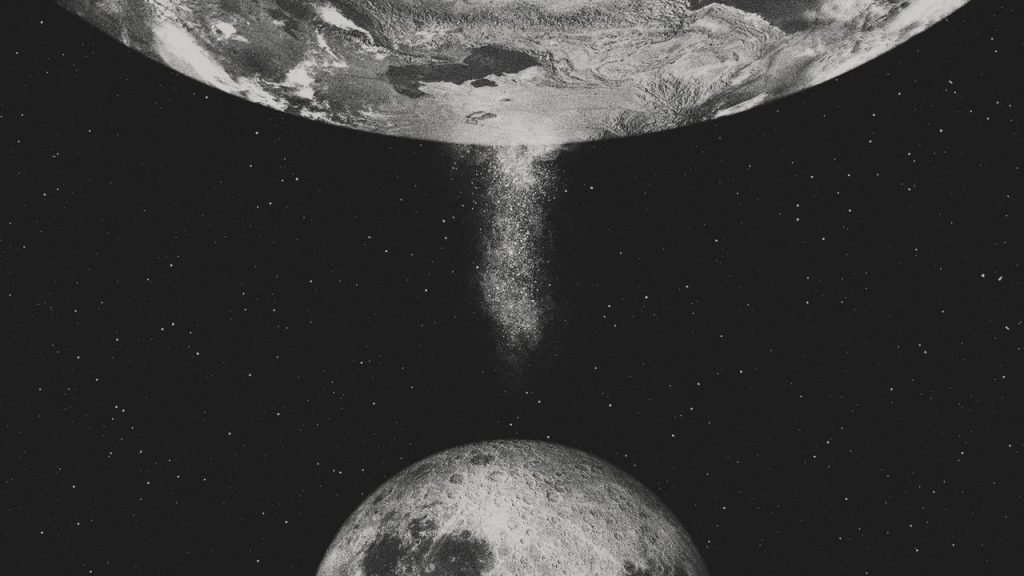
The moon is chock-full of Earth’s history. Elements from our planet’s atmosphere have made their way into moon dust, also called regolith, on a pathway created by the Earth’s magnetic field. These substances can help supply a lunar base, but using the dust can also be cumbersome and potentially dangerous.
Sharing is caring
Earth’s atmosphere “contributes significantly to light volatile elements” found in moon dust, said a study published in the journal Communications Earth & Environment. That is because our planet is surrounded by a magnetic field that “may actually help guide atmospheric particles” into space and toward the moon, said a release about the study. As a result, “lunar soil may not only hold a long-term record of Earth’s atmosphere,” but “could be even more valuable than scientists once thought for future space explorers living and working on the moon.”
Soil brought back from the Apollo missions in the 1970s contained volatile substances, including “water, carbon dioxide, helium, argon and nitrogen,” said the release. While some of these volatiles came from the “sun’s constant stream of charged particles, known as the solar wind,” the amounts of the substances, especially nitrogen, were “too high to be explained by solar wind alone.” In the study, scientists created computer simulations that showed that rather than “blocking atmospheric ions from being blown from our planet, the magnetic field lines within Earth’s tail act as invisible highways for charged particles,” said Live Science. This moves the particles toward the moon, allowing them to settle into the regolith.
That also means that this transfer of particles has likely been happening for over 3.7 billion years, since the formation of Earth’s magnetosphere. “By examining planetary evolution alongside atmospheric escape across different epochs, we can gain insight into how these processes shape planetary habitability,” Shubhonkar Paramanick, the study lead author, said in the release. The study could have “broader implications for understanding early atmospheric escape on planets like Mars, which lacks a global magnetic field today but had one similar to Earth in the past, along with a likely thicker atmosphere.”
All the dust is not gold
The elements in moon dust could be harvested and used in lunar bases. Substances like water and nitrogen could be “used for life support or fuel production, thereby reducing the need to bring everything from Earth and making a sustainable human presence more feasible,” said Techno-Science.net. Researchers have also conceptualized a device that could possibly turn moon dust into usable water and oxygen, according to a study published in the journal Joule. The method “takes advantage of the abundant solar energy and the extreme thermal conditions of the lunar surface” and “offers a potential route for sustaining human life on the moon and enabling long-term extraterrestrial exploration,” said Earth.com.
Despite this, moon dust can be a double-edged sword. While resources within could help supply lunar bases, the concentrations are trace. “Miners would still need to heat several tons of regolith for every household bucket they hope to fill,” said Earth.com. Working with the dust is also difficult. When it is “lightly agitated or showered by radiation, it becomes electrically charged,” which means it can “levitate above the lunar surface” and “glue itself onto astronauts,” said National Geographic. Inhaling it can also be dangerous to an astronaut’s health. “It’s very, very sharp. It’s very aggravating and agitating. It gets everywhere,” Amy Fritz, a dust-mitigation researcher at Johnson Space Center, said to National Geographic.
The substances could help supply a lunar base