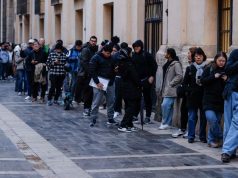
After months of federal occupation by thousands of Department of Homeland Security forces across the Twin Cities of Minneapolis and St. Paul, disruptions to daily life have become commonplace across much of Minnesota — including throughout the local court system, which has been under unprecedented stress from both the volume and nature of the cases before it.
As frustrations from judges, attorneys and civic leaders begin to boil into public view, Minnesota’s courts are struggling on rapidly shifting legal ground. And with no end to the administration’s mass deportation agenda in sight, local courts may be unable to maintain their core functionality in the face of President Donald Trump’s maximalist agenda.
‘The system sucks. This job sucks.’
Operation Metro Surge has seen a “rupture” between the DHS actions on the ground in Minnesota and the Justice Department attorneys who claim they’ve “struggled” to gain ICE cooperation and are “running on fumes to manage the extraordinary workload,” said Politico. It’s a dynamic that has “clogged court dockets” nationwide, but “nowhere more acutely than in Minnesota.” Courts in the state are “buckling beneath the weight of a deluge of cases,” said The New York Times. The resulting “turmoil” has “demoralized prosecutors, outraged judges, exhausted defense lawyers” and, crucially, has left detainees “languishing in detention in violation of court orders.”
“What do you want me to do?” asked federal prosecutor Julie Le of U.S. District Judge Jerry Blackwell during a hearing on Tuesday. “The system sucks. This job sucks. And I am trying every breath that I have so that I can get you what you need.” The remarks offered an “extraordinary window” into the volume of cases “overwhelming federal prosecutors,” said CBS News. At the same time, the incident highlighted the “frustrations of exasperated judges” whose orders are often ignored or lost. Le was later “removed from her role after that outburst,” said The Washington Post, but hers has been “hardly the only voice expressing deep frustration in recent days.”
More than a dozen DOJ lawyers in the U.S. Attorney’s office of Minnesota have quit their posts over the administration’s actions since the start of the deportation surge. Those include members of the civil division, which has been tasked with dealing with “hundreds of lawsuits from migrants who allege that ICE illegally jailed them,” said NPR.
Shifting away from ‘pressing and important priorities’
The glut of deportation cases is impacting more than just immigration court. All the attorneys working on the welfare fraud cases that the administration has used as its impetus for targeting Minnesota have left, forcing the White House to bring in “reinforcements from other states and even the military,” said NPR. The circumstances present a major problem even for experienced lawyers who lack “intimate knowledge of the cases.”
Responding to the “wave of habeas petitions” for detained immigrants has also forced the Minnesota Attorney’s office to “shift its already limited resources from other pressing and important priorities,” said Minnesota U.S. Attorney Daniel Rosen in a recent court filing. Accordingly, Rosen’s office has “cancelled all [civil enforcement] work and any other affirmative priorities” to operate “in a reactive mode” instead.
Mass arrests and chaotic administration have pushed Twin Cities courts to the brink as lawyers and judges alike struggle to keep pace with ICE’s activity