
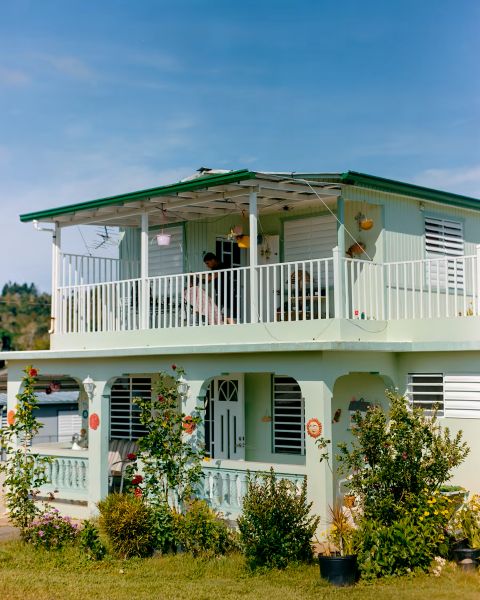
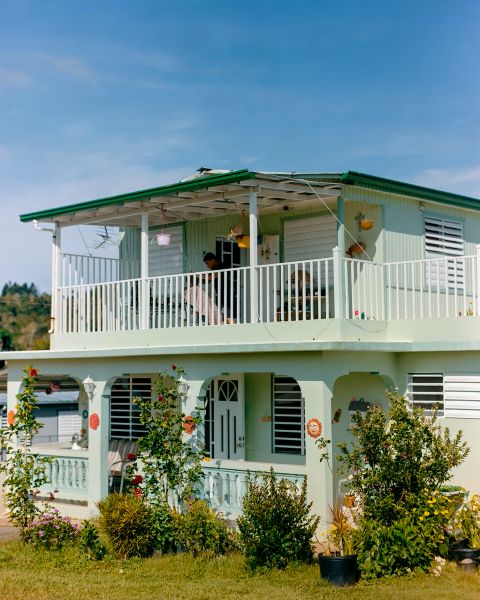
[Many thanks to Peter Jordens for bringing this item to our attention.] In this article, Ana Teresa Toro (El País, 23 May 2026)— with photographs by Steph Segarra— analyzes how the casita may work as a universal metaphor for a homeland and much more. Toro writes, “Bad Bunny’s casita is at the center of his concerts on the ‘DebÍ Tirar Más Fotos’ world tour. It’s a symbol of home, but also of an entire community.” Here are excerpts; for full article, the short film “Debí tirar más fotos,” and additional photos, visit El País.
It’s not a house: it’s a casita. The diminutive of casa — Spanish for “house” — is important. Not because it minimizes or diminishes what it describes, but because it implies affection, intimacy, and family. In the Caribbean, diminutives have the ability to smooth over complex topics.
In these parts, you don’t ask for a favor: you ask for un favorcito, a little favor. You don’t boast about having a huge sailboat (even if it really is): you simply have a tiny boat. And you don’t go out for a meal; instead, you grab a little something, even if you’re referring to a banquet. So, when the complete stage setup for Bad Bunny’s concert residency — titled No me quiero ir de aquí (“I don’t want to leave this place”) — was unveiled last summer in San Juan, Puerto Rico, it was only natural that everyone started calling it la casita, or “the little house.”
It’s true that its dimensions support the nickname: it’s about 42 feet wide and 42 feet deep, with an 11-foot ceiling. The model is as wide as the real house that inspired it, but less deep.
However, that affectionate diminutive has much more to do with the emotional and historical weight of the structure than with its appearance.
The casita first appeared in the short film (directed by Arí Maniel Cruz and Bad Bunny) that accompanied the release of the album titled Debí Tirar Más Fotos (2025). It stars filmmaker and actor Jacobo Morales — a key figure in Puerto Rican culture — and tells a story about the near future, in which the displacement currently taking place on the island is evident. The Puerto Rico depicted is one in which there are no Puerto Ricans, something that a certain political force today desperately longs for.
The original house was found by designer and art director Mayna Magruder Ortiz in the municipality of Humacao, in the southeast of the island. It was initially intended for the film, but later on, Bad Bunny’s team decided to incorporate a replica of the house into the world tour’s stage design instead. The creative process behind this decision — like almost everything that the singer’s inner circle works on — is a closely guarded secret. This isn’t only to maintain the element of surprise, but also to avoid pushing viewers and listeners toward a specific interpretation. [. . .]
While the focus is on the casita, the guests are — so to speak — family, while the rest of the concertgoers effectively become friends of friends, distant cousins, or neighbors who show up at the party somewhat uninvited, but end up dancing in the middle of it all, helping out in the kitchen, and watching the night go by in a rocking chair on the balcony. The little set piece thus manages to convey the intimacy of a house party within the massive scale of a concert that brings thousands of people together in a stadium. [. . .]
As they dance around — and as the show moves in and out of the structure — guests can see artwork by Puerto Rican artists like Lorenzo Homar and Alexis Díaz, sit on the sofa to watch one of the screens installed inside, order a drink in the kitchen (which doubles as a bar), or wander around the area where the DJ is playing music. Outside, there are lots of plants, typical of the island’s home gardens. At times, Bad Bunny comes and goes, dances with the crowd, sits and sings in the balcony chair, and climbs onto the roof and walks across it (something much appreciated by concert-goers whose view was obstructed by the prop house). [. . .]
At the peak of the concert, the audience is invited not only into the intimacy of the space — “I invite you to my casita,” the singer declares — but also into the liberating, transgressive energy of dancing with complete abandon. Whether one comes back up from that level of intensity is another matter. [. . .]
For full article, videos, and additional photos, visit https://english.elpais.com/culture/2026-05-23/mi-casa-es-su-casa-the-architecture-that-explains-puerto-rico.html
[Many thanks to Peter Jordens for bringing this item to our attention.] In this article, Ana Teresa Toro (El País, 23 May 2026)— with photographs by Steph Segarra— analyzes how the casita may work as a universal metaphor for a homeland and much more. Toro writes, “Bad Bunny’s casita is at the center of his