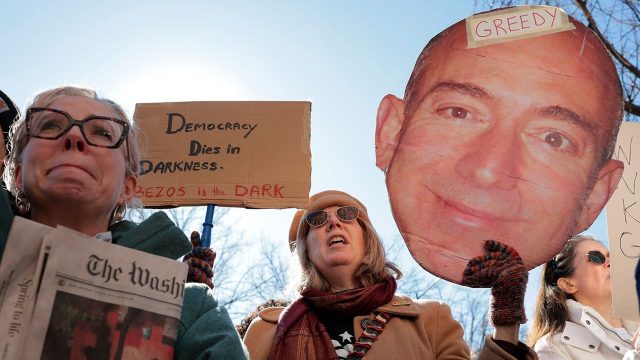
The digital age has killed off thousands of American newspapers, said Ashley Parker in The Atlantic. But at The Washington Post, “we’re witnessing a murder.” This month, at the direction of its owner, Jeff Bezos, Post executive editor Matt Murray laid off—by Zoom—nearly half of the paper’s editorial staff, more than 350 reporters, including correspondents reporting from the front line in Ukraine and most of those covering the D.C. region. Explaining the cuts, Murray cited the paper’s financial losses—$100 million in 2024 alone—which he blamed in part on the Post’s liberal slant. “We too often write from one perspective,” he said, “for one slice of the audience.” But these excuses make no sense, said Margaret Sullivan in The Guardian. The New York Times is “profitable and expanding,” with a political stance arguably to the left of the Post’s. And for Bezos, who is worth close to $250 billion and just casually splashed $75 million on a Melania Trump documentary that’s “leaving seats empty in a theater near you,” the Post’s losses are “essentially pocket change.” Was this really a business decision? Or did the Amazon founder gut the paper that brought down President Nixon to “curry favor” with President Trump?
Bezos is wildly rich, it’s true, said Ben Domenech in the New York Post. He could keep “lighting cash on fire” indefinitely if he wanted to keep the Post afloat and unchanged. But why would he want that? Any newspaper that loses $100 million a year is clearly not giving people “the stories they want or need to read.” For the Post to survive long-term, radical change is in order, including a return to the political center and away from “race-focused, pro-transgender, anti-Trump coverage.” The Post’s 2017 reinvention as a “Democracy Dies in Darkness organ of Resistance” was good for a short-term spike in subscribers, said National Review in an editorial, but it didn’t last. The notion that Bezos is somehow “obligated” to keep funding that failed experiment “reeks of entitlement.”
But Bezos is largely to blame for the paper’s woes, said Alex Kirshner in Slate. His 2024 decision to kill a planned endorsement of Kamala Harris “drove away 250,000 paying subscribers,” about 10% of the digital subscriber base, and the “bleeding” continued when he decreed that the opinion section would stop fretting about authoritarianism and focus instead on “personal liberties and free markets.” Nobody wanted a center-right Post, said Nick Catoggio in The Dispatch: not the paper’s liberal subscribers, nor the conservatives Bezos hoped to woo, who prefer the “insane slopaganda” of cable news and social media. At this point, he should admit defeat and “just sell the paper.” There must be some “civic-minded billionaire” out there willing to save one of the world’s great newspapers.
It’s “not going to happen,” said Jonathan V. Last in The Bulwark. In Trump’s authoritarian America, what billionaire wants to invite a flood of frivolous 10-figure lawsuits, even criminal prosecutions, by funding journalism that holds the president accountable? And why would Bezos sell? asked Eoin Higgins in The Intercept. If he now does to the Post what billionaires Larry and David Ellison have done to CBS News—gutting the newsroom and imparting a “rightward,” Trump-friendly spin to its coverage—he’ll be lavishly rewarded in merger approvals and new government contracts for his many ventures. Maybe there is some benevolent billionaire willing to swoop in and save the Post, but if Bezos has taught us anything, it’s that “billionaires are only benevolent until they’re not.”
Possibilities include to curry favor with Trump or to try to end financial losses