
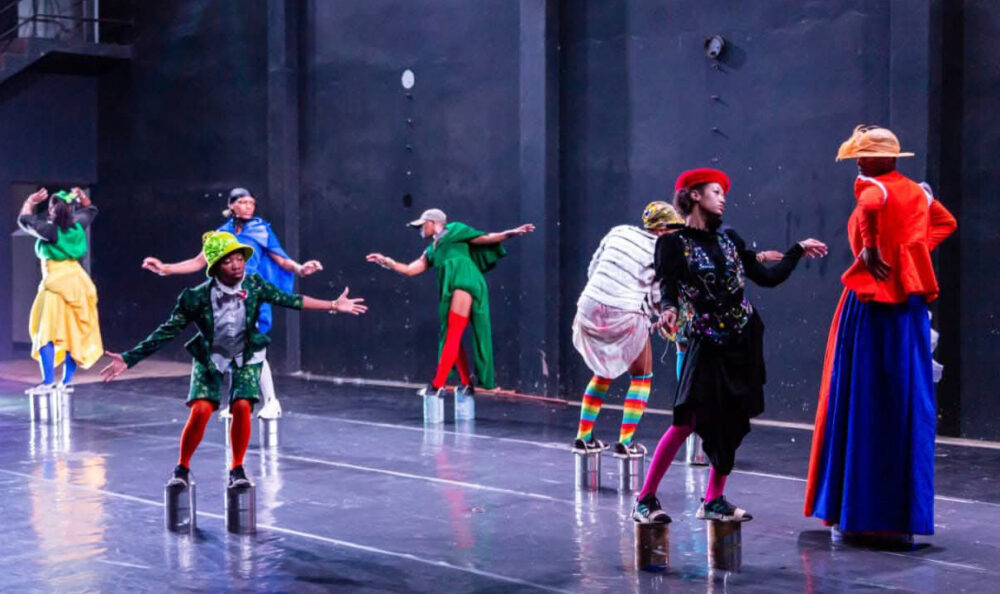
In isiXhosa, mamela means to listen, focus, take heed or simply “look here!” It is also the name of a globally recognised performance artist Mamela Nyamza.
True to its etymology, the name functions as a directive for the world to attend to Nyamza’s narratives of dance and theatre.
An unending stream of accolades serve as evidence that the world is indeed listening. Bamamele (“They are listening”).
Nyamza was recently awarded the 2026 Biennale Danza Silver Lion and the Stand Foundation’s Mohlopi Award.
In 2022 she won the Marraines Fiddo Award at the Festival Inter-national de Danse de Ouagadougou. She is an international top-five finalist for the prestigious 2026 Salavisa European Dance Award.
When I spoke to Nyamza last week, she had just touched down in France, where her team were preparing for a sold-out week’s run of Hatched Ensemble at the Maison de la Danse in Lyon. Performing for 1 800 people a night, as part of the Dance Reflections festival by Van Cleef & Arpels.
“Hatched Ensemble premiered in Makhanda, Grahamstown, at the National Arts Festival in June 2023. It was an expansion of my 2007 solo work, Hatched. Today, I am no longer on stage.
“I remain in the wings as choreographer, presenting an ensemble of dancers I handpicked in 2023. The oldest is 46, the youngest 14. This piece has matured and it has travelled the world quite extensively,” Nyamza said.
The production has toured internationally to more than 17 countries and festivals, among them the UK, Italy, Russia, Germany, The Netherlands, Canada, Norway, Mozambique, the US and most recently France.
The cast includes opera singer Litho Nqai and African Instrumentalist Given Mphago.
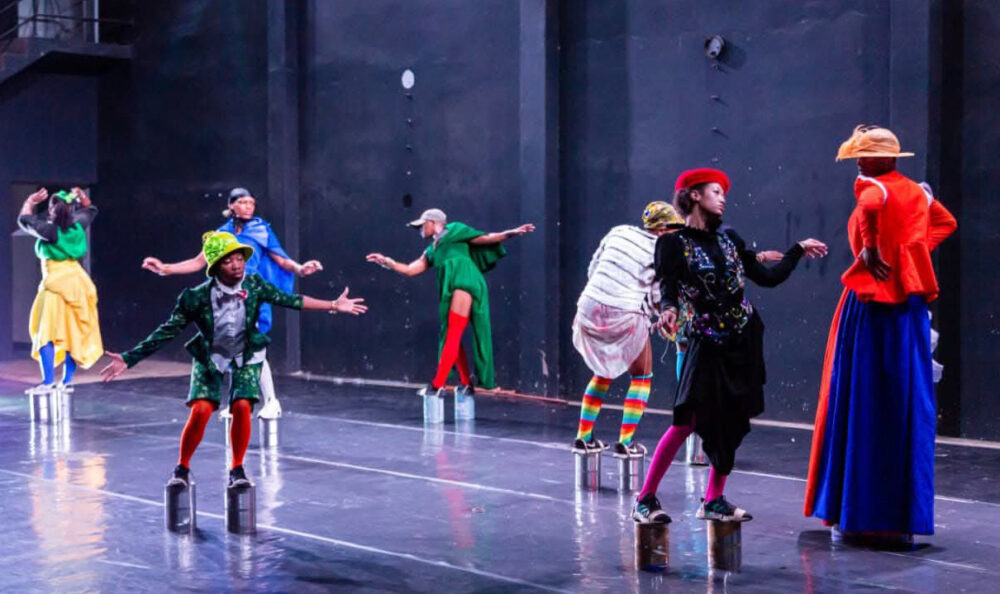
“Hatched Ensemble features 10 ballet-trained dancers from different ethnic backgrounds. On stage they convey deeply personal and challenging issues of tradition and their evolving experiences of gender norms in dance classics, until they ultimately realise their own respective true identities.
“The production speaks to anyone who has felt conflicted about their own identity and where they belong in the status quo.
“The ballet shoes worn in this piece represent colonialism, the Western world, confinement — they are like tools of oppression.
“The white tutus represent marriage and the ballet world in general — how black ballet dancers could not fit in on that ballet stage. I wanted to show that anybody can dance, regardless of the production they want to be a part of.”
Hatched Ensemble is a blend of history, song and dance. Ballet. Deconstructed ballet to be exact.
Despite international acclaim, Nyamza remains focused on a South African audience. Hence, through her Artistic Movement NPC, she was able to raise funds to do two runs of Hatched Ensemble at the Baxter Theatre in Cape Town.
“It is vital for South Africans to see this. Our work is celebrated abroad but I want South Africans to experience this work on their home stages too.”
Nyamza is aware of the history that rendered theatre an inaccessible luxury for most South Africans. Nevertheless, she believes a culture of theatre-going can be engineered.

govern us.
“It starts with the younger generation. My own family bought tickets; they told me: ‘MaZaba, siwathengile amatikiti siyokubukela (MaZaba, we bought tickets to watch)!’ Now their friends and fellow church-goers are following them to the Baxter this Wednesday and Thursday! They want to see lo mzukulwana kaMaDlamini [MaDlamini’s grandchild] on that stage. That is how you shift the status quo!”
Born in Gugulethu, Cape Town, in 1976, Nyamza dreamt of becoming a teacher. Her path shifted at the age of eight when she discovered dance at Gugulethu’s Zama Dance School. It was love at first dance. She never looked back and in 1994 she graduated with a national diploma in ballet from Tshwane University of Technology.
In 1999, she won a scholarship to study at Alvin Ailey American Dance Theatre School in New York, where she co-created and performed The Dying Swan. The work earned her the Dance Umbrella Award for Outstanding Performance by a Female Dancer in Contemporary Style in 2000.
This week, the very same Nyamza of international acclaim brings two trailblazing productions, Hatched Ensemble and The Herd/Less to The Baxter in Cape Town for only two performances each.
The Herd/Less is yet another contemporary dance-theatre production by Nyamza.
Though she played her cards close to her chest on the upcoming two-day world premiere, she shared that The Herd/Less is an uncomfortable interrogation of collective behaviour and the social structures that govern us.
It essentially plays on the linguistic duality of the word “herd” to explore the thin line between community and conformity.
The Herd/Less interrogates the fallacy of a “beautiful world” while exposing violent realities of vulnerability. The performance is also an opportunity to see Nyamza’s stage-directing skills.
This one is a more intimate and physically demanding work. The cast takes on the immense physical and emotional labour of representing both the individual and the “herd”.
The power of the piece, it is said, lies in its ability to use their own bodies to mimic the movements of a collective; oscillating between the grace of a community and the rigid, mechanical movements of a controlled group.
The Herd/Less has generated much interest from various festivals and dance platforms.
It has been invited to a season of the 2026 JOMBA! Dance Festival and been short-listed for the National Arts Festival in Makhanda this year. It will also make its European debut at the Venice Dance Biennale in Italy in July.
Hatched Ensemble will be staged on 29 and 30 April from 8pm at The Baxter. The Herd/Less world premiere will be staged on May 1 at 8pm and again on May 2 at 2pm also at The Baxter. Bookings are open on Webtickets and at Pick n Pay.
Internationally celebrated dancer Mamela Nyamza returns home with two powerful productions interrogating identity, colonial legacies and belonging through bold, deconstructed movement