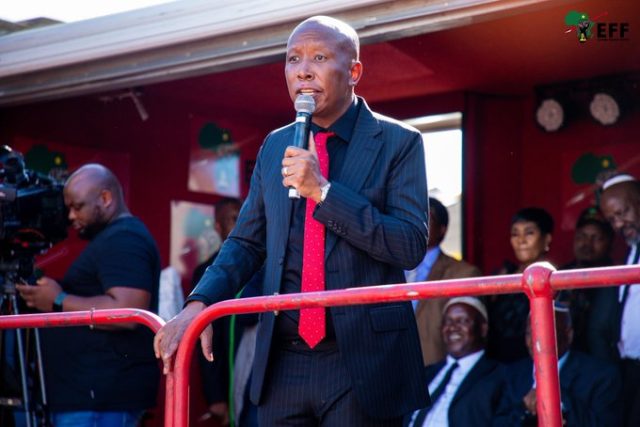
Economic Freedom Fighters leader Julius Malema is set to challenge his five-year prison sentence after being granted leave to appeal, triggering a legal process that will focus on whether the punishment imposed for discharging a firearm at a political rally was appropriate, even as his conviction remains.
Malema was granted leave to appeal his sentence but not his conviction following a ruling by magistrate Twanet Olivier in connection with a 2018 incident in which he was filmed firing a rifle into the air during the party’s fifth anniversary celebrations in Mdantsane in the Eastern Cape.
The court found that there were reasonable prospects that another court could arrive at a different conclusion on sentence but not on the question of guilt. This effectively narrows the scope of the next phase of litigation to the appropriateness of direct imprisonment, rather than the lawfulness of the conviction itself.
Within minutes of the ruling, Malema’s legal team, led by advocates Tembeka Ngcukaitobi and Laurence Hodes, moved to secure leave to appeal. The application was partially successful, opening the door to further proceedings in a higher court, where the proportionality of the sentence will be tested against the trial record.
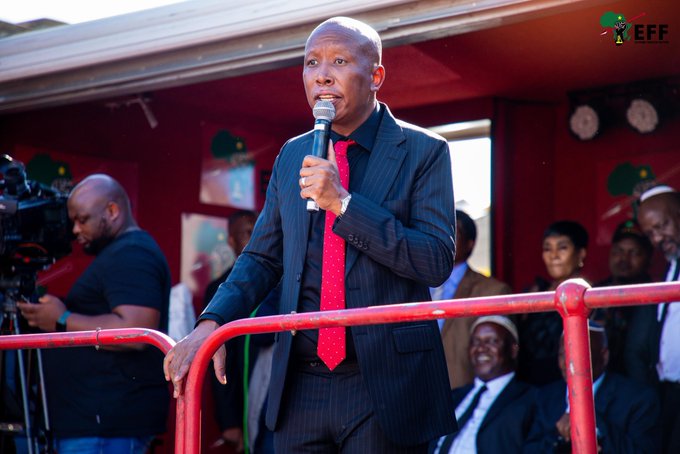
Addressing supporters and the media outside the KuGompo City regional court, Malema rejected the outcome and directed sharp criticism at Olivier, alleging that the judgment was neither independently authored nor free from external influence.
He further accused the magistrate of bias and suggested that her conduct should be reported to oversight bodies.
“It’s not her judgment. It is a sponsored judgment,” Malema said. He added that what he described as an “invisible hand” had shaped the outcome of the case.
“She is the most incompetent magistrate. We suspect she doesn’t write her own judgments. You are dealing with an invisible hand that is controlling the proceedings of the court.
“We must make sure that she gets reported to the magistrates council because the prosecutor knew about the judgment before she could read the judgment. “We did not even have to pay for bail; they just said free bail, go home.”

Malema characterised the prosecution as politically motivated and framed the case as part of a broader attempt to weaken him ahead of the 2026 municipal elections. He maintained that pursuing an appeal was a lawful exercise of his rights and did not imply a lack of remorse.
The EFF echoed these sentiments in a statement, describing the sentence as disproportionate and inconsistent with both the facts and the broader context of the incident.
The party said the matter had unfolded in a highly politicised environment and accused the National Prosecuting Authority of demonstrating what it called a suspicious appetite for imprisonment in a case where no physical injuries were reported.
According to the party, the discharge of the firearm occurred in a celebratory context during a political gathering and there had been no intention to cause harm. It further raised concerns about procedural issues, including the handling of evidence and alleged that the prosecution sought to make an example of Malema.
In delivering sentence, Olivier rejected the defence’s framing of the incident and emphasised that the court was guided by the evidence before it rather than political considerations. She said the circumstances under which the firearm was discharged were of serious concern, particularly given the planning involved.
“What was of great concern to the court was that an event was planned and what appeared to be a unique picture of the event ended up being an offence,” she said.
The magistrate found that the conduct was not impulsive but formed part of a premeditated sequence of actions. She said it required forethought to determine how and when the firearm would be obtained and discharged. “To reason otherwise is nonsensical,” Olivier said.
She rejected the argument that the shots were fired as part of a celebration, holding that the decision to act unlawfully had been taken in advance and with awareness of its illegality. “Such acts can never be condoned by the courts. The action cannot be justified as celebratory shots,” she said.

Olivier further stressed that the offence could not be justified within any broader political context. She said the proceedings concerned an individual accused, not a political organisation and that political arguments raised during the trial did not form part of the evidentiary record.
“It is not a political party that has been convicted, it is an individual,” she said, adding that the judiciary would not be intimidated by politically charged statements.
The court’s findings were based on the testimony of 19 witnesses and other evidence placed before it. Olivier said the matter had been decided on the facts and not on any external considerations.
For the state, advocate Joel Caesar argued for a custodial sentence of up to 15 years, submitting that the discharge of a firearm in a crowded public setting constituted a serious offence requiring a deterrent response, particularly when committed by a public figure.
Although the court imposed a lesser sentence, Caesar said he considered the outcome to be fair.
He opposed the application for leave to appeal, arguing that there was no reasonable prospect of another court reaching a different conclusion and that an appeal would amount to an unnecessary use of judicial resources.
“There is no reasonable prospect of success on appeal. Another court would come to the same conclusion,” Caesar said.
Ngcukaitobi, however, argued for a non-custodial sentence, submitting that there had been no intention to cause harm and that the incident occurred within the context of a political rally. He said the test for leave to appeal was whether another court, faced with the same facts, could reasonably arrive at a different conclusion.
“The question is whether another court, looking at the same facts, could come to a different conclusion,” he said.
Ngcukaitobi maintained that the prospects of success on appeal in respect of sentence were strong, adding that several grounds advanced by the defence had not been meaningfully opposed by the state.
Legal analyst Ulrich Roux said the appeal court would be confined to the trial record in determining whether the sentence should stand. He said the central issue would be whether a different court could reasonably impose a lesser penalty on the same set of facts.
Roux noted that the state had presented strong evidence during the trial, including ballistics analysis confirming that live ammunition had been discharged. This, he said, was inconsistent with Malema’s version that he had handled what he described as a toy gun.
He added that the defence argument regarding the absence of DNA evidence linking Malema to the firearm appeared to conflict with his own admission during the trial that he had handled the weapon.
“It is all on paper. You cannot rely on the demeanour of witnesses or how they performed under cross-examination,” Roux said.
According to Roux, the appeal proceedings would not revisit factual disputes as in a trial but would instead assess whether the sentence imposed was reasonable in light of the established facts and applicable legal principles.
Other legal analysts have similarly indicated that while the threshold for overturning a conviction is high, appellate courts are more willing to intervene on a sentence where it is found to be disproportionate or not aligned with precedent.
This places the focus of the forthcoming appeal squarely on whether direct imprisonment was justified, or whether an alternative sanction such as a suspended sentence would better serve the interests of justice.
Inside the courtroom, there was little visible reaction from Malema’s family members and senior party leaders when the sentence was delivered. Many remained quiet as proceedings concluded.
During a break, some party leaders and family members sang “bizani i fire brigade kuyasha”, loosely translated as “call the fire brigade, it is on fire”.
Malema briefly addressed photographers, asking how many pictures they wanted before indicating fatigue with the process.
Outside court, supporters gathered in numbers and continued to chant struggle songs. While vocal, many did not appear surprised by the outcome.
EFF national chairperson Godrich Gardee said the party was prepared to pursue further legal avenues should the appeal process not succeed. He said contingency plans included approaching the high court urgently and, if necessary, escalating the matter to the Constitutional Court.
“We are ready to trigger plan B and we are also ready to trigger plan C,” Gardee said.
EFF representative Nkululeko Dunga framed the outcome as part of a broader political struggle, saying the party would continue to challenge the ruling through legal channels.
The Democratic Alliance’s Geordin Hill-Lewis welcomed the sentence, saying it underscored the seriousness of firearm-related offences and reinforced the principle that no individual is above the law.
“Gun violence is out of control in South Africa, so any crime involving illegal gunfire is extremely serious,” he said. He added that strong consequences for such offences were necessary to deter similar conduct and restore public confidence in the rule of law.
After the proceedings, Malema was released without bail. His supporters gathered outside the court, chanting his name and welcoming him as he addressed them. He reiterated his criticism of the magistrate, alleging incompetence and bias and said he would not be going to prison in the near future as the legal process continued.
The case is now expected to proceed to an appellate court, where the central question will be whether the sentence imposed by the lower court was appropriate in the circumstances.
With the conviction upheld and only the sentence under review, the outcome of the appeal will determine whether Malema faces imprisonment or a reduced penalty, ensuring that the matter remains before the courts for the foreseeable future.
The EFF leader will appeal his five-year prison sentence after a court upheld his conviction for firing a rifle at a political rally, while granting leave to challenge the punishment