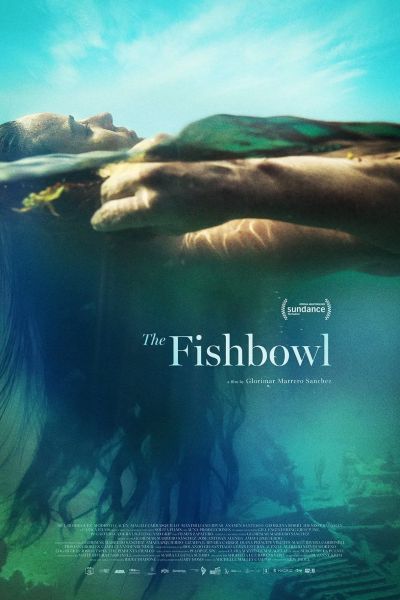
[Many thanks to Linda Rodríguez Guglielmoni for bringing this item to our attention.] In her review of La pecera [The Fishbowl], directed by Puerto Rican filmmaker Glorimar Marrero Sánchez, Lizabel Mónica describes the film as being “about contamination, care, grief, and the dangerous question of who gets to decide what survival means.” Read this incisive and poignant review at Between Tongues; here are excerpts.
There are invitations that arrive like a knock from another island. Punzantes y con olor a salitre.
A few days ago, Susana Draper — now a friend, but also one of my former professors from Princeton’s Department of Comparative Literature — sent me a warm note inviting me to a screening of La Pecera, by Puerto Rican filmmaker Glorimar Marrero Sánchez. She said she had been thinking of me lately.
Ya tú sabes, for Cuban reasons.
She did not have to spell out the bridge between Puerto Rico and Cuba. The connection was there, quietly pulsing under the invitation. [. . .]
So I went.
And then I sat in the dark watching a film where everything was wet: sea, bathtub, hurricane, archive, skin. A film where the Caribbean was not a postcard but a contaminated organism. A film where the real question was not how to survive, but who gets to decide what survival means.
Un filme lleno de agua y circunstancia.
Agua,
y circunstancia
y muerte,
por todas partes.
Una muerte que está llena de vida, o viceversa.
La Pecera began, according to Glorimar, somewhere in the orbit of Princeton’s Program in Latin American Studies in 2019. Cooked, as I wrote in my notes, in PLAS. Which is to say: it had already traveled through the strange institutional kitchen where ideas become scripts, where islands enter classrooms, where grief becomes research, where research becomes art, and where art, if it is honest enough, refuses to stay clean.
Menos mal.
It is beautiful, yes. Painfully so. But not in the sanitized way institutions sometimes prefer their “Caribbean” beauty: palm trees, turquoise waters, folkloric dignity, a little suffering but not too much, preferably framed for the grant report where “native informants” have the second-to-last word.
No.
This beauty is inseparable from the pain. [. . .]
The Fishbowl Is Not a Metaphor, or Not Only
The film follows Noelia, an artist whose cancer has returned and spread. She refuses further treatment and goes back to Vieques, where the island itself is also sick, marked by the toxic aftermath of U.S. military occupation and bombing practices. But the film does not flatten her into metaphor.
That matters.
The sick woman is not simply “Puerto Rico.” Puerto Rico is not simply “a sick woman.”
The body and the island touch each other, echo each other, contaminate each other, but they do not collapse into one lazy symbol.
There is a difference between resonance and reduction. La Pecera knows this. Some criticism, bless its laminated heart, does not.
[. . .] But La Pecera resists the laziness of perfect metaphor. The more I think about it, the less interested I am in what the body “stands for” and the more interested I am in what the body does: leaks, refuses, tires, desires, wraps itself, listens, chooses.
When someone asked Glorimar why the title — La Pecera, the fishbowl — she said it had to do, above all, with looking. With being watched. And then the question opened like a wound: Who is looking? The person inside? The person outside? Who is kept in the microenvironment? Who gets to stand outside the glass and call that distance objectivity? [. . .]
Read the full review at https://lizabelmonica.substack.com/p/la-pecera-or-the-caribbean-refuseswa
[Many thanks to Linda Rodríguez Guglielmoni for bringing this item to our attention.] In her review of La pecera [The Fishbowl], directed by Puerto Rican filmmaker Glorimar Marrero Sánchez, Lizabel Mónica describes the film as being “about contamination, care, grief, and the dangerous question of who gets to decide what survival means.” Read this incisive