In Spain’s El País (11 April 2026), renowned author Leonardo Padura published a razor-sharp opinion piece: “¿Y qué va a pasar en Cuba?” [And what’s going to happen in Cuba?”]. He stresses that “The country must change, not because it’s being suffocated from the outside, but because Cubans need it to change.” Here are translated excerpts; read the full article, in Spanish, at El País. The original offers numerous links from El País that are directly related to this topic. [Many thanks to Dr. Michael Connors for bringing this item to our attention.]
Cuba has become fashionable, and I’m in high demand. Fellow journalists seek me out to report, from inside the country, on what they already know is happening, but with the predictable aim of getting me to speculate on what might happen. And, of course, I can only tell them that all scenarios are on the table, ranging from something changing so that nothing really changes, to, at the other extreme, some kind of military operation with unpredictable consequences. But I warn them that, right now, I don’t think anyone can choose one over the other.
Apparently, US President Donald Trump intends to do even more than he already has: he’s intensified the maximum pressure policy with the energy blockade, which is suffocating not only the country’s economy but also many of its citizens. And then, as if he were the last crusader, using textbook conquistador rhetoric, he insistingly says that he will “take” Cuba (because that “would be nice”) without really explaining how he will do it, though implying that it will be his way (which could be any way).
In Cuba, meanwhile, the government maintains its principled stance: preservation of sovereignty and the political system, although it is open to dialogue with US counterparts whose existence, after weeks of denial, was finally acknowledged, without any transparency regarding its development. It is difficult, however, to imagine the content of these exchanges between two positions that, as far as we can tell, are quite irreconcilable.
Meanwhile, without altering its rhetoric, the Cuban leadership has begun to make moves, though it can’t be easy to do so under a Damocles’ sword. One of the most recent measures has been to authorize Cuban emigrants to establish almost any type of business on the island, of any size they wish, including those in production, infrastructure, and even banking and finance. This decision, which also affects Cuban-Americans, does not extend the same entrepreneurial opportunities to Cuban citizens residing in the country, who are currently limited to small and medium-sized enterprises. [. . .]
The truth is that Cuba is currently experiencing one of its most dramatic economic and social crises, catalyzed by an energy blockade that has paralyzed or at least severely impacted a wide range of activities across many sectors of national life. But it is also true that the oil shortage has only exacerbated the critical situation already plaguing the country with prolonged blackouts, deteriorating public transportation, a lack of medical supplies, inflation, and the resulting high cost of living, reflected in the low wage of a large portion of the population.
An important element in understanding how the current polycrisis is being experienced in the country is to try to differentiate it from the crisis of the 1990s, the so-called Special Period that followed the Soviet collapse. Back then, the extremely dramatic situation of scarcity of everything imaginable had a political agenda: the shortages were experienced horizontally, that is, they affected almost the entire population equally, and in this way, the homogeneous structure of Cuban society was maintained. [. . .]
In any case, it’s true that changes are being promoted, changes with some social impact, and attempts are being made to do what could have already been done. Because what is undeniable is that Cuba must change, but not because it’s being suffocated by external forces, but because Cubans—impoverished, weary, and hopeless—need it to change, in many ways. And it’s no longer surprising that there are some who yearn for change at any cost, regardless of where the impetus comes from. [. . .]
And, by the way, the hardest thing for those colleagues who ask how things are in Cuba is making them understand some of the deeper layers of this reality. I will offer just one example.
Across from my house there is a private café where the owners of the electric scooters that are increasingly popping up around the city, now the most common solution for public transportation, often stop to eat and drink something. So, whether there is electricity or a blackout, most of them take their break next to their scooters, which they’ve fitted with speakers that blast the latest reggaeton hits throughout the neighborhood. There’s a crisis, it’s true, many problems, that’s the truth, but, for the moment, it’s also true that we have Bad Bunny and Bebeshito. And, of course, a great desire to live.
For full article (in Spanish), see https://elpais.com/opinion/2026-04-12/y-que-va-a-pasar-en-cuba.html
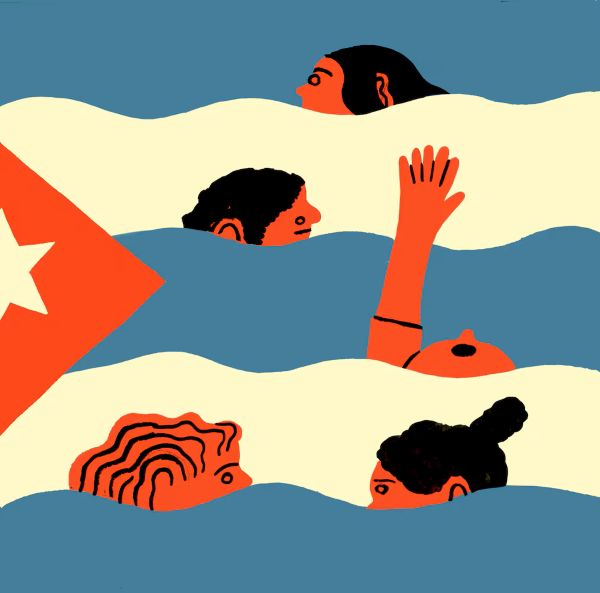
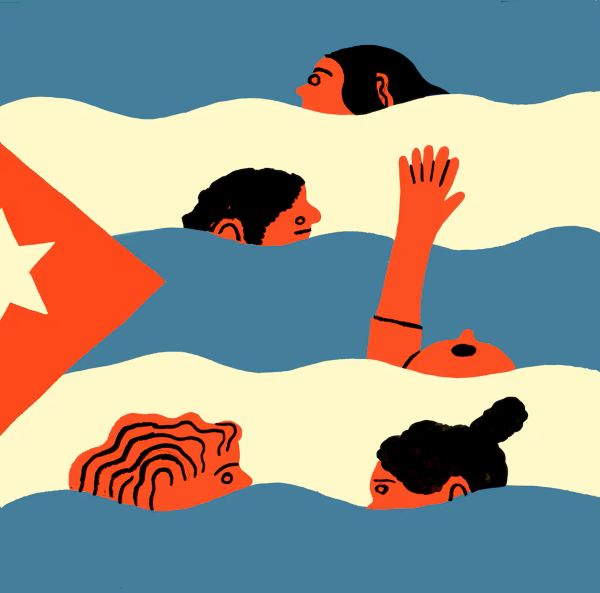
[Illustration above by Cinta Arribas.]
In Spain’s El País (11 April 2026), renowned author Leonardo Padura published a razor-sharp opinion piece: “¿Y qué va a pasar en Cuba?” [And what’s going to happen in Cuba?”]. He stresses that “The country must change, not because it’s being suffocated from the outside, but because Cubans need it to change.” Here are translated