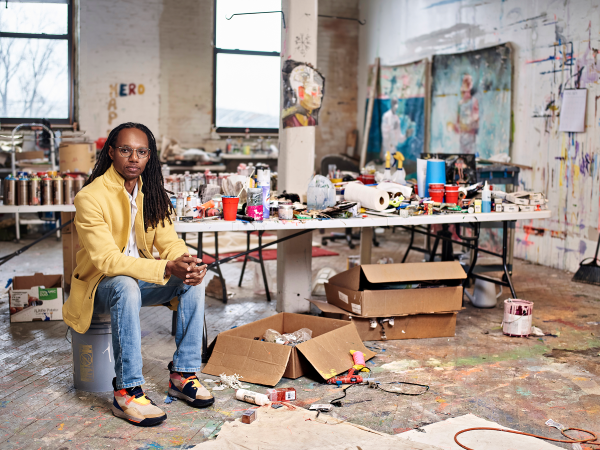
“Per capita, the Bahamas has one of the highest concentrations of working artist studios in the world.” ArtReview recently interviewed Bahamian artist Lavar Munroe who, alongside work by the late John Beadle, is representing the Bahamas at the 2026 Venice Biennale.
ArtReview writes: [We] sent a questionnaire to artists and curators exhibiting in and curating the various national pavilions of the 2026 Venice Biennale, the responses to which will be published daily in the leadup to and during the Venice Biennale, which runs from 9 May through 22 November. Lavar Munroe and the late John Beadle are representing the Bahamas; the pavilion is in San Trovaso Art Space. Here are excerpts from the interview.
ArtReview: Tell ArtReview what you plan to exhibit in Venice. What has influenced or inspired you?
Lavar Munroe In Venice, I will present three interrelated bodies of work that explore ritual, ancestry, spirituality and communion.
The earliest of the three emerges from a long-term research project in Zimbabwe, where I spent three years investigating and responding to Kurova Guva, a Shona ceremony used to ‘call home’ the spirit of the dead. Drawing from anthropology and immersive research, the work examines belief systems, spiritual continuity and ancestral communion. This process also became a lens through which I reflected on my own spiritual upbringing in the Bahamas, allowing parallels to surface between Zimbabwean ritual practices and Bahamian understandings of death and spirituality.
The second body of work, No Matter How Dreary and Gray, We People of Flesh and Blood Would Rather Live Here, Than in Another Man’s Yard (2026), is an eleven-panel painting. Inspired by the Bahamian Junkanoo Wake – a ceremonial sending-off of the spirit of the dead – the work functions as both homage and invocation, dedicated to my late collaborator John Beadle. The panels depict a solemn yet musical procession led by a young girl carrying a red One Family Junkanoo Organization flag, referencing Beadle’s Junkanoo group. Her presence merges leadership, rhythm, celebration and mourning, while the procession itself becomes a metaphor for collective memory, migration (physical and spiritual) and resilience. This work is also littered with other signifiers to Beadle, such as the newspaper article announcing his death, references to his mobile house and oar sculptures, logos and materials such as cardboard, which was prominent in his work.
The final work, However Long the Night, the Dawn Will Break (2026), will be a site-specific sculptural installation and posthumous collaboration with Beadle. I will reimagine unrealised sketches from Beadle’s sketchbooks. A key component of this work will be the repurposing of Junkanoo costumes from the most recent Boxing Day and New Year’s Day parades. These costumes, created through the collective labor of Bahamian communities, will be shipped from Nassau to Venice. This process not only reflects the transformation of cultural material into fine art but also embodies the many Bahamian hands, bodies and spirits that have engaged with these objects – drawing, pasting, performing, sweating and bleeding into them. Through this material invocation, I aim to summon the presence of John Beadle and create a work that resonates with memory, collaboration and national identity.
AR In what ways (if at all) does your work relate to the theme of the Biennale exhibition, In Minor Keys?
LM My work foregrounds subtle emotional frequencies such as memory, breath, grief, mourning and music as meditation. Rather than asserting meaning didactically, the work invites slow engagement and meditative attention, allowing viewers to visually listen, feel and linger within the work.
In my work, sound and rhythm function as metaphor, allegory and acts of remembrance. In No Matter How Dreary and Gray…, a rain-soaked, somber atmosphere frames each panel. I attend closely to the visual translation of sound: the song of breath; the rattle of a cart full of pigeons on a lonely dirt road; footsteps in movement; mourning and crying; humming, the ringing of chinaware bells; the sound of rain drops on various surfaces and the quiet noise of a vast ocean set against that of a sublime mountaintop are a few visual clues that play on the idea of minor keys.
Materially, the work is grounded in inheritance and offering. Objects inherited from my late grandmothers – Sadie Curtis, a celebrated Bahamian educator, and Cynthia Hanna, a revered baker and fruit dealer – appear in the works and function as offerings to the ancestors. Hand-fringed Bahamian national newspapers appear not as documentation alone but as sites of mourning, public memory and collective witnessing. Together, these elements hold beauty and grief simultaneously, affirming art’s capacity to connect us to deeper emotional and sensory worlds. [. . .]
AR Who, for you, is the most important artist (in any discipline) that your country has produced?
LM For me, as an artist working on the global circuit, one of the most significant is Tavares Strachan. His importance lies not only in the rigor and ambition of his multidisciplinary practice, but also in his role in expanding the international visibility of Bahamian art. In 2013, Strachan initiated and became the first artist to present the Bahamas National Pavilion at the Venice Biennale, marking a pivotal moment in the country’s cultural history. That gesture fundamentally shifted what was imaginable for Bahamian artists on the world stage. [. . .]
For full interview, see https://artreview.com/lavar-munroe-on-representing-the-bahamas-at-the-61st-venice-biennale/
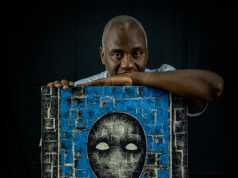
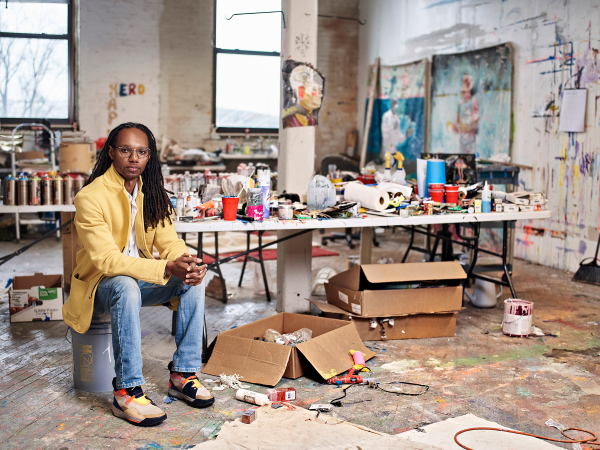
[Photo of the artist by Roy Cox.]
“Per capita, the Bahamas has one of the highest concentrations of working artist studios in the world.” ArtReview recently interviewed Bahamian artist Lavar Munroe who, alongside work by the late John Beadle, is representing the Bahamas at the 2026 Venice Biennale. ArtReview writes: [We] sent a questionnaire to artists and curators exhibiting in and curating the