
Akima McPherson (Stabroek News) writes about artists Wifredo Lam— whose retrospective is presently on view until April 11, 2026, at the Museum of Modern Art (MoMA) in New York— Denis Williams, and Guyana’s indebtedness to Cuba in the arts. [Many thanks to Peter Jordens for bringing this item to our attention.]
In August 1941, Wifredo Lam (1902-1982) arrived in Cuba, returning to the country of his birth after nearly a two-decade absence. He was fleeing war-torn Europe. However, in returning to Cuba, he left behind his proximity to the centre of Modern art. According to Veerle Poupeye in Caribbean Art, he had been “accepted into the Paris avant-garde as a protégé of Picasso” (61). This resulted in (among others) an introduction to André Breton, a founder and leader of Surrealism. Later, when escaping the impending German occupation of Paris, he joined Breton and other French artists and intellectuals and travelled to Martinique (a first stop for some). There, Lam met Aimé Césaire, a founder of the Négritude movement. Seven months later, Lam arrived in Cuba.
Lam was met by “a strong, original expression, rooted in the rediscovery of traditions contained in the idealized memory of a colonial past” (Amate, 196). [. . .] Additionally, childhood exposure to the mysteries and syncretism of Santeria through lived proximity to African communities and the practices of his Afro-Cuban grandmother (and/or godmother) was a reservoir to be explored. To this, he added from his association with ethnologist and scholar of Afro-Cuban folklore and customs, Lydia Cabrera. Therefore, from multiple fonts – childhood memory, certain movements of Modern art, generative friendships, and no doubt consciously living in his native land – “Lam worked hard on adapting Cubism and Surrealism to the magical “virgin” world [of Cuba]” (Amate, 198).
In an interview with Cuban art historian Gerardo Mosquera, first published in 1980 and translated and republished in the Journal of Surrealism and the Americas in 2009, Lam reflected: “Here in Cuba there were things that were pure Surrealism (surrealismo puro). One example would be Afro-Cuban religious beliefs [Santería]; one can immediately see the poetry that is preserved in this elemental magical state (estado mágico, primitivo).”
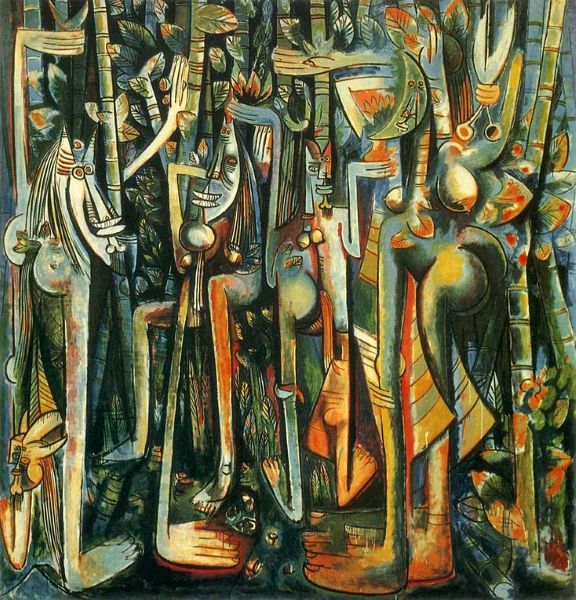
[. . .] By his own assertions, Lam positioned himself within anticolonial and anti-imperialist movements. Important, as by foregrounding his works’ affinity to Afro-Cuban practices, his work was often depoliticised. To Mosquera he stated: “Africa has not only been dispossessed of many of its people, but also of its historical consciousness. It irritated me that in Paris African masks and idols were sold like jewelry. In La Jungla and in other works I have tried to relocate Black cultural objects in terms of their own landscape and in relation to their own world. My painting is an act of decolonization (un acto de descolonización) not in a physical sense, but in a mental one.”
[. . .] Lam, the son of a Chinese immigrant and a mixed-race Afro-Cuban woman, appeared to have fused the aesthetic sensibilities of these dual influences in La Jungla/The Jungle, unifying both in a shared state of colonial/neo-coloniality. For instance, the horse mask to the left of the composition recalls an animal that is significant in both Santeria and Chinese culture.
Speaking on the shift from being an academically trained traditional painter, Lam stated: “At any rate, I don’t think the academic years were merely a wasted time period. I did succeed in becoming a polemical representative of the Third World within European culture, even though Europe had earlier dominated that culture. I was able to speak in a language that turned out to be a lucid one. If a young untrained Black person had come along painting these things, the Europeans would almost certainly have paid no attention to him, because he did not have the skills or instruments to transpose those contents. Yet, I could do it, because I had studied European art very deeply.” [. . .]
In a December 1949 Review in Kyk-over-al, Wilson Harris wrote: The closest parallel to Denis Williams’ painting in the West Indies is the work of Wifredo Lam, the great Cuban painter. Williams’ work is, like his, an amazing compression of the mystical, the tragic, the beautiful. And both artists are vitally concerned in their work with the approach to the particular and the universal.” (quoted in Williams, p. 23)
Both Williams and Lam had left their home countries to study portraiture in their respective colonial ‘motherlands’. Both sharply changed trajectory, embraced Modernism but repositioned it to decolonial/anticolonial gestures. Dismissed by their national elites on their return home, each eventually exerted tremendous influence in their respective home spaces, and in Lam’s case, beyond. Lam’s employ of Synthetic Cubism, his manner of thinning paint for layered application was studied and embraced varyingly by Guyanese artists who, like him, turned to their local spaces for subject matter to paint. [. . .]
Guyana’s indebtedness to Cuba in the arts, and more specifically visual art, is substantial. Lam is but one example of that indebtedness; one which I cannot adequately convey in these few words. Beyond Lam, our art school has benefitted (and continues to benefit) from Cuban-born and Cuban-trained artists. For instance, celebrated sculptors were either trained there or by Cuban-born Josefa Tamayo. Our indebtedness to Tamayo is profound. [. . .]
For full article, see https://www.stabroeknews.com/2026/03/15/sunday/eye-on-art/lam-williams-and-a-final-word/
Also see https://www.moma.org/calendar/exhibitions/5788
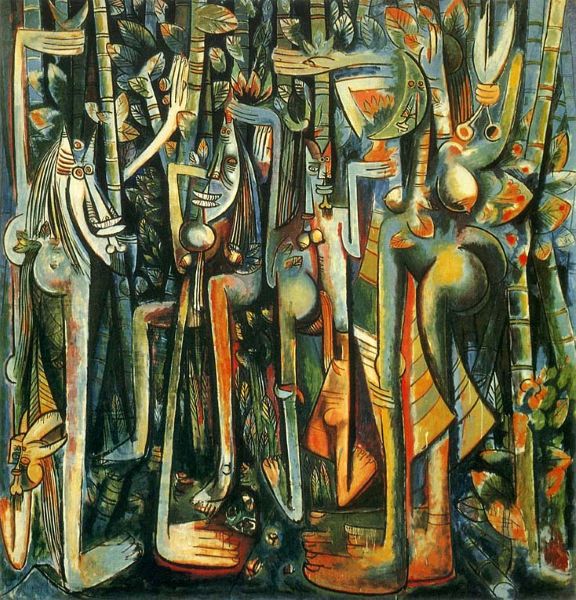
[Lam’s “The Jungle,” 1943 – 94 1/4 x 90 1/2” (239.4 x 229.9 cm) Image source: https://www.artchive.com/artwork/the-jungle-wifredo-lam-1943/]
Akima McPherson (Stabroek News) writes about artists Wifredo Lam— whose retrospective is presently on view until April 11, 2026, at the Museum of Modern Art (MoMA) in New York— Denis Williams, and Guyana’s indebtedness to Cuba in the arts. [Many thanks to Peter Jordens for bringing this item to our attention.] In August 1941, Wifredo