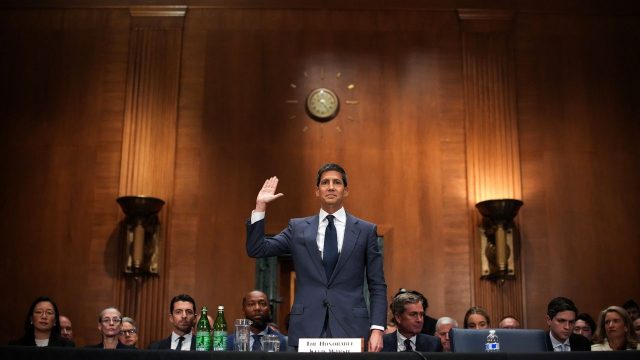
Congratulations to Kevin Warsh, President Trump’s preferred pick to be the new chairman of the Federal Reserve, said Hakyung Kim in the FT. He managed to get through an eagerly awaited grilling about his nomination by the Senate Banking Committee “without causing a Treasuries market meltdown”.
Risk of escalation
Warsh carefully “sidestepped multiple gotchas on his independence from Trump” – including the suggestion that he is “a human sock puppet”. But ultimately the world’s most important central bank still faces a political deadlock, said DealBook in The New York Times.
Thom Tillis, a Republican committee member, has vowed to block Warsh’s appointment unless the Department of Justice drops its investigation into the current chair Jay Powell‘s building renovations. Powell has refused to quit next month as scheduled unless his successor is in place; Trump has threatened to fire him. For the moment, investors “are largely ignoring the drama”. But any escalation “carries huge risks”.
Even if this soap opera is swiftly resolved, Warsh faces “a high-wire act” convincing investors that he’s his own man, “without angering Trump”, said Nick Timiraos in The Wall Street Journal. An erstwhile inflation “hawk”, he auditioned for the job by constructing a case for the rate cuts Trump wants – arguing that an AI boom “would soon deliver a productivity surge”. Yet the Iran war has changed everything.
Regime change
When Trump picked Warsh in January (in part because of his “central casting” looks), markets were factoring in at least one or two cuts this year, probably more, said The Economist. But the soaring oil price pushed headline inflation to 3.3% in March (up from 2.4% the month before) and next month’s data could be equally painful. Few now expect cuts this year. Moreover, Warsh’s AI argument has always been “shaky”. If the technology really does make US workers more productive, “the correct monetary response might well be to raise interest rates”.
Warsh’s most interesting views, which also potentially bring him into conflict with politicians and the markets, concern the Fed’s balance sheet, said John Authers on Bloomberg. “He is loudly on record that it should be smaller” – meaning that the Fed should sell down some of the huge portfolio of bonds it took on to deal with the 2008 financial crisis and then the pandemic. “At the margin, that would mean less liquidity in the market, and higher bond yields.”
Yet we’re no clearer how he might actually go about this, said Hakyung Kim. Warsh is proposing “regime change”. But “if you’re going to rip up the current playbook, you’d better have a better one, and it’s not clear that Warsh does”.
Millions of Americans tuned into Warsh’s nomination hearing. What did they learn?