Jacqueline Charles (Miami Herald) reports on a ceremony to honor Reverend Jesse Jackson, who passed away on February 17, 2026. He is remembered for his advocacy for voting rights, the rights of the poor, and migration rights, especially of Haitian migrants, “leading prayer vigils and protest marches in the ‘80s and ‘90s as he called attention to their unequal treatment in comparison to [. . .] other migrants.”
Pioneers of Miami’s Haitian rights movement paid homage Saturday to the late Rev. Jesse Jackson, recalling his support for their struggle while drawing parallels to renewed challenges their community faces amid the threat of detention and deportation. The gathering, rich with personal anecdotes and reflections on the civil rights leader’s multiple visits to South Florida and Haiti, underscored his decades-long advocacy on behalf of Haitian refugees, particularly his push to have those fleeing the troubled Caribbean country recognized as political refugees rather than economic migrants.
Jackson died Feb. 17 at the age of 84 at his home in Chicago. Alongside his advocacy for voting rights and the poor, he championed the rights of Haitian migrants, leading prayer vigils and protest marches in the ‘80s and ‘90s as he called attention to their unequal treatment in comparison to arriving Cubans and other migrants.
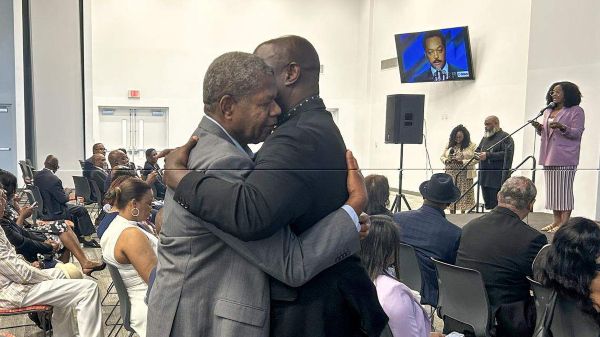
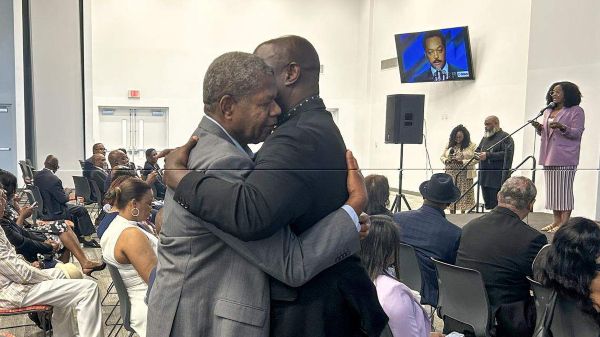
Though the icon has been remembered in tributes across the country, Saturday’s gathering at the Father Gerard Jean-Juste Community Center in North Miami-Dade carried particular resonance. The event brought together African Americans and Haitians, elected leaders and Democratic Party organizers, longtime immigration advocates and residents whose lives were shaped by those efforts.
“This is a celebration, and I’m grateful for a life so powerfully lived,” Miami-Dade County Commissioner Marleine Bastien said, citing the local, national and global impact of Jackson’s fight for justice. “The Rev. Jesse Jackson was not only the towering figure of a civil rights movement. He was the force of good who stood boldly for the marginalized, the voiceless, the underserved, and he never, never withered in his pursuit of justice.”
Bastien spoke of the honor of knowing Jackson personally and “working alongside him in moments that mattered deeply for our community.”
Those moments included the fight for Temporary Protected Status for Haiti before it was granted by the Obama administration after the country’s devastating 2010 earthquake. During a trip with Jackson to her homeland, Jackson didn’t want to just remain inside the presidential palace or visit Pétion-Ville, the affluent suburb where many of Haiti’s wealthy live, Bastien recalled. He insisted on meeting with ordinary Haitians, which he did when they visited Cité Soleil, the country’s largest slum.
“He made an indelible impact on all of our lives,” Bastien said. “And this impact will continue to live on.”
Still, the speakers reflected on the moment the community now faces: More than 50 years after Haitian refugees began arriving in South Florida in boatloads, prompting court challenges and street demonstrations for immigration protections, the community again finds itself in the throes of an immigration fight. [. . .]
For full article, see https://www.miamiherald.com/news/nation-world/world/americas/haiti/article315148896.html
[Photo provided by Jacqueline Charles JCharles@miamiherald.com. Abel Jean-Simon Zephir, left, one of the first Haitians to arrive in Miami by boat, is greeted by Rep. Wallace Aristide on Saturday, March 21, 2026, during a ceremony to honor the late Rev. Jesse Jackson, who died on Feb. 17, 2026. Jackson was a pivotal voice in the Haitian immigration struggle in Miami during the ‘80s and ‘90s.]
Jacqueline Charles (Miami Herald) reports on a ceremony to honor Reverend Jesse Jackson, who passed away on February 17, 2026. He is remembered for his advocacy for voting rights, the rights of the poor, and migration rights, especially of Haitian migrants, “leading prayer vigils and protest marches in the ‘80s and ‘90s as he called