
[Many thanks to María Cristina Rodríguez for bringing this item to our attention.] The full title of this provocative review article by Ángela Molina (El País) is “Kant en el jardín criollo: una Bienal de Venecia consistente, envolvente e intensa” [Kant in the Creole Garden: a consistent, immersive, and intense Venice Biennale]. Molina writes, “The Venice Biennale, curated by Koyo Kouoh, the first African woman to hold the position, turns down the volume of the world to consider art as a space for listening and consensus. The result is an undeniable success.”
While not diminishing any of its monsters—media spectacle, crowds, luxury empires, geopolitical controversies— the 61st Venice Biennale celebrates with didactic obstinacy one of the most profitable tenets of Kantian philosophy: the illusion that aesthetic judgment, without being strictly knowledge, functions as if it were. It doesn’t correct the market— nothing does —but it mobilizes something more effective: the idea of a global community that recognizes itself in what it feels. Within this framework, art no longer functions as mere symbolic production, but as a technology of soft consensus, the space where it is possible to agree without the need to vote.
This edition’s proposal introduces a shift that deserves to be considered, even with a certain critical gratitude: a politics of listening and low intensity that Koyo Kouoh formulated in her curatorial text as an invitation to enter into the minor keys, an idea that alludes both to the structure of music and to its emotional effects. Turning down the volume of the world means attending to its less strident frequencies, where contemporary art abandons proclamation and remains as a persistent vibration. In times of overexposure, this attitude is not trivial: it implies diverting the accumulation of discourses toward an economy of perception. [. . .]
Her absence permeates the project and creates tension, not without a certain temptation to monumentalize her figure, which the exhibition itself seems to contain. What remains is a body of work sustained by her team, who assumed continuity as a responsibility rather than as authorship. Kouoh, born in Cameroon in 1967, a Swiss citizen by adoption, and the first Black woman to direct the Venice Biennale, never attended art school but founded one, the RAW Material Company in Dakar. She embodied the intersection between institution and rupture that her practice transformed into a method. In this context, the image of Édouard Glissant’s “Creole Garden” resonates: a room of the world where species coexist without fixed hierarchies, contaminating and protecting one another in the same parcel of reality. Diverse plants sharing a boundary without losing their difference. Glissant formulated it as a poetics of relationship: everything is in everything, but nothing completely dissolves. [. . .]
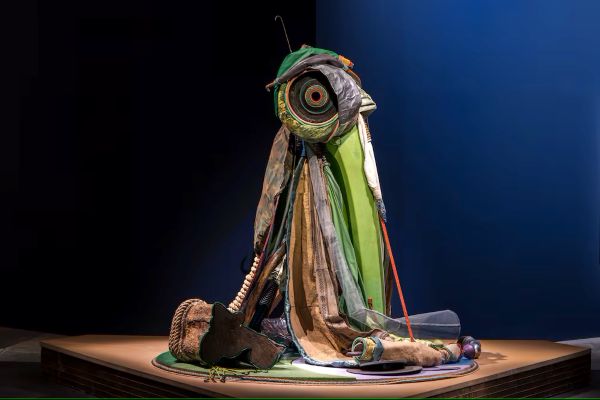
From the very first rooms, the exhibition unfolds scenes of immersive intensity: ceramics of black Artemisia (Seyni Awa Camara) and animal figures (Celia Vázquez-Yui), sculptures assembled from industrial waste (Daniel Lind-Ramos), and murals where the plant and the human merge in a single affective iconography (Magdalena Campos-Pons and Kamaal Malak). The tone is set: a drift toward magical realism that, only in a few cases, borders on the extreme (Nick Cave’s exuberant bronze sculptures, which can evoke both laughter and tears).
In a different vein, Wangechi Mutu’s video installation recreates a cosmological garden where the artist rewrites the creation myth from an ecofeminist poetics. Access to this pristine paradise, populated by chimeras and birds that fly over organic matter and a female womb that resembles a sacred mound, functions as a kind of sensory ascent, where even a clock made of hair that spins on coffee grounds introduces another temporality capable of suspending the inexorable climatic catastrophe. [. . .]
Excerpts translated by Ivette Romero. For full article (in Spanish), see https://elpais.com/babelia/2026-05-09/bienal-de-venecia-kant-en-el-jardin-criollo.html
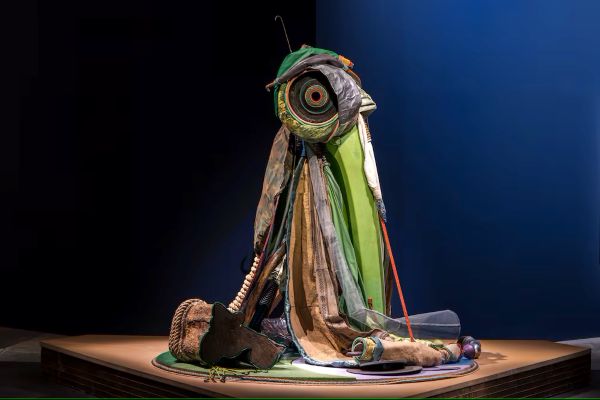
[Shown above, photo by ANDREA AVEZZÚ: “The Green Guardian” (2024-25) by Daniel Lind-Ramos, Arsenale de Venecia.]
[Many thanks to María Cristina Rodríguez for bringing this item to our attention.] The full title of this provocative review article by Ángela Molina (El País) is “Kant en el jardín criollo: una Bienal de Venecia consistente, envolvente e intensa” [Kant in the Creole Garden: a consistent, immersive, and intense Venice Biennale]. Molina writes, “The