By 5am, in temperatures hovering around 5°C , the queue outside H&M Sandton had begun to form. Wrapped in scarves, puffer jackets and blankets, shoppers waited in the Johannesburg winter darkness for access to the Stella McCartney collaboration before the doors opened.
Some had come for specific pieces. Others wanted the experience. By sunrise, phones were out, documenting the growing line that snaked along the entrance as security guards managed the crowd outside one of the most anticipated fashion launches of the season.
Twenty years after Stella McCartney’s first collaboration with H&M helped redefine the relationship between luxury fashion and the high street, the British designer’s return arrives in a dramatically different retail climate.
Consumers are more economically constrained, fashion is more digitally driven and sustainability has shifted from niche concern to central marketing language.
Yet the appetite for fashion spectacle remains intact.
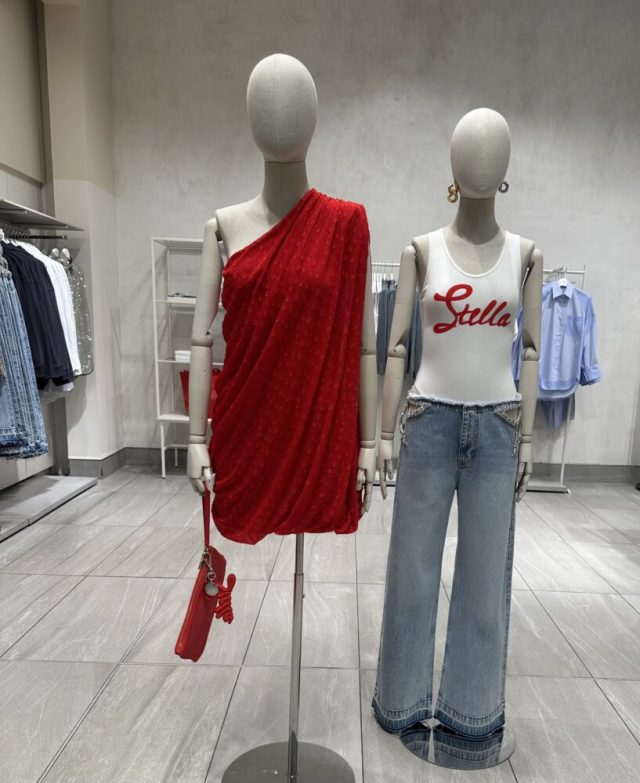
Inside the store, shoppers moved quickly between rails carrying oversized tailoring, striped shirting, structured wool blazers, lace-trimmed dresses and accessories marked by McCartney’s signature chain detailing.
Large mesh totes in translucent red drew immediate attention, alongside chain loafers and oversized shirts finished with recycled glass embellishments.
The collection leans heavily into nostalgia while attempting to reposition fast fashion through the language of sustainability. H&M’s campaign material foregrounds recycled polyester, organic cotton, recycled metals and alternative materials throughout the range.
The emphasis is not incidental. It reflects the growing pressure on global fashion brands to demonstrate environmental consciousness at a time when the fashion industry faces increasing scrutiny over waste, overproduction and labour practices.
McCartney has long occupied a distinct position in luxury fashion as one of the industry’s earliest and most vocal advocates for sustainable design. Her rejection of leather and fur, once considered commercially risky within luxury fashion, has become increasingly aligned with shifting consumer sentiment, particularly among younger shoppers.
But the collaboration also exposes one of fashion’s central contradictions. H&M remains one of the world’s largest fast fashion retailers, operating in a business model built on scale and rapid consumption. The result is a collection attempting to merge exclusivity with accessibility, and sustainability with mass retail.
The tension was visible throughout the launch.
Shoppers moved between price points ranging from R529 T-shirts to structured tailoring and outerwear approaching R4 500. Some gravitated towards wearable investment pieces such as oversized striped shirts and black wool blazers.

Others searched immediately for the more visibly collectible items: red mesh totes, graphic tees and embellished separates that probably dominated social media feeds within hours of the launch.
The atmosphere felt less like conventional retail and more like event culture. Fashion launches increasingly operate within the logic of scarcity and digital visibility. Consumers are no longer simply purchasing clothing. They are participating in a cultural moment designed to circulate online.
The queue itself became part of the performance. That dynamic reflects broader shifts in global retail. Under economic pressure, consumers are often buying fewer items while placing greater emphasis on statement purchases tied to identity, aspiration and perceived longevity.
Collaborations between luxury designers and mass retailers continue to thrive precisely because they occupy the middle ground between exclusivity and accessibility.
In South Africa, the tension is particularly pronounced. Rising living costs and constrained household spending have reshaped discretionary consumption across sectors. Yet aspirational retail remains remarkably resilient, particularly when attached to global cultural brands capable of generating both scarcity and social capital.
Fashion has also become increasingly intertwined with digital identity. Certain pieces are purchased as much for how they circulate online as for how frequently they are worn.
The Stella McCartney collaboration appears acutely aware of the reality. Oversized silhouettes, translucent accessories, logo placement and archival references all lend themselves to immediate social media recognition.

At Sandton, shoppers photographed rails before trying on garments. Friends FaceTimed each other from inside the store. Some arrived with screenshots of specific items saved to their phones overnight.
The launch unfolded as both retail experience and content production line. Beneath the spectacle, there were signs of a quieter shift in consumer taste. The strongest pieces in the collection were not necessarily the loudest.
Oversized shirting, structured tailoring and understated accessories drew sustained attention from shoppers seeking items with longer-term wearability rather than novelty alone.
That may ultimately explain the enduring power of collaborations like this one.
Two decades after Stella McCartney first partnered with H&M, consumers remain drawn not only to designer names but to the promise of transformation attached to them — the idea that fashion can briefly offer access to another world, another identity, another version of oneself.
On a freezing Johannesburg morning, hundreds queued before sunrise for precisely that possibility.
Shoppers lined up in freezing temperatures outside H&M Sandton for the Stella McCartney collaboration, underscoring the enduring appeal of luxury-fashion partnerships despite mounting scrutiny over fast fashion and sustainability