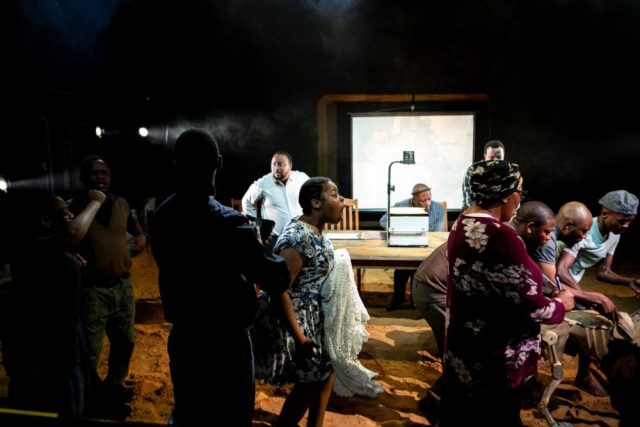
In trying to contextualise the work of Algerian psychiatric scholar and militant Frantz Fanon in my life, I have to think seriously about what sociopolitical implications there are for theatre-makers in postcolonial and post-apartheid South Africa.
In reading The Wretched of the Earth, I feel like I have to start to think through my artistic and political role in a world that might seek to reconcile itself with a new and emerging humanism. It will be my assertion that theatre in the colony, which can also be read as theatre within South Africa’s status quo, needs to premise itself on that which is political and pedagogical.
In order for theatre-makers to reclaim their position within the cultural and political struggles of their respective nations, we need to see a significant shift from that which is “art for arts’ sake” to a kind of art that actively generates work that is mindful of the socio-histories of its people. The creation of art and culture is inherently the creation and the mirror of a new political identity born out of struggle.
Frantz Fanon’s Wretched of the Earth has been described, in part, as a prophetic entry into the inner workings of a decolonised and decolonising state. Without being reductive or essentialist, one could argue that the first three chapters of the book typify and chart the complexities that come with a people who have been denied their sociopolitical subjectivities and their subsequent struggles to liberate themselves and in so doing, try to maintain the sentiments of their revolution.
However, as Fanon shows consistently throughout the book, the transition into self-governance is an inherently difficult position to navigate, especially when your personhood and political subjectivity has been eroded by the structural mechanisms of colonialism. Fanon writes in 1965 text that “the problem is not as yet to secure a national culture, not as yet to lay hold of a movement differentiated by nations, but to assume an African or Arabic culture when confronted by the all-embracing condemnation pronounced by the dominating power”.
This is a call taken seriously by the creative team of Isitha Sabantu currently showing at the Market Theatre. The assemblage of Neil Coppen, Tony Miyambo, Nhlanhla Mahlangu, Dylan McGarry, Craig Leo, Tina Le Roux and Mpume Mthombeni have been meticulously crafting the story of Fikile Ntshangase who was a South African environmental activist assassinated on 22 October 2020.
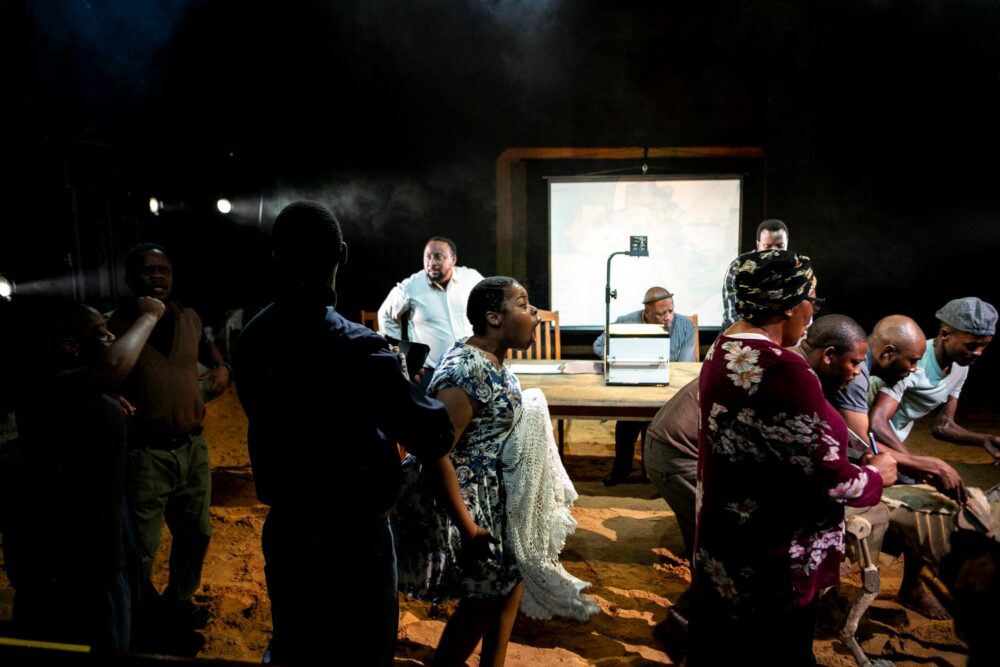
All the cultural collaborators form part of the nexus of Empatheatre and Iben Scope. As the winner of the 2024 Ibsen Scope Grants, Isitha Sabantu is a triumph of a show which has sensitively fused multi-idiomatic disciplines including praise poetry, maskandi, choral song and puppetry. As they note in their programming note, the show “invites audiences to a world where justice is more than a legal ideal but a deeply ecological, spiritual and communal practice”.
What is perhaps most compelling about the piece is the poetic isiZulu prose that accompanies the story. The writing is full-parts hilarious, dripping in misogynistic violence, careful and full of the polite double speak of isiZulu bureaucracy. It is in many ways, attentive to the mandate of the artistic and political subject which is to establish an archive which accounts for the production and reproduction of socio-histories of previously colonised subjects.
The play in many ways is also an example of the process of decolonisation, which is about an uncovering of past socio-histories; it is effectively the resistance of the negated subject who rejects the fragmented, colourless story that has been presented to them by the coloniser.
With a story set in a tranquil village called Hlanzeka, the bonds that carefully knit and know this community begin to fray when residents discover their homes lie in the path of a new coal mine. What follows is devastating heartbreak portrayed exquisitely by a cast of actors who are carefully attuned to one another on stage. Part of the reverence the audience encounters on stage is owed to where the story comes from.
The show is a loose adaptation of the life of Fikile Ntshangase who was born in 1957 and assassinated on 22 October 2020. She was a leading member of the Mfolozi Community Environmental Justice Organisation, which is taking legal action against the proposed expansion of an open-cast coal mine operated by Tendele Coal Mining (Pty) Ltd, near Somkhele, situated close to Hluhluwe–iMfolozi park, the oldest nature reserve in Africa. This context provides the basis for a compelling theatrical story suffused with tragedy and unclear and untidy villains tugging at your attention throughout the story.
The work sits squarely in the realm of Brazilian theatre practitioner Augusto Boal who was an example of an artist who is trying to reconcile the tenets of culture and theatre with a revolutionary humanism. Through a theatre-making process, which he referred to as “Theatre of the Oppressed”, Boal tries to humanise humanity.
One of the guiding principles for this kind of theatre is the assertion that a) every human being is theatre and b) every human being is capable of seeing a situation and seeing themselves in that situation which means that the theatre is a site of empathy and transformation. The ideas are ever present in Isitha Sabantu which is loosely translated to mean “the enemy of the people”. A really thoughtful name given that the enemies aren’t clear or reducible to the characters in the play but instead to broader systemic structures of patriarchy, toxic paternalism, femicide, eco-cide and ageism.
This kind of theatre is reminiscent of what Fanon calls a culture of combat. It would be my suggestion that “it is a [theatre] of combat, because it moulds the national consciousness, giving it form and contours and flinging open before it new and boundless horizons; it is a [theatre] of combat because it assumes responsibility, and because it is the will to liberty expressed in time and space”, as Fanon writes.
It is also a permutation of Boal’s Theatre of the Oppressed which is a theatre that is derived from games, contact and movement. It is a kind of theatre that has been born out of political struggle and negotiations between the theatre-maker and the audience. Both parties can lay claim to the outcome — audience and actor — and even activist and bureaucrat.
It is through this kind of art, culture and theatre that the contact of the people with the new movement gives rise to a new rhythm of life and to forgotten muscular tension and develops the imagination. Every time the storyteller relates a fresh episode to their public, they preside over a real invocation.
The existence of a new type of human is revealed to the public. The present is no longer turned in upon itself but spread out for all to see, to paraphrase the Algerian militant who has become the life blood of the land debate in South Africa and is continually quoted and misquoted in South African parliament and lecture halls. This production is perhaps one of the most articulate examples of the contradictions in the land debate and requires urgent and focused attention.
Isitha Sabantu is running at the Market Theatre until March 29
A powerful reflection on how Isitha Sabantu channels Fanon’s radical thought into a deeply political, emotionally resonant theatre of resistance and remembrance