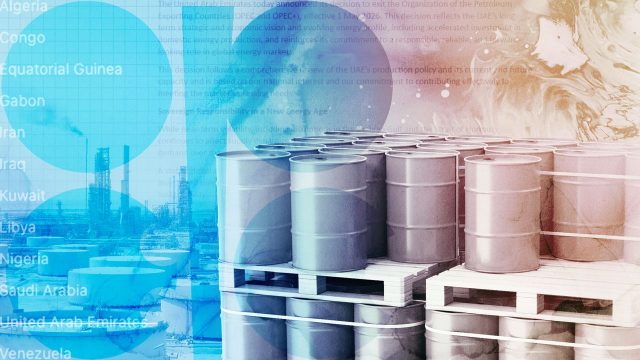
Indonesia, Qatar, Ecuador and Angola have all departed the Organisation of the Petroleum Exporting Countries in recent years. But the loss of the UAE, one of its longest-serving and most influential members, is seen as a major blow to the cartel.
The UAE said on Tuesday that quitting Opec and the broader Opec+ alliance next month reflects its “long-term economic vision” and desire to speed up investment in energy production. But Emirati officials had threatened for years to leave, blaming Opec’s production quotas for unfairly curtailing its oil exports. (The UAE has repeatedly been accused of exceeding those limits.)
Rising tensions with Saudi Arabia, Opec’s de facto leader, have also been greatly exacerbated by the Iran war; the UAE has criticised its Gulf neighbours for failing to defend it from Iranian retaliation. The question is whether the blow to Opec of losing its third-biggest oil producer will be a knockout one.
What did the commentators say?
This is “the beginning of the end of Opec”, energy analyst Saul Kavonic told the BBC. The group “loses about 15% of its capacity and one of its most compliant members”. Saudi Arabia “will struggle to keep the rest of Opec together”. This means “a fundamental geopolitical reshaping of the Middle East and oil markets”.
Opec’s ability to influence oil prices will be “clearly weakened”, said former International Energy Agency official Neil Atkinson. The UAE “will attempt to sell as much oil as they can to as many people as possible”. That “will run up against any attempts” Opec makes to “keep prices high”.
But when the UAE announced its decision, “oil markets merely shrugged”, said the Financial Times. The “muted” reaction is “a symptom of Opec’s declining relevance”. It was a “major power” in 1973 when its Arab members carried out a “devastating” embargo on countries supporting Israel. But despite its expansion to include 10 nations in Opec+, its influence has “waned” as non-members, particularly the US, boosted oil production.
Iran’s stranglehold on the Strait of Hormuz is “a further blow to Opec’s ability to control the market”. Tehran showed it could halt most of the flow of oil from the Gulf – more than half the cartel’s oil production. “It completely dilutes Opec’s market power and puts Iran in control of the vast majority of Opec’s exports,” said Joel Hancock, senior commodities analyst. Opec “effectively becomes an instrument of Iran’s foreign policy”.
The UAE’s departure would probably not be “fatal” for Opec, said Raad Alkadiri of the Center for Strategic and International Studies – unless Venezuela, Iraq or Iran also quit.
And that’s “only a matter of time”, said Damien Phillips in The Spectator. “Opec has always been a tenuous and fractious alliance that just about holds together when convenient and nearly falls apart when it isn’t.” It has always been “beset by chronic quota cheating” and “wildly inconsistent” compliance. There are “endless disputes over baseline production levels”, which often lead to “full-blown price wars”. Membership has also become “increasingly toxic”; the West sees Opec’s attempts to tighten oil supply as “helping to fund Russia’s war effort and immiserating ordinary consumers”.
The UAE understands “energy security and abundance” is now a global priority. In a world of “drill, baby, drill”, “price-fixing relics like Opec are being left behind”. Opec members “can see that the end is nigh”.
What next?
Opec’s remaining 11 members, and 10 more in Opec+, will still account for about 40% of global oil output. But Kazakhstan and Iraq are seen as most likely to “soon start creeping toward the door”, said MarketWatch. Both have excess crude-production capacity that could “incentivise them to leave”. Kazakhstan, like the UAE, has been “chafing” under Opec’s production quotas.
The UAE, meanwhile, is “splashing cash on production infrastructure”, aiming to increase production from the current 3.6 million barrels a day to 5 million by 2027, said The Economist. But any increase in exports depends on when the Strait of Hormuz reopens. The UAE’s departure from Opec, long a “bugbear” of Donald Trump, may “endear” it to the US, but it will “further sour its relations with Saudi Arabia”.
Saudi Arabia “might respond with an oil price war” that poorer Opec members might not be able to withstand, said the BBC’s economics editor Faisal Islam. “Much depends” on their response. Emirati officials also talk of building new pipelines from the Abu Dhabi oil fields towards “the underused port of Fujairah”, bypassing the strait entirely. If they do so, “Emirati oil will flow like never before”. “It will have little effect on the current blockades. It could change everything afterwards.”
Loss of third-biggest oil producer and one of longest-serving members could be existential threat to alliance, as other countries ‘chafe’ under production quotas