Documents have emerged from “clandestine” meetings in 2023 between Russian and Chinese leaders over neutralising the threat of Elon Musk’s Starlink in Ukraine, while also revealing a growing military cooperation between the two allies.
The joint investigation by The Insider, Der Spiegel and Le Monde exposes China’s “professed neutrality” in Ukraine “as a fiction”, and poses questions about the nature and targets of their alliance.
What did the commentators say?
The China-Russia “no limits” alliance is “one of the world’s most consequential relationships”, said Brookings. The “biggest misconception”, said policy expert Patricia Kim, is that Russia and China are either “inseparable partners” or “inevitable rivals that are on the brink of a split”. Neither may be true, but the relationship is “stronger than it ever has been in decades, certainly since the post-Cold War period”.
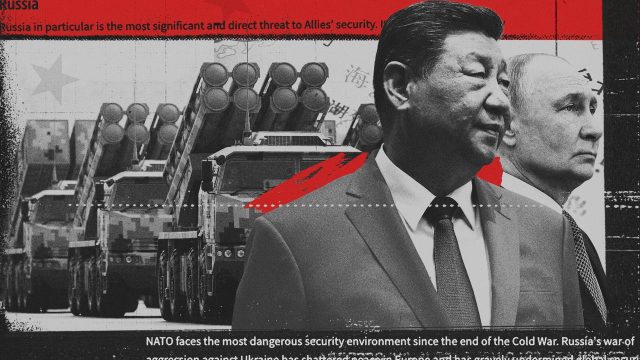
The personal connection between Xi Jinping and Vladimir Putin is at the heart of the relationship, said Ankur Shah, editor of the Global China Unit on the BBC. The “strongmen” have described each other as “best friends”, and have met more than 40 times. Economically, the alliance is highly uneven, with China being “Russia’s largest trading partner, while Russia makes up just 4% of China’s international trade”. But as leaders, Xi and Putin “do not pass judgement on the actions of the other”, and despite their “asymmetries and differences”, they “share vital interests”.
China is by far the dominant party of the pair, and intent on satisfying Xi’s desire for a “Sino-centric world”, said The Economist. In the past three months, China has received visits from Donald Trump and Vladimir Putin, both seeking economic stability while engaged in wars of their own making. Crucially, Putin left without assurances for the proposed gas pipeline “Power of Siberia 2” that would allow Russia to sell “50 billion cubic metres of gas annually” to China, which it can no longer supply to Europe. In the space of a matter of days, both at home and abroad, China appeared the singular “fulcrum of global geopolitics, dealing with America as an equal” and relegated Russia to a “junior partner”.
Current relations between Russia and China have been strengthened by the influence of Donald Trump, said Leonid Ragozin in Al Jazeera. The war in Iran has given a “powerful impetus to strengthening Russo-Chinese ties”, meaning China has become “reliant” on Russian oil, and in turn funded the Russian war effort in Ukraine.
Let’s also not forget that Trump had pledged to “un-unite” Russia and China before his second presidential term in 2024. However, his recent “ambivalent” stance in effect echoes the “counterproductive policies of his predecessors”. Trump is famous for his “short span of attention”, and “may not even remember” what he promised to achieve in Russia and China. “But of course, the latter two do remember it well.”
It is true policymakers “suffered from a failure of imagination over the past decade” towards the potential of a Russia-China alliance, said Christopher Walker in the Centre for European Policy Analysis. Yet there is also a “risk of overcorrecting”. There are limits, “important imbalances and points of friction in the Sino-Russian relationship”, highlighted by China’s inactivity following American intervention in Venezuela and Iran: they appear unwilling to “close ranks against external threats”.
On a fundamental level, the two nations lack the “dense institutional connective tissue” that could match Nato, acting in “parallel play” rather than with lasting cohesion.
What next?
Nato has already reacted, said Seong Hyeon Choi in the South China Morning Post. Following the summit in Ankara, the organisation unveiled defence initiatives in response to “security challenges posed by Russia and China”. These included a motion on raw materials and a new Drone Edge programme, investing “US$40 billion in the next five years” into expanding modern warfare.
“China continues to modernise its armed forces and expand its nuclear capabilities without transparency”, and “North Korea continues to expand its nuclear programme and supply Russia”, said Mark Rutte, Secretary General of NATO. These countries working together “should concern us all”, because they “do not have our best interests in mind”, he continued: “to meet the challenge, we need a transatlantic defence industrial revolution”.
Seen as a friendship with ‘no limits’, the nature of this alliance could be changing as Nato ramps up defence spending