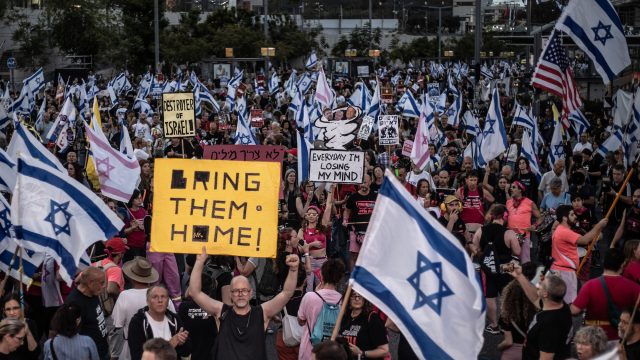
The invasion of Rafah continues to strain Israel’s relations with its international allies but – until now – Prime Minister Benjamin Netanyahu could rely on public support within Israel for the war against Hamas.
But new polling shows support for military action is potentially dwindling in favour of making a deal with Hamas to free the hostages. This appears to chime with a sense that the mood of some Israelis may be beginning to shift. The survey by the Israel Democracy Institute showed that 56% of Jewish Israelis thought “reaching a hostage deal with Hamas should be the country’s top national priority”, said The Times of Israel, while a poll by public broadcaster Channel 11 said 47% felt the same, with only 32% against.
But how much is public opinion in Israel changing?
What the commentators said?
More Israelis are “echoing global calls” for some kind of ceasefire, whether permanent or temporary, but their reasons for it can “differ”, said Mat Nashed at Al Jazeera. Few have the “blunt position” of completely deriding the war, but many, particularly those related to hostages, believe that a ceasefire deal with Hamas is the “best way to save Israeli captives”.
Taking a public position against the war “was almost a taboo until just a few weeks ago”, said Meron Rapoport in The Guardian; but it is still “hardly considered a legitimate position within Israel” particularly amongst the media and politicians who maintain that “only military pressure would bring back the hostages”. This position is beginning to look “more and more like empty words”, Rapoport added.
There are political reasons for the war to continue, beyond the rescue of hostages and destruction of Hamas that Israel says it is fighting for. Netanyahu is working to “secure both his short-term political survival and his long-term legacy”, and victory in the war or a deal in which Israel’s demands are met is essential to that, said Patrick Kingsley in The New York Times. But neither the political fight at home nor the one in Gaza is “going according to plan”, and recent polls suggest he would “easily lose an election if one were held tomorrow”.
The prime minister is also rapidly losing friends abroad, adding to the pressure. US President Joe Biden’s decision to halt some military aid to Israel and decry its strategy in Gaza has left many Israelis “shocked and dismayed” that the country’s most steadfast ally is now at “its limits”, said Gideon Rachmann at the Financial Times.
On top of that, Netanyahu has also reportedly been “consumed for several weeks by the risk from the International Criminal Court”, where warrants for war crimes could be issued, said The Economist. In response, he has “reversed Israeli policies on supplying aid to Gaza”, but it appears publicly that he has “less and less control over events” and is being instead “guided by the threats and urgings of both his allies and his enemies”.
What next?
There is little doubt that support for the war, at least publicly, remains largely intact amongst Israelis, but Netanyahu has certainly lost the “unstinting public support” of the US he had when the war began, said David Horovitz in The Times of Israel.
In the face of its allies’ ebbing enthusiasm, the prime minister has responded with “bravado and defiance”, said Rachmann, saying Israel “will stand alone” if it needs to. But the “practical question Israelis are asking right now”, added Horovitz, is “for how long Israel is actually capable of doing so”.
International criticism and a lack of progress in freeing hostages is piling pressure on the Israeli prime minister