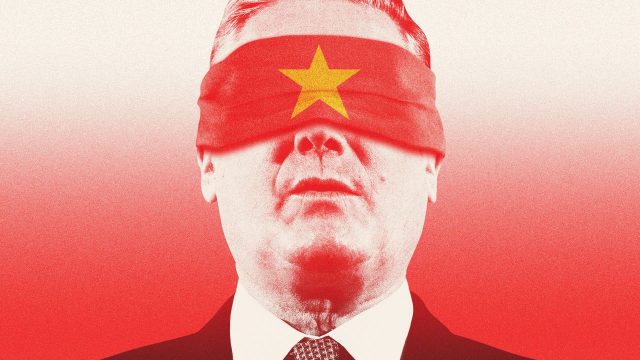
The UK must “balance the tension between security and prosperity” in its relationship with China, the parliamentary intelligence watchdog has warned, after the prime minister called for a “more sophisticated” approach to its dealings with Beijing.
At a speech in the City of London, Keir Starmer recognised that China posed “national security threats”, but stressed that it was also “a defining force in technology, trade and global governance”.
The Intelligence and Security Committee’s annual report acknowledged the need for “dexterity” in dealing with Beijing, but found the government has been “reluctant to prioritise security considerations”. This despite renewed scrutiny of Chinese interference following the contentious collapse of a spying case, the ongoing row over the London super-embassy and reports connecting a recent cyberattack on the Foreign Office to Chinese-affiliated hackers.
What did the commentators say?
This was “typical Starmer, pursuing a balancing act amid overwhelming imbalances”, said Simon Tisdall in The Guardian. It is “true Britain’s stagnant economy badly needs foreign investment” but “doing business with this predatory authoritarian regime” for nothing more than the “uncertain hope of future dependency-creating economic, financial and tech benefits” is a price simply ”too high” to pay.
Like previous governments, Labour has “found it difficult to come up with a clear answer” as to whether China “should be regarded as a UK national security threat”, said The Sunday Times.
The Intelligence and Security Committee report accused the government of “dragging its heels” over whether to add China to the “enhanced tier” of its threat regime. Under the Foreign Influence Registration Scheme, which came into force in July, only those working for Russia and Iran are required to register and declare their activity in the UK, even though many experts agree China poses a greater threat to national security.
And the threat is “very real”, said Luke de Pulford, co-founder and executive director of the Inter-Parliamentary Alliance on China, on UnHerd. It includes industrial espionage, cyberattacks and spying on politicians by Chinese operatives in the UK. It is all “part of a broader effort to shape UK institutions to be less resistant to the aims of the Communist Party, and to help Beijing assert its dominance by all and any means necessary, lawful or illicit”.
Make no mistake, China has “the means, manpower and intent to reshape our way of life” but we have chosen to fight “a house fire with a syringe filled with lighter fluid” – in this instance, “the syringe being the resources available to contain the threat, and the lighter fluid being the UK government’s seemingly irrepressible desire to make things worse”.
What next?
Early next year, Starmer will become the first British prime minister since Theresa May in 2018 to visit China. The aim, said The Independent, is to “strengthen economic and diplomatic relations with the state”. As a show of good faith, the government is expected to give the go-ahead for China’s controversial new “mega embassy” in London, despite concerns from the security services.
If he must go, Starmer should use the China trip to push for the release of Jimmy Lai and the “200-odd political prisoners in Hong Kong”, said Melanie McDonagh in London’s The Standard. Both the decision about the Chinese embassy in London and any future trade deal “should be conditional on Jimmy Lai’s release”. This is about “Britain’s honour, if we can still talk in these terms”.
Yet trying to separate politics and security from business and trade is “a naive approach”, said Tisdall in The Guardian. “In navigating the world, Starmer should follow a simple rule: hug friends close – and know your enemy.”
PM’s attempt to separate politics and security from trade and business is ‘naïve’